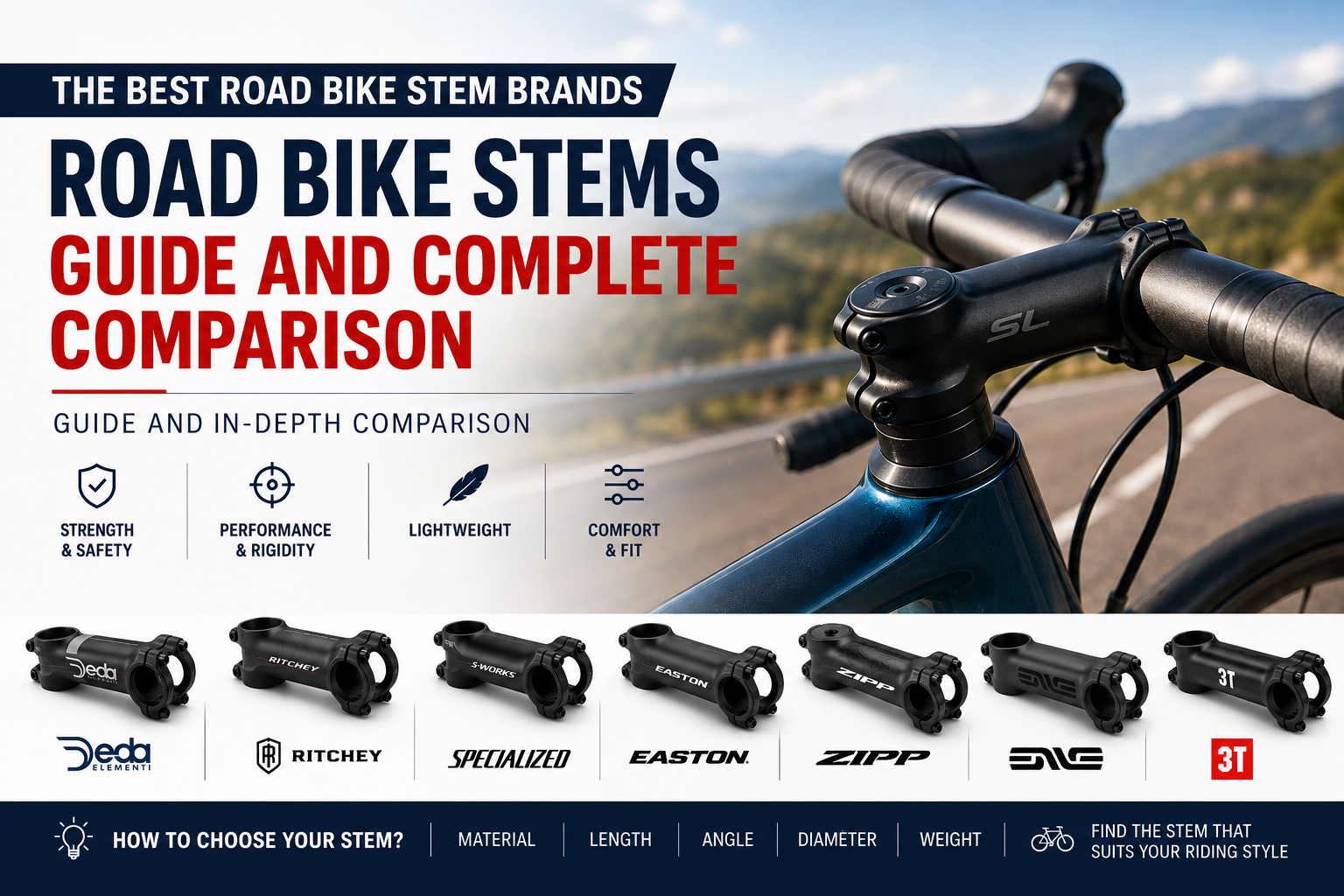
The road bike stem market is dominated by around ten brands with very different positioning: from the Italian historic brand that introduced the 31.8 mm standard to the world, to the American carbon specialist whose components appear on bikes costing over £5,000 / €5,000. In between, a full spectrum of references covering every budget, every material and every type of cyclist.
This guide compares the 7 essential brands on the market — Deda, Ritchey, FSA, Zipp, ENVE, PRO and ITM — with for each one the flagship models, key strengths and limitations, price ranges and the type of cyclist each suits best. A summary table and a budget-by-budget guide complete the picture to help you make the right call.
1. How to evaluate a road bike stem brand
To compare stem brands objectively, six criteria cut through the marketing claims and provide concrete data to work with.
- Materials and manufacturing: aluminium alloy used (6061, 7075, 2014), carbon range availability, specific manufacturing processes (3D forging, CNC machining, unidirectional carbon layup).
- Flagship model weight: actual weight at an equal length (100 mm as reference) allows objective comparison across brands and ranges.
- Range breadth: number of available lengths (70–130 mm or more), angles offered, finishes. A wide range reduces the risk of not finding the exact configuration you need.
- Value for money: the ratio between technical performance (weight, stiffness, finish) and retail price. This is the most decisive criterion for 90% of cyclists.
- Compatibility and universality: standard stems are universal (1-1/8" steerer, 31.8 mm handlebar); proprietary integrated systems (DCR, IN-Route) impose ecosystem constraints.
- Presence in competition: World Tour team partnerships are a trust signal for quality and durability under maximum stress conditions.
Rating methodology: in this guide, each brand is rated across 5 criteria scored 1 to 5 — value for money, lightness, range breadth, universality and competitive presence. These ratings are indicative and reflect the brand's overall positioning, not any specific model.
2. Deda Elementi — the Italian reference
Deda Elementi
Deda Elementi is the Italian brand that transformed the cockpit components market by introducing the oversize 31.8 mm standard — now the universal norm worldwide. Its technical signature is 3D-forged 2014 aluminium alloy, a proprietary process that optimises material distribution to achieve remarkable weights without sacrificing stiffness.
The Zero100 is the jewel of the range: approximately 126 g at 100 mm, CrMo hardware, two-piece faceplate, available from 80 to 140 mm — one of the lightest aluminium road stems on the market for under £80 / €80. The Superzero adds an aerodynamic profile for aerodynamics-conscious riders, and the Superbox DCR addresses internal cable routing bikes.
Strengths: exceptional aluminium weight, unmatched value for money, refined design, wide length range.
Limitations: proprietary DCR system, less developed carbon range than Zipp or ENVE.
Ideal for: leisure to confirmed sportive cyclists — the brand that suits the widest range of riders.
→ For a complete guide to the range, see our article on Deda road bike stems.
3. Ritchey — the American veteran
Ritchey Design
Founded in 1974 by Tom Ritchey — one of the fathers of modern mountain biking and a pioneer of CNC-machined aluminium road components — Ritchey Design has embodied reliability and consistent quality for over 50 years. It is the brand that experienced cyclists recommend first when asked "which stem lasts the longest".
The WCS C220 (7075 CNC, ~150 g at 100 mm, £85–90 / €85–90) is its flagship: machined with remarkable precision, available in a wide choice of angles (6°, 17°, 25D) and lengths, it is the benchmark for cyclists who want a premium stem without worrying about replacement for years. The Comp range (6061) offers an affordable entry into the Ritchey world from around £35 / €35.
Strengths: impeccable machining quality, exceptional longevity, universal compatibility, wide angle selection.
Limitations: no road carbon range, understated design with limited evolution, slightly heavier than Deda at an equivalent budget.
Ideal for: regular cyclists who want to invest once in a durable stem — from sportive to endurance riding.
4. FSA (Full Speed Ahead) — the all-rounder
FSA — Full Speed Ahead
FSA (Full Speed Ahead) is the brand that covers the widest spectrum of the market: from the entry-level OS-115 (6061, ~£20 / €20) to the K-Force carbon (~£120–150 / €120–150), with the OS-99 (7075) sitting in the middle as one of the best value-for-money options at this price point. FSA is regularly fitted as original equipment on mid-range bikes and has professional team partnerships.
The OS-99 (7075, ~165 g at 100 mm, £40–55 / €40–55) is the range reference for cyclists wanting a serious component without exceeding £60 / €60. The K-Force carbon is a competitive alternative to Zipp stems for budgets of £100–150 / €100–150.
Strengths: widest range on the market, competitive pricing across all brackets, universal availability, professional presence.
Limitations: less premium image than Deda or Ritchey, quality variation between entry and high-end ranges.
Ideal for: cyclists seeking maximum choice at a controlled budget — from entry level to high-end carbon.
5. Zipp (SRAM) — the carbon specialist
Zipp / SRAM
Founded in 1988 and now part of the SRAM group, Zipp has established itself as the world reference in high-end carbon — first on wheels, then across cockpit components. Its carbon stems achieve some of the lowest weights on the market (~105 g at 100 mm for the SL Speed) and benefit from massive presence in the professional peloton.
The range includes the Service Course in 7075 aluminium (accessible but less competitive than Deda at equivalent weight), the SL Speed in carbon (the best-seller, excellent carbon weight-to-price ratio), and the SL Sprint which represents the pinnacle of SRAM's Exogram technology for minimum weight.
Strengths: exceptional carbon lightness, optimal stiffness, World Tour presence, refined aerodynamics.
Limitations: high price, aluminium less competitive than Deda/Ritchey, sometimes limited length availability.
Ideal for: competitive cyclists or demanding riders who want the best in carbon without going to ENVE.
6. ENVE — the absolute premium
ENVE Composites
ENVE Composites is the American brand that defines the ceiling of the road carbon components market. Its 100% unidirectional carbon stems achieve sub-100 g weights and a stiffness that few competitors can match. The IN-Route system — enabling full cable integration on compatible modern frames — represents the state of the art in integrated cockpits, at £449 / €449 for the stem alone.
ENVE targets a very specific audience: owners of bikes above £5,000 / €5,000, competitors chasing marginal gains, or passionate cyclists for whom component excellence is an end in itself. For all others, the value for money is objectively unfavourable compared to Zipp or Deda.
Strengths: impeccable build quality, maximum lightness, most advanced IN-Route system on the market, excellent vibration damping.
Limitations: prohibitive pricing, restricted range, limited to premium budgets, sometimes limited availability.
Ideal for: owners of bikes above £5,000 / €5,000, competitive riders, enthusiasts who demand absolute excellence.
7. PRO (Shimano) — Di2 integration
PRO — Shimano Division
PRO is Shimano's components division, designed to complement Shimano groupsets naturally — and in particular Di2 electronic shifting, for which PRO stems offer particularly clean cable routing integration. The range covers all budget brackets, from the Vibe in 7075 (~£40–70 / €40–70) to the PLT carbon (~£150–180 / €150–180).
The Vibe (7075, ~165 g at 100 mm) is the most popular model in the range: quality finish, good stiffness, accessible pricing and wide availability. The Tharsis carbon is a competitive option for cyclists looking to reduce cockpit weight without exceeding £100 / €100.
Strengths: native Di2 integration, quality Japanese finish, good mid-range value for money, coherent range.
Limitations: less recognised than Deda or Ritchey, high-end carbon less competitive than Zipp.
Ideal for: Shimano Di2 riders seeking perfect electronic cable integration.
8. ITM — the historic European brand
ITM
ITM is an Italian brand with over 50 years in the cycling component market. Without the visibility of Deda or the innovation of Ritchey, it occupies a solid niche: robust, durable and accessible stems, manufactured with European know-how, that suit leisure, endurance and touring cyclists who want a reliable component without overspending.
The Millenium and Forgie models (6061 or 7075 depending on version, £25–60 / €25–60) are its references: no particular pretension in terms of weight, but solid, well-finished and available in the most common lengths.
Strengths: solidity and durability, very accessible pricing, European manufacturing, universal compatibility.
Limitations: higher weight than the competition, limited range, little innovation, no carbon option.
Ideal for: leisure or endurance cyclists seeking durability at a low price without weight concerns.
9. Comparison table: 7 brands at a glance
| Brand | Materials | Flagship weight (100 mm) | Price guide | Key strength | Ideal for |
|---|---|---|---|---|---|
| Deda ⭐ | 2014 alu / 6061 / Carbon | ~126 g (Zero100) | £30–120 | Weight-to-price ratio | Leisure → Sportive |
| Ritchey | 7075 / 6061 | ~150 g (WCS C220) | £35–90 | Longevity, reliability | Regular cyclists |
| FSA | 6061 / 7075 / Carbon | ~165 g (OS-99) | £20–150 | Range breadth | All profiles |
| Zipp | 7075 / Carbon | ~105 g (SL Speed) | £60–200+ | Carbon lightness | Competitive riders |
| ENVE | Unidirectional carbon | ~95 g (Road Stem) | £180–450+ | Absolute excellence | Premium / Bike > £5,000 |
| PRO | 7075 / Carbon | ~165 g (Vibe) | £40–180 | Di2 integration | Shimano Di2 riders |
| ITM | 6061 / 7075 | ~185 g (Millenium) | £25–60 | Durability, price | Leisure, endurance |
10. Which brand to choose for your budget?
Once your budget is set, here are the most rational recommendations for each price bracket.
| Budget | Recommended brand(s) | Suggested model(s) | Why? |
|---|---|---|---|
| < £40 / €40 | ITM, FSA, Deda | ITM Millenium, FSA OS-115, Deda Zero1 | Reliable solidity for leisure and fitness riding |
| £40–80 / €40–80 | Deda ⭐, Ritchey, FSA | Deda Zero100, Ritchey WCS, FSA OS-99 | The sweet spot: premium alu, remarkable weight |
| £80–150 / €80–150 | Deda, Zipp, FSA | Deda Superleggera, Zipp Service Course SL, FSA K-Force | Maximum alu lightness or entry into carbon |
| £150–250 / €150–250 | Zipp, PRO | Zipp SL Speed (carbon), PRO PLT (carbon) | Premium carbon, weight under 110 g |
| > £250 / €250 | ENVE | ENVE Road Stem, ENVE IN-Route | Absolute excellence, full cable integration |
Our overall recommendation: for 80% of cyclists, the £40–80 / €40–80 bracket with a Deda Zero100 represents the best optimum on the market. You get a weight (~126 g at 100 mm) that rivals some entry-level carbon stems, at two to three times less cost, with superior durability. There is no need to exceed this budget for sportive or gran fondo riding.
To refine your choice by riding style, see our guide on road bike stem by riding style. For length and angle guidance, see our articles on stem length and stem angle.
11. FAQ — Best road bike stem brands
Conclusion
The road bike stem market today offers a range of brands and ranges capable of satisfying any rider profile — from the weekend cyclist to the competitor chasing marginal gains. The good news: you do not need to spend a great deal to get an excellent component.
For the vast majority of cyclists, the Deda Zero100 remains the most rational choice: exceptional aluminium weight, universal compatibility and an accessible price. Ritchey WCS if longevity is the priority, FSA for maximum choice, Zipp or ENVE if budget is no constraint and carbon lightness is the goal.