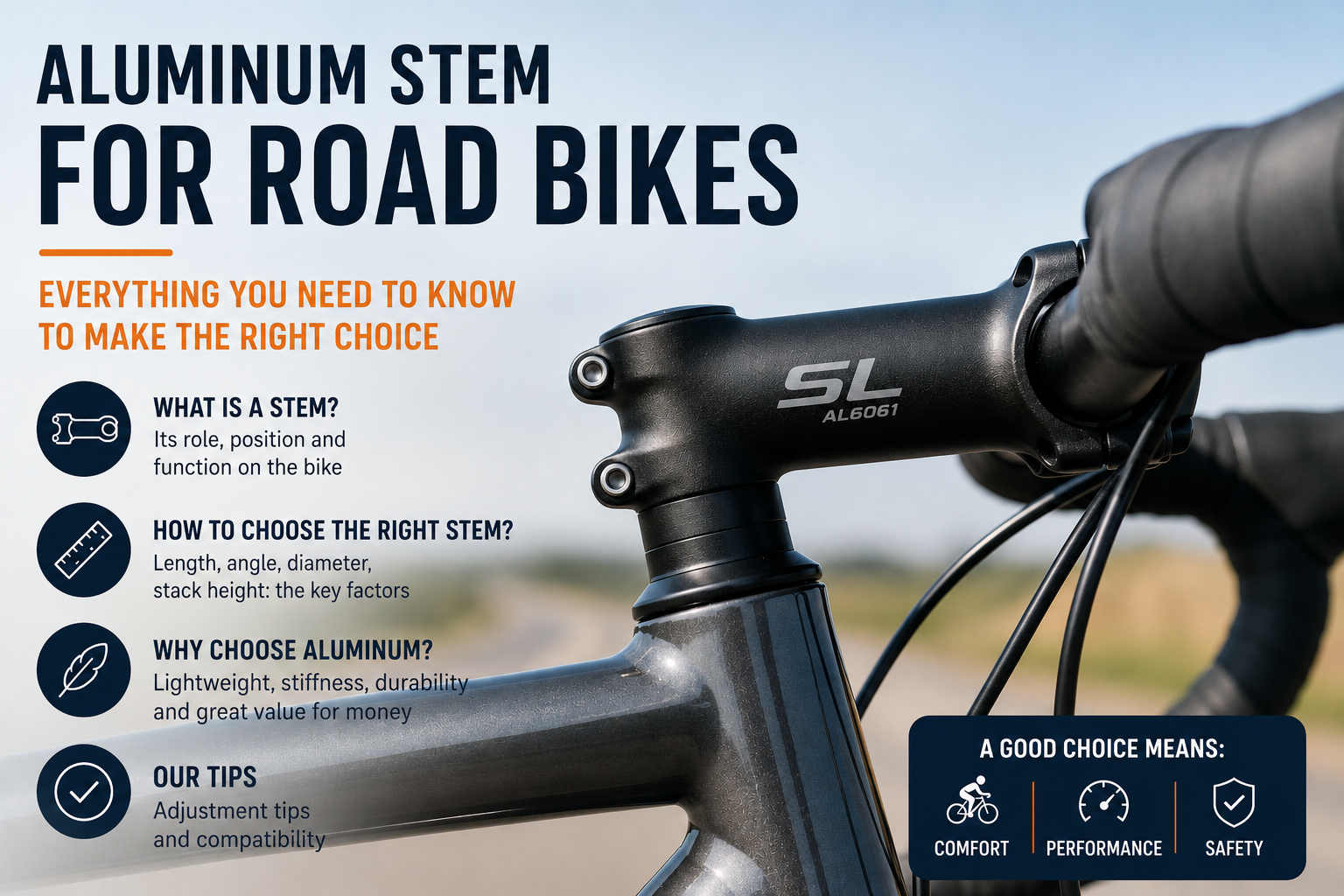
The aluminium road bike stem accounts for over 80% of stems sold on the market — and for good reason. Available in every length, angle and finish, it meets the needs of the vast majority of cyclists, from beginners to experienced sportive riders, with a value-for-money ratio that no other material can match at an equivalent price point.
But not all aluminium is created equal. Between an entry-level 6061 alloy stem and a high-end 7075 unit from Deda or Ritchey, the differences in weight, stiffness and finish are substantial. This guide gives you the knowledge to understand those differences, know when aluminium is the right call (and when it is not), and choose the right model for your riding style and budget.
1. Why aluminium dominates the road bike stem market
Look at the road bikes in your local cycling club, at a sportive start line or in any bike shop, and you will find that the overwhelming majority of stems are aluminium, across all price brackets. This is no coincidence: aluminium combines several qualities that competing materials struggle to match simultaneously.
- Unbeatable value for money: a high-end 7075 aluminium stem costs 2 to 4 times less than a carbon stem of equivalent stiffness and finish. For a component where the weight difference versus carbon is 50–70 g, the calculation is straightforward for most cyclists.
- Total availability: aluminium is available in every length (60–130 mm), every angle (−17° to +17°), every finish (matte, gloss, anodised, polished) and every diameter standard. Carbon, which is more expensive to manufacture, is often available in a more limited range of lengths and angles.
- Durability and impact resistance: unlike carbon, which can develop invisible micro-cracks after an impact, aluminium deforms visibly before failing. This predictable behaviour is a meaningful safety advantage for cyclists who crash or regularly transport their bikes.
- Ease of installation: aluminium tolerates a wider tightening torque range than carbon, which makes self-installation easier. Correct torque values should still be respected for safety, but the margin for error is more forgiving.
- Vibration damping: contrary to popular belief, a quality aluminium stem — particularly in 7075 with an optimised geometry — offers good vibration filtering on rough roads. This is less true of thick-walled 6061 stems, which tend to be stiffer and transmit more road buzz.
Key takeaway: for more than 90% of cyclists riding for leisure, endurance, sportive events or touring, a high-end aluminium stem is the most rational choice. Carbon only becomes genuinely relevant for timed racing, bikes above £3,000 / €3,000, or riders counting every gram.
2. Aluminium alloys: 6061 vs 7075 — what is the difference?
The word "aluminium" actually covers dozens of alloys with very different properties. In the road bike stem world, two alloys dominate the market by a wide margin: 6061 and 7075. Understanding the difference between them is the key to understanding the performance hierarchy of aluminium stems.
6061 alloy — the entry- and mid-range standard
6061 alloy (aluminium-magnesium-silicon) is the most versatile and widely used aluminium alloy in industrial applications. Easy to machine, weld and anodise, it is the base material for entry- and mid-range stems. Its mechanical properties are solid — tensile strength of approximately 270 MPa after T6 heat treatment — but its walls must be thicker than 7075 to achieve the same stiffness, which results in a higher final weight.
7075 alloy — premium aluminium
7075 alloy (aluminium-zinc-magnesium-copper) is the high-strength aluminium par excellence, originally developed for aerospace applications. Its tensile strength reaches 500–570 MPa in T6 treatment — roughly 40% higher than 6061 at the same wall thickness. This superior strength allows manufacturers to reduce wall thickness and significantly reduce the final weight of the stem while maintaining at least equivalent stiffness. It is the alloy used in Deda, Ritchey WCS and FSA OS-99 premium stems.
| Property | 6061-T6 alloy | 7075-T6 alloy |
|---|---|---|
| Tensile strength | ~270 MPa | ~500–570 MPa |
| Brinell hardness | ~95 HB | ~150 HB |
| Weight at equal stiffness | Reference | −20 to −30% |
| Machinability | Excellent | Good (more demanding) |
| Weldability | Very good | Limited |
| Corrosion resistance | Good | Lower (anodising recommended) |
| Raw material cost | Low | High (×2 to ×3) |
| Typical use | Entry / mid-range | Premium |
| Typical stem models | ITM, FSA OS-115, own-brand | Deda Zero100, Ritchey WCS, FSA OS-99 |
How to identify the alloy before buying: the alloy is rarely engraved on the stem itself, but it is always stated in the product technical sheet (look for "Alloy 7075" or "CNC 7075"). If no information is given, stem weight is the most reliable indicator: a 100 mm stem weighing under 175 g is almost certainly 7075; above 200 g, it is very likely 6061.
3. Aluminium road bike stem weight: the numbers
The weight of an aluminium road bike stem depends on three factors: length, alloy and construction (CNC profiling, wall thickness). Here are the reference weight ranges from the current market.
| Length | 6061 alu (g) | 7075 alu (g) | Carbon (g) |
|---|---|---|---|
| 80 mm | 180–215 | 135–160 | 95–115 |
| 90 mm | 190–225 | 145–170 | 100–120 |
| 100 mm | 200–240 | 150–180 | 105–130 |
| 110 mm | 215–255 | 160–190 | 110–135 |
| 120 mm | 225–265 | 165–200 | 115–140 |
Visual comparison — 100 mm stem:
The weight gap between a premium 7075 aluminium stem and a carbon equivalent is 50–70 g — roughly half an energy bar. Relative to a complete road bike weighing 7–9 kg, this represents under 1% of total weight. For the vast majority of cyclists, it is simply not perceptible in real-world riding.
To put it in perspective: saving 60 g on the stem by switching to carbon is equivalent to the gain from a tyre that is slightly less inflated, or from a half-empty bottle. If weight reduction is your goal, start with the wheels, saddle and handlebar — components where the weight saving per pound or euro spent is far greater.
4. Aluminium vs carbon stem: when should you choose aluminium?
The "aluminium or carbon?" question is the most common one when buying a road stem. The honest answer: for the vast majority of cyclists, aluminium is the better choice. Here is why — and in which cases carbon becomes relevant.
✓ Aluminium — advantages
- 2 to 4 times cheaper than carbon of equivalent quality
- Superior durability after impact or crash
- Predictable failure behaviour (visible deformation)
- More forgiving installation (wider torque range)
- Available in all lengths, angles and finishes
- Recyclable and straightforward to source
- Very acceptable weight in premium 7075
✗ Aluminium — limitations
- Heavier than carbon at equal stiffness (+ 50–70 g)
- Less visually integrated on a full-carbon premium build
- Marginally less vibration damping than comfort-oriented carbon
- Can show fatigue on very high-mileage bikes (30,000+ km)
Choose aluminium if…
- Your stem budget is under £80 / €80
- You ride for leisure, endurance, sportive events or touring
- You crash occasionally or travel regularly with your bike
- You ride fewer than 8,000 km per year
- You service your own bike without a torque wrench
- Your bike is an aluminium or entry- to mid-range carbon model
Consider carbon if…
- You compete in timed events or road races
- Your bike exceeds £3,000 / €3,000 and is already a carbon build
- You ride more than 10,000 km per year and every gram counts
- You suffer persistent vibration issues (very rough or cobbled roads)
For a deep dive into carbon stem specifics, see our complete guide on carbon road bike stems.
A common misconception to correct: "carbon absorbs vibration better than aluminium." This is true of a high-end comfort-oriented carbon stem — but a well-designed 7075 aluminium stem (thin CNC-profiled walls) filters road vibration very effectively. In practice, the impact on riding comfort is far smaller than the choice of tyres, tyre pressure, saddle or handlebar tape.
5. The best aluminium road bike stem brands
The aluminium road stem market is dominated by a handful of specialist brands that have consistently proven their quality of machining, finish and durability. Here are the key references, by segment.
Deda Elementi Premium
Italian benchmark for road stems. Their cold-forged 7075 alloy delivers one of the best weight-to-stiffness ratios available in aluminium.
Ritchey Premium
American pioneer in road components since 1974. The WCS range in 7075 is universally regarded for its machining precision and longevity.
FSA Mid-range
Wide range covering all budgets and standards. Good availability and consistent value for money — often found as original equipment on mid-range bikes.
ITM Mid-range
Historic Italian brand with decades in the road component market. Solid and accessible, particularly appreciated for its durability over time.
PRO (Shimano) Mid-range
Shimano's component division. Well-finished aluminium stems, often designed for compatibility with Shimano Di2 internal cable routing systems.
Own-brand / OEM Entry-level
Major retailers (Decathlon, Canyon, Trek…) offer own-brand 6061 stems. Functional for leisure use, worth upgrading if you are looking to improve ride quality.
| Brand / Model | Alloy | Typical weight (100 mm) | Indicative price | Ideal profile |
|---|---|---|---|---|
| Deda Zero100 | 7075 forged | 155–170 g | £50–80 / €50–80 | Sportive, experienced rider |
| Ritchey WCS C220 | 7075 CNC | 150–165 g | £55–85 / €55–85 | Sportive, gran fondo |
| FSA OS-99 | 7075 | 160–180 g | £35–55 / €35–55 | All-round, strong value |
| FSA OS-115 | 6061 | 200–230 g | £20–35 / €20–35 | Leisure, budget replacement |
| ITM Millenium | 6061 / 7075 | 170–210 g | £25–50 / €25–50 | Endurance, touring |
| PRO Vibe | 7075 | 160–175 g | £40–65 / €40–65 | Di2 compatible, sportive |
6. Compatibility and tightening torques
The compatibility of an aluminium stem rests on the same two fundamental measurements as any other road stem: the steerer tube diameter (1-1/8 inch / 28.6 mm on the vast majority of modern road bikes) and the handlebar clamp diameter (31.8 mm oversize on current bikes). For a full explanation of compatibility standards, see our article on road bike stem compatibility.
Tightening torques specific to aluminium
Aluminium tolerates higher tightening torques than carbon, but the manufacturer's specified values should always be respected to avoid deforming threads or crushing clamping zones.
| Clamping area | Recommended torque | Assembly product |
|---|---|---|
| Steerer clamp bolts | 5–6 Nm | Light grease on bolt threads |
| Faceplate bolts — aluminium bar | 4–6 Nm | Light grease on bolt threads |
| Faceplate bolts — carbon bar | 3–5 Nm | Carbon assembly paste (mandatory) |
| Top cap bolt | 3–5 Nm | Light grease — do not over-tighten |
After a crash: even on an aluminium stem, any direct impact on the cockpit requires a thorough visual inspection. Look for deformation, deep scoring in a clamp zone, or any sign of bending. Any visible deformation — however slight — means immediate replacement. Never ride on a stem you are unsure about.
7. Which aluminium stem for your riding style?
Once aluminium is confirmed as your material of choice, your riding style guides the alloy, length and brand decision. Here is a quick reference table — for a detailed guide, see our article on road bike stem by riding style.
| Riding style | Recommended alloy | Length | Angle | Suggested brands |
|---|---|---|---|---|
| 🏆 Racing | 7075 — or carbon | 110–130 mm | −6° to −17° | Deda Zero100, Ritchey WCS |
| 🚴 Sportive / Gran Fondo | 7075 | 100–120 mm | −6° to 0° | Deda Zero1, Ritchey WCS, FSA OS-99 |
| 🛣️ Endurance / Long distance | 6061 or 7075 | 80–100 mm | 0° to +6° | FSA OS-115, ITM, PRO Vibe |
| 🌿 Leisure / Beginner | 6061 | 70–100 mm | +6° to +17° | FSA OS-115, ITM, own-brand |
To choose the right length for your body proportions, see our guide on what stem length to choose for a road bike.
8. FAQ — Aluminium road bike stems
Conclusion
The aluminium road bike stem is the most rational choice for the vast majority of cyclists. Versatile, durable, available in every configuration and offered at very accessible prices in both 6061 and 7075, it fully meets the demands of leisure riding, endurance cycling and sportive events — the three most common disciplines on the road.
The key points to remember: opt for 7075 whenever you want a lightweight, stiff component without stepping up to carbon; reserve 6061 for budget builds or leisure use. Choose your length and angle based on your body proportions and riding style, verify your compatibility standards, and tighten to the recommended torque — your stem will last for years.
Road bike stem guides — further reading
- Road bike stems — category page
- Carbon road bike stem guide
- What stem length should I choose?
- Road bike stem adjustment guide
- Which stem angle should I choose?
- Road bike stem compatibility guide
- Road bike stem by riding style
- Adjustable road bike stem guide
- How to change a road bike stem
- Best road bike stem brands