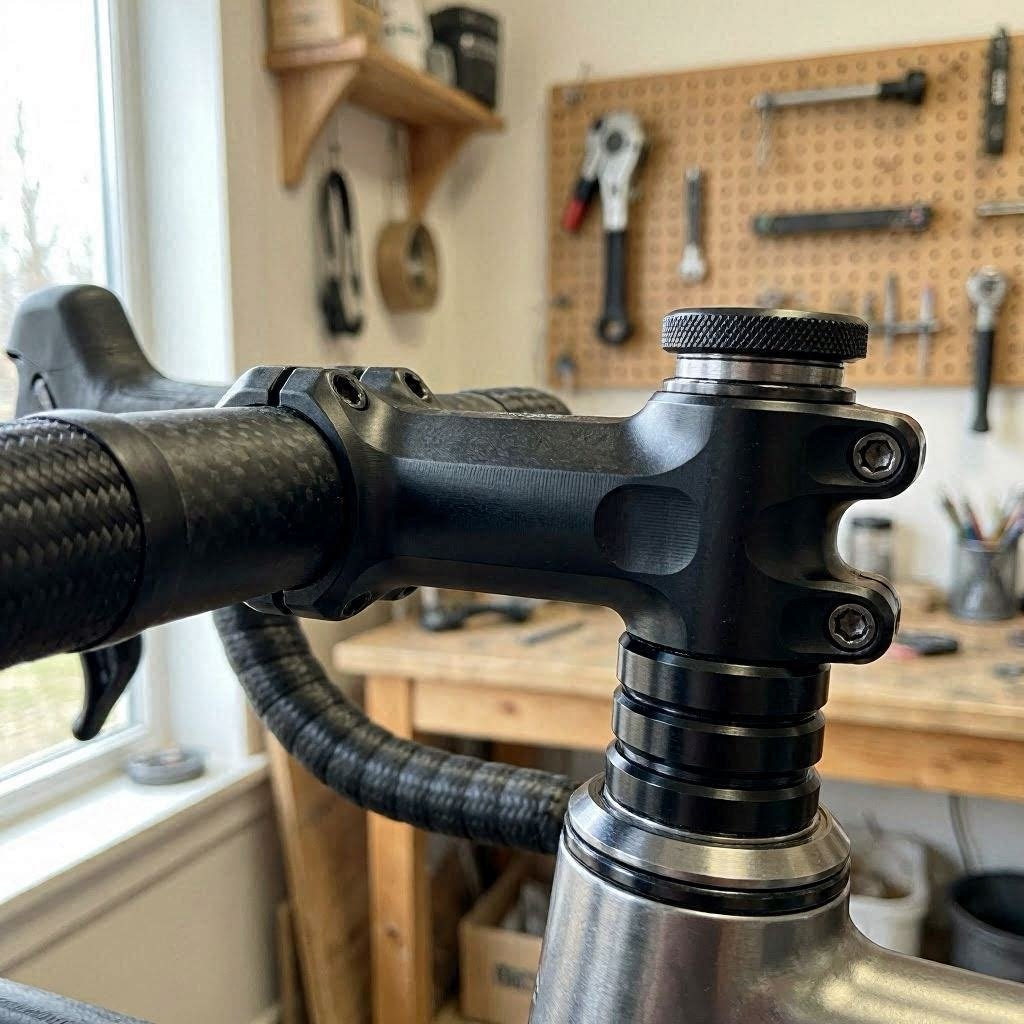
Choosing a compatible road bike stem is an essential step before any purchase. Unlike many other components, an error of just a few millimetres on the steerer tube diameter or handlebar clamp standard makes fitting impossible — and an incorrect adaptation can compromise steering safety.
And yet, stem compatibility comes down to just two fundamental measurements and a handful of simple rules. This complete guide gives you everything you need to check compatibility in under five minutes, understand the different standards on the market, and avoid the most common buying mistakes.
1. The two measurements that determine compatibility
Road bike stem compatibility depends exclusively on two physical parameters. All other characteristics — length, angle, material, brand — are free choices that have no impact on mechanical compatibility.
-
The steerer tube diameter — this is the tube that protrudes from the frame and onto which the stem clamps. It is the most critical measurement: it determines the mounting system type (threadless or quill) and the bore diameter of the stem clamp.
-
The handlebar centre clamp diameter — this is the diameter of the section of the bar that sits inside the stem faceplate. It is different from the diameter of the drops or flare sections, which are not affected by this standard.
Golden rule: before purchasing any stem, note two numbers: your steerer tube diameter and your handlebar centre clamp diameter. Both values are always engraved or marked on the components. If you cannot find them, a vernier calliper will give you the answer in ten seconds.
2. Steerer tube standards: 1 inch, 1-1/8 inch and 1-1/4 inch
Three steerer tube diameter standards exist on road bikes. Each corresponds to a different era and market positioning.
The 1 inch standard (25.4 mm) — bikes from before the 1990s–2000s
The 1 inch (25.4 mm) steerer is the historic standard of threaded-steerer road bikes. It is found on bikes manufactured before the widespread adoption of threadless headsets, as well as on some entry-level city or touring bikes still sold today. Stems designed for this standard are quill stems, which insert inside the threaded steerer tube and lock via a central wedge bolt — a completely different system from threadless.
The 1-1/8 inch standard (28.6 mm) — the universal current standard Current
The 1-1/8 inch (28.6 mm) steerer is today the universal standard on modern road bikes. Widely adopted in the 1990s alongside the threadless headset system, it offers an excellent balance between steering stiffness and component compatibility. If your bike was manufactured after 1995 and is not an entry-level or city model, there is over a 95% chance your steerer is 1-1/8 inch.
The overwhelming majority of stems on the market — fixed, adjustable, aluminium, carbon — are manufactured for this standard. It is the reference to remember.
The 1-1/4 inch standard (31.8 mm) — premium frames Rare
The 1-1/4 inch (31.8 mm) steerer is a less common standard used by certain prestige brands — notably on high-end carbon frames or specific competition geometries — to increase steering stiffness. If your bike uses this standard, compatible stems do exist but the selection is more limited.
Important: do not confuse the 1-1/4 inch steerer (31.8 mm) with the handlebar clamp diameter, which is also 31.8 mm — the two measurements coincide numerically but refer to completely different components.
| Standard | Diameter | Era / bikes concerned | Associated stem type | Availability |
|---|---|---|---|---|
| 1 inch | 25.4 mm | Bikes pre-~1995, city bikes | Quill stem (threaded) | Limited — replacement parts only |
| 1-1/8 inch Current | 28.6 mm | All modern road bikes | Threadless stem (aheadset) | Very wide — universal standard |
| 1-1/4 inch | 31.8 mm | Specific high-end frames | Threadless stem (large bore) | Restricted — premium brands |
3. Handlebar clamp standards: 25.4 mm, 26 mm and 31.8 mm
The diameter of the handlebar centre section — where the stem faceplate clamps — has also evolved over the years. Three main standards are in circulation on road bikes.
25.4 mm — the classic standard for older bikes
The 25.4 mm diameter was the dominant standard until the early 2000s. It still equips many second-hand, vintage and some entry-level bikes. Compatible stems are still available, but the choice is more limited than for 31.8 mm.
26 mm — a transitional standard
The 26 mm diameter is an intermediate standard that emerged in the 1990s–2000s, particularly on road bikes and early mountain bikes from European manufacturers. It is less common than 25.4 mm and 31.8 mm, but you will still find it on bars from that era.
31.8 mm (oversize) — the current standard Current
The oversize 31.8 mm diameter is today the dominant standard on modern road bikes. Progressively adopted through the 2000s, it provides greater cockpit stiffness and is now used on the vast majority of mid-range and high-end drop handlebars. If you buy a new road bike today, there is over a 90% chance the bar will be 31.8 mm.
| Standard | Diameter | Bikes concerned | Notes |
|---|---|---|---|
| Classic | 25.4 mm | Bikes pre-~2000, entry-level | Stems still available but limited choice |
| Transitional | 26 mm | European bikes, 1990s–2000s | Niche standard, few current references |
| Oversize Current | 31.8 mm | All modern road bikes | Universal standard since the 2000s |
How to read your handlebar diameter: on any quality bar, the centre clamp diameter is always engraved or printed directly on the bar — usually near the centre section or on the inner face of the drops. Look for a value such as "31.8" or "OS" (oversize). If there is no marking, measure the centre section with a vernier calliper.
4. Threadless vs quill stem: two incompatible systems
Beyond diameters, the stem mounting system constitutes a second absolute compatibility barrier. There are two families of stems, and they are completely incompatible with each other.
The threadless stem (aheadset) — the modern standard
The threadless stem, also called an aheadset stem, has been the universal standard on all modern road bikes since the 1990s. The stem slides over the top of the steerer and clamps around it via one or two side bolts. Height is set by a stack of spacers between the stem and the headset crown, and headset bearing preload is set via a top cap bolted onto a star nut or expander pressed inside the steerer.
- Fixing: external clamping via side bolts (4–6 Nm)
- Height adjustment: adding or removing spacers
- Steerer standard: 1-1/8 inch in the vast majority of cases
- Advantages: lightweight, stiff, very wide model selection
The quill stem (threaded) — older and city bikes
A quill stem inserts inside a threaded steerer tube. It is held at height by friction, achieved by loosening and then tightening a central bolt that expands a wedge at the bottom of the quill. This system is still found on city bikes, entry-level touring bikes and bikes manufactured before 1995.
- Fixing: internal expansion via central bolt
- Height adjustment: slides freely, then tightened at desired height
- Steerer standard: 1 inch (25.4 mm) in the majority of cases
- Advantages: very easy height adjustment, compatible with older bikes
Absolute incompatibility: a threadless stem cannot be fitted to a threaded quill steerer, and vice versa. These are two fundamentally different headset architectures. If you want to switch from one system to the other, the fork, headset and stem must all be replaced together.
| Feature | Threadless stem | Quill stem |
|---|---|---|
| Steerer type | Unthreaded (threadless) | Threaded |
| Steerer standard | 1-1/8 inch (28.6 mm) mainly | 1 inch (25.4 mm) mainly |
| Fixing principle | External clamping via bolts | Internal expansion via central bolt |
| Height adjustment | Via spacers (requires stem removal) | Free sliding, then clamped |
| Bikes concerned | All modern bikes (post-1995) | Older bikes, city bikes |
| Cross-compatibility | ❌ None — systems are completely incompatible | |
5. Compatibility table: which bike needs which stem?
This table covers the most common scenarios encountered when buying or replacing a road bike stem.
| Your bike | Steerer tube | Current handlebar | Compatible stem |
|---|---|---|---|
| Modern road bike (post-2000) | 1-1/8 inch — 28.6 mm Standard | 31.8 mm oversize | Threadless 1-1/8 inch — 31.8 mm clamp ✓ |
| Road bike from 1995–2000 | 1-1/8 inch — 28.6 mm | 25.4 mm or 26 mm | Threadless 1-1/8 inch — 25.4 mm or 26 mm clamp ✓ |
| Vintage road bike (pre-1995) | 1 inch threaded — 25.4 mm | 25.4 mm | Quill stem 1 inch — 25.4 mm clamp ✓ |
| High-end frame (specific) | 1-1/4 inch — 31.8 mm | 31.8 mm oversize | Threadless 1-1/4 inch — 31.8 mm clamp ✓ |
| New road bike (2015 onward) | 1-1/8 inch — 28.6 mm | 31.8 mm oversize | Threadless 1-1/8 inch — 31.8 mm clamp ✓ |
6. Tightening torques by standard and material
Mechanical compatibility alone is not enough: correct tightening torque is an absolute safety requirement. The appropriate torque depends on both the diameter standard and the material of the components in contact (aluminium, carbon, titanium).
Critical safety point: always use a torque wrench when fitting a stem, especially on carbon components. Over-tightening can crack a carbon bar or carbon steerer with no visible sign of damage, creating a risk of delayed failure under load.
| Clamping area | Material | Recommended torque | Assembly product |
|---|---|---|---|
| Steerer clamp bolts | Aluminium steerer | 5–6 Nm | Light grease on bolt threads |
| Steerer clamp bolts | Carbon steerer | 4–5 Nm | Carbon assembly paste (mandatory) |
| Faceplate bolts | Aluminium handlebar | 4–6 Nm | Light grease on bolt threads |
| Faceplate bolts | Carbon handlebar | 3–5 Nm | Carbon assembly paste (mandatory) |
| Top cap bolt | All materials | 3–5 Nm | Light grease — do not over-tighten |
Why is carbon assembly paste mandatory?
Carbon assembly paste (also known as carbon grip) contains micro-abrasive particles that increase the friction coefficient between carbon surfaces. This allows tightening to a lower torque while achieving the same resistance to slipping. Without the paste, you would need to tighten much harder to achieve the same grip, risking fibre damage. With the paste, the torque stays within the safe range for the material.
For more detail on the specific requirements of carbon components, see our guide on carbon road bike stems.
7. Adapters and solutions for incompatible standards
If your bike uses older or uncommon standards, solutions do exist — but they come with important limitations.
Handlebar reduction shim — 31.8 mm to 25.4 mm
An aluminium reduction shim allows a 31.8 mm stem clamp to be fitted around a 25.4 mm or 26 mm bar by filling the gap between the two diameters. This is acceptable for leisure or cycle-touring use, but not recommended for sport or competition: assembly stiffness is reduced and the shim can shift if torque is not perfectly controlled.
1 inch to 1-1/8 inch steerer adapter
Adapters exist to fit a threadless 1-1/8 inch stem onto a 1 inch threaded steerer using a transition sleeve. The procedure is delicate and often involves modifying the existing headset. The reverse is impossible: you cannot fit a 1 inch stem on a 1-1/8 inch steerer.
The best solution: replace the fork
In most cases of incompatibility between a 1 inch threaded steerer and a modern frame, the cleanest and safest solution is to replace the fork entirely with a model featuring a 1-1/8 inch threadless steerer. The cost is higher but safety and full compatibility are guaranteed. This is strongly recommended if you plan to upgrade a vintage road bike for regular sport use.
Key takeaway: adapters are acceptable workarounds for light leisure use. For sport riding, sportive events or any situation where steering safety is at stake, always respect the original standards without adapters.
8. How to measure and identify your standards in practice
Here is the full procedure for identifying your standards in under five minutes, without any specialist documentation.
-
Identify your current stem type
Look at how your current stem is fixed. If it clamps around the steerer via side bolts with a top cap — it is a threadless stem (modern system). If it inserts inside the steerer and has a central bolt accessible from the top of the steerer — it is a quill stem (older system). -
Read the marking on the fork steerer
On modern forks, the steerer diameter is often printed or engraved on the side or crown. Look for "1-1/8", "28.6" or "OS". On an unmarked steerer, measure the outer diameter with a calliper with the headset removed: approximately 28.6 mm = 1-1/8 inch. -
Read the marking on the handlebar
On a road handlebar, the centre clamp diameter is engraved or printed — most often on the inner face of the drops or at the centre of the bar. Look for "31.8", "OS" or "25.4". On an unmarked bar, measure the centre section (not the drops or flare) with a calliper. -
Check your bike's technical specifications
If you still have the original technical sheet for your bike or frame, the steerer standard and original handlebar diameter are always listed in the component specifications. If you no longer have it, search for the exact model on the manufacturer's website. -
Check the markings on your existing stem
Your current stem is also marked: the steerer diameter (e.g. "28.6" or "1-1/8") is usually engraved on the clamp body, and the handlebar clamp diameter (e.g. "31.8") is engraved on the faceplate. These markings confirm your bike's standards.
Essential tool: a digital or vernier calliper for under £10 is the best investment to ensure you never get the wrong standard. If a measurement seems ambiguous, take it twice and compare against the four standard values: 25.4 mm, 26 mm, 28.6 mm or 31.8 mm — any reading in between is simply one of these four with normal manufacturing tolerance.
Once your standards are confirmed, see our guide on what stem length to choose for your road bike to complete your selection.
9. FAQ — Road bike stem compatibility
Conclusion
Road bike stem compatibility comes down to two fundamental measurements: the steerer tube diameter (1-1/8 inch on the vast majority of modern bikes) and the handlebar clamp diameter (31.8 mm oversize on current bikes). To these two parameters, add the mounting system — threadless or quill — whose confusion is the most common source of error when buying a replacement stem.
Before purchasing, read the markings on your existing components, or measure with a calliper in ten seconds. Once your standards are confirmed, your stem choice is entirely free: length, angle, material and brand have no impact on mechanical compatibility.
Browse our full selection of road bike stems — sorted by standard, length and material — in our dedicated category.