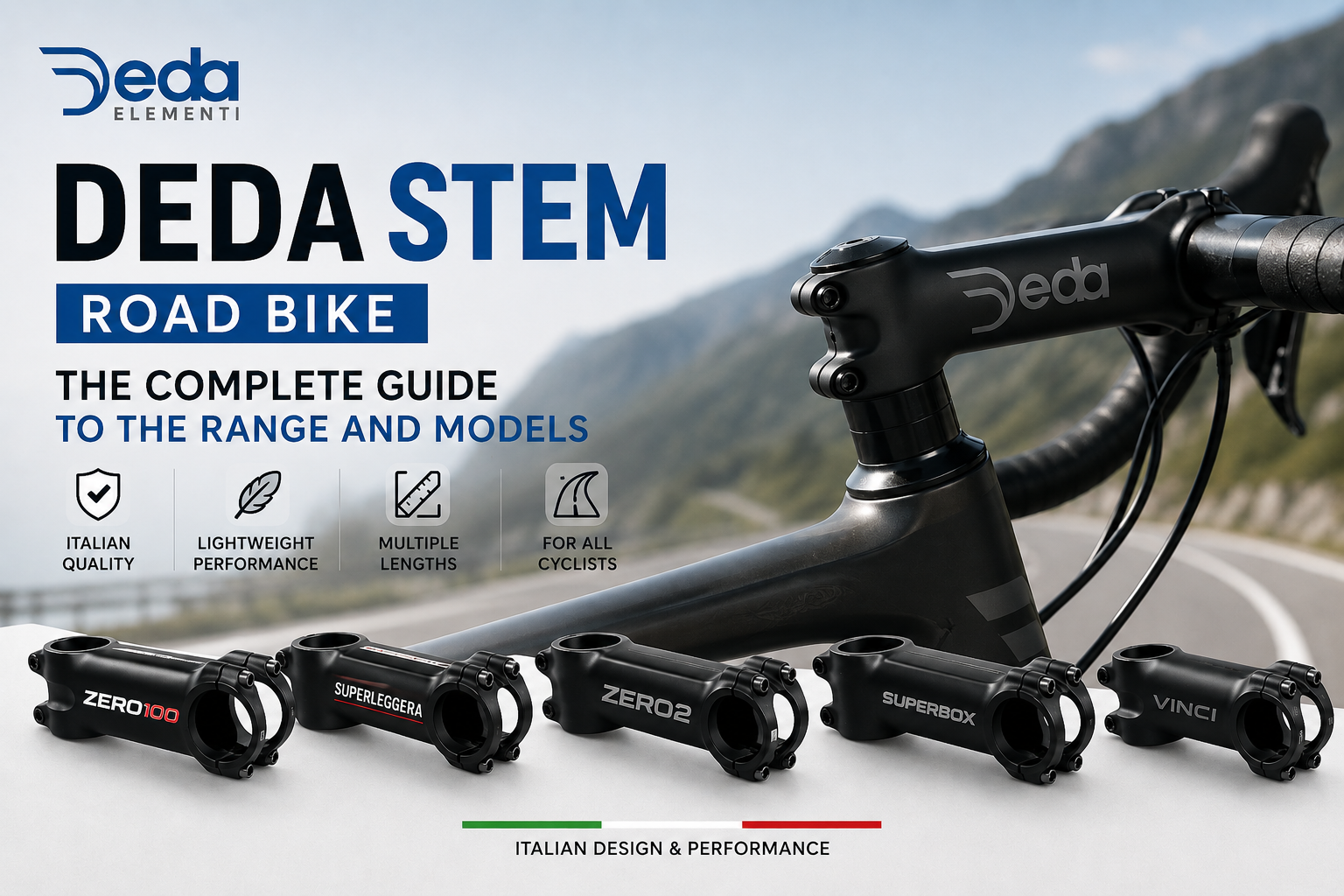
Deda Elementi is one of the benchmark names in the road bike stem market. The Italian brand, founded in the 1980s in Bergamo, has built its worldwide reputation on the quality of its 3D-forged aluminium, precision machining and a range that covers every budget — from the weekend rider to the professional racer.
But faced with six models in the current range (Zero1, Zero100, Superzero, Superleggera, Superbox DCR, Vinci), the choice can seem complex. This guide presents each model in detail, compares their specifications and helps you identify the ideal Deda stem for your riding style and budget.
1. Deda Elementi: the brand in brief
Deda Elementi is an Italian brand specialising in road bike cockpit components — stems, handlebars, seatposts and accessories. Based in Lombardy, it has built its reputation over decades of collaboration with professional World Tour teams and a relentless focus on technical innovation.
Deda Elementi founded in Bergamo, Italy. Immediate specialisation in road bike cockpit components.
Deda introduces the oversize 31.8 mm standard to the road market, progressively replacing the old 26 mm standard. A revolution that became the worldwide norm.
Development of the 3D forging process in 2014 aluminium alloy, the technical signature of the Zero100 and Superzero models. Launch of the first Superleggera carbon range.
Introduction of the DCR system (Deda Cable Routing) for full cable integration, responding to the growing trend for internal cable routing on high-end frames.
A complete range covering every segment: from the accessible Zero1 to the Superleggera RS carbon, with active partnerships across World Tour teams.
What sets Deda apart from its direct competitors (Ritchey, FSA, 3T) is the use of 3D-forged 2014 aluminium alloy on its flagship models — a process that achieves remarkably low weights (126 g at 100 mm on the Zero100) without sacrificing stiffness or durability.
Key takeaway: Deda offers a coherent vertical range with no redundant models. Each reference has a clear positioning: Zero1 for tight budgets, Zero100 for demanding everyday use, Superzero for aero-minded amateurs, Superleggera for the maximum aluminium can offer, and the Superbox DCR for bikes with integrated cable routing.
2. Deda road bike stem models
Deda Zero1 — Entry level
The Deda Zero1 is the entry point into the Deda range. Manufactured in 6061 alloy, it delivers the solidity and finish expected of the brand at a very accessible price. Its clean design has been updated and modernised to align visually with the rest of the Zero family.
Its 8° angle is reversible: fitted in the raised position (+8°) for more comfort, or flipped to the dropped position (−8°) for a more performance-oriented setup. Available from 70 to 130 mm, it covers almost all rider proportions.
Ideal for: leisure or fitness riders, first build on an entry-level bike, budget replacement after a crash. For regular sportive riding, the Zero100 offers a significant quality step up for a modest additional cost.
Deda Zero100 — Best-seller of the range
The Deda Zero100 is without question the best-known and best-selling stem in the Deda range — and one of the absolute benchmarks on the market. Its remarkable weight of approximately 126 g at 100 mm is achieved through 3D forging in 2014 aluminium alloy, a process that optimises material distribution and eliminates all unnecessary mass.
The CrMo (chromoly steel) hardware ensures excellent long-term bolt holding under repeated tightening, with no risk of thread deformation. The two-piece faceplate, introduced on this version, makes handlebar installation and adjustment easier without having to dismantle the front of the bike entirely.
Available from 80 to 140 mm in 10 mm increments, it covers all rider profiles — from small builds to tall riders. Its reversible 8° angle (+8° / −8°) covers both comfort and performance positions without any additional purchase.
Ideal for: sportive cyclists, gran fondo riders, regular cyclists seeking the best weight-to-stiffness-to-price ratio in aluminium. The Zero100 is the stem we recommend first for 80% of enquiries.
Deda Superzero — Aerodynamic profile
The Deda Superzero shares the same 3D-forged 2014 alloy as the Zero100, but distinguishes itself through its aerodynamic geometry: its top face is flat rather than rounded, which improves air penetration by reducing drag at the cockpit. It comes with a dedicated aerodynamic cap that extends this effect across the top of the stem.
This aero profile results in a slightly higher weight than the Zero100 (~140 g vs ~126 g at 100 mm), the additional material being required to form the stiff flat upper surface. In return, the Superzero's lateral stiffness is excellent thanks to this wider cross-section.
Available in POB (Polish On Black) and white finishes. Lengths from 90 to 140 mm in 10 mm increments.
Ideal for: demanding sportive cyclists who want an aerodynamic advantage without moving to carbon, riders who care about cockpit aesthetics, non-timed events where aero remains a factor.
Deda Superleggera — Maximum lightness in aluminium
The Deda Superleggera ("super light" in Italian) represents the pinnacle of Deda's aluminium engineering. Designed for cyclists who want to extract every possible gram without stepping up to carbon — whether for budget reasons or because they prefer aluminium's durability — it weighs under 130 g.
Its availability in lengths is more limited than other models in the range (100–130 mm), making it best suited to riders who have already confirmed their definitive position. Finish quality is impeccable, befitting a premium component.
Worth noting: Deda also offers a Superleggera RS carbon version, which represents the absolute summit of the range for competitors seeking maximum weight savings without compromise.
Ideal for: competitive amateurs and demanding sportive cyclists who have locked in their position and want the best aluminium can offer before considering carbon.
Deda Superbox DCR — Integrated cable routing
The Deda Superbox DCR is the direct evolution of the Superzero, designed specifically for bikes with internal or semi-internal cable routing. Its patented DCR (Deda Cable Routing) system allows up to 4 cables (brakes and derailleurs) to be routed inside the stem, connecting with DCR-compatible Deda handlebars for a completely cable-free cockpit exterior.
Its clever cover allows two modes of use: full DCR mode (100% integrated routing, requires a DCR Deda handlebar) and S-DCR mode (semi-integrated, compatible with any handlebar). Its included adapter makes it compatible with both 46 mm (1-1/8") and 56 mm (1.5") steerer tubes.
Important note: unlike other Deda models, the Superbox DCR has a fixed 82° angle that is non-reversible. It is also heavier (~175 g at 110 mm) due to the internal cable routing channels built into the body.
Ideal for: owners of bikes with semi-internal or fully internal cable routing who want to upgrade their cockpit for a clean, integrated look. Compatible with Trek, Specialized, Canyon and most modern internal-routing frames.
Deda Vinci — Premium cable integration
The Deda Vinci is the premium evolution of the Superbox DCR. Designed for high-end bikes with fully internal cable routing, it offers an even more refined integration with a cable channel optimised for electronic groupsets (Di2, eTap, EPS) and hydraulic systems, in a clean, uncluttered profile.
Ideal for: owners of high-end bikes (above £3,000 / €3,000) with full internal routing who want complete aesthetic and technical coherence across their cockpit.
3. Full range comparison table
This table summarises the key specifications of all six models for a quick at-a-glance comparison.
| Model | Alloy | Weight (100 mm) | Angle | Lengths | Price guide | Ideal for |
|---|---|---|---|---|---|---|
| Zero1 Entry | 6061 | ~155 g | ±8° reversible | 70–130 mm | £30–40 | Leisure, fitness |
| Zero100 Best-seller | 3D-forged 2014 | ~126 g ⭐ | ±8° reversible | 80–140 mm | £65–80 | Sportive, gran fondo |
| Superzero Aero | 3D-forged 2014 | ~140 g | ±8° reversible | 90–140 mm | £70–90 | Sportive, aero profile |
| Superleggera Premium | Premium forged | < 130 g | ±8° reversible | 100–130 mm | £80–120 | Competitive rider, fixed position |
| Superbox DCR | 6061 | ~175 g* | 82° fixed | 70–140 mm | £80–110 | Internal routing bikes |
| Vinci | Aluminium | ~165 g | 82° fixed | 90–130 mm | £100–130 | Premium full internal |
* Superbox DCR weight measured at 110 mm.
4. Deda alloys: 2014 aluminium, 6061 and carbon
Deda uses three types of material across its road stem range. Understanding the differences helps you read the positioning of each model more clearly.
3D-forged 2014 aluminium — Deda's signature material
2014 alloy (aluminium-copper-magnesium) is the signature material of Deda's premium models: Zero100, Superzero and Superleggera. It is a high-strength alloy (tensile strength ~420–480 MPa in T6 treatment) with mechanical properties comparable to the 7075 used by other brands, but processed using Deda's proprietary 3D forging method that optimises material distribution in every plane.
This 3D forging achieves remarkable weights — 126 g at 100 mm on the Zero100 — while maintaining very high stiffness and long-term durability. It is the primary reason Deda's 2014-forged stems are among the lightest on the market in aluminium, without resorting to carbon.
6061 aluminium — the accessible models
6061 alloy is used on entry-level models (Zero1) and on certain specialist models (Superbox DCR). Easier to machine and less costly than 2014, it provides solid performance for leisure use or for applications where weight is not the primary criterion — such as the Superbox DCR, whose weight is in any case increased by the internal cable routing channels built into the body.
Carbon — the Superleggera RS range
Deda also offers carbon stems in its Superleggera RS range, aimed at competitors who want the absolute maximum in lightness and stiffness. These models are outside the scope of this article focused on aluminium stems — for more information, see our guide on carbon road bike stems.
Tip: for the vast majority of cyclists, the 3D-forged 2014 alloy of the Zero100 offers the best balance of lightness, stiffness and durability. There is no need to step up to the Superleggera or carbon to achieve excellent performance on a sportive event or gran fondo.
5. Deda stem compatibility
All current Deda stems (outside vintage models) share the same universal compatibility standards:
- Steerer tube: 1-1/8 inch (28.6 mm) on all models — the universal standard for modern road bikes. The Superbox DCR includes an adapter for 1.5 inch (56 mm) steerers.
- Handlebar clamp diameter: 31.8 mm oversize on all current models — compatible with the vast majority of modern road handlebars, regardless of brand (Ritchey, FSA, 3T, Fizik, Zipp, etc.).
- Cross-brand compatibility: Deda stems are completely universal for standard use. Only the DCR system is proprietary: it requires a Deda handlebar with the DCR port to function in full integrated mode.
DCR system notice: if you are buying a Superbox DCR or Vinci specifically for their cable integration system, check that your handlebar is DCR-compatible before purchasing. On a non-DCR bar, only S-DCR (semi-integrated) mode will be available — functional, but less visually integrated than the full DCR mode.
For a complete guide to stem compatibility standards, steerer tube and handlebar diameters, see our article on road bike stem compatibility.
6. Which Deda stem for your budget and riding style?
To help you decide quickly, here is our cross-referenced budget/riding style recommendation grid.
| Budget | Riding style | Recommended Deda model | Why? |
|---|---|---|---|
| < £40 / €40 | Leisure, fitness | Zero1 | Solid, well-finished, unbeatable price for the brand |
| £40–80 / €40–80 | Sportive, gran fondo | Zero100 ⭐ | Best aluminium road stem at this price, 126 g at 100 mm |
| £70–90 / €70–90 | Sportive + aero focus | Superzero | Flat aero top profile, same 2014 alloy as the Zero100 |
| > £80 / €80 | Competition, fixed position | Superleggera | Under 130 g, maximum lightness in aluminium before carbon |
| £80–110 / €80–110 | Internal routing bike | Superbox DCR | Full cable integration, compatible with 1-1/8" and 1.5" steerers |
| > £100 / €100 | Premium full internal | Vinci | Premium integration for high-end bikes above £3,000 / €3,000 |
To refine your length choice based on your body proportions, see our guide on what stem length to choose. To match your stem to your dominant riding discipline, see our article on road bike stem by riding style.
Our overall recommendation: for the majority of cyclists, the Deda Zero100 is the best choice — it combines the best aluminium weight on the market at its price point, a premium finish, universal compatibility and availability in every length. It is the stem we recommend first, regardless of riding style, as soon as the budget exceeds £60 / €60.
7. FAQ — Deda road bike stems
Conclusion
The Deda road bike stem range is one of the most coherent on the market: each model has a clear positioning with no unnecessary overlap between references. The Zero100 remains our primary recommendation for the vast majority of cyclists — a weight-to-stiffness-to-price ratio in aluminium that is very hard to match. The Superzero suits cyclists who prioritise aerodynamics without going to carbon, and the Superbox DCR addresses the growing demand for integrated cockpits on modern road bikes.
Browse the full selection of Deda stems in stock in our dedicated category, filterable by length, model and availability.
Road bike stem guides — further reading
- Road bike stems — category page
- Aluminium road bike stem guide
- Carbon road bike stem guide
- What stem length should I choose?
- Road bike stem adjustment guide
- Road bike stem compatibility guide
- Road bike stem by riding style
- Adjustable road bike stem guide
- How to change a road bike stem
- Best road bike stem brands