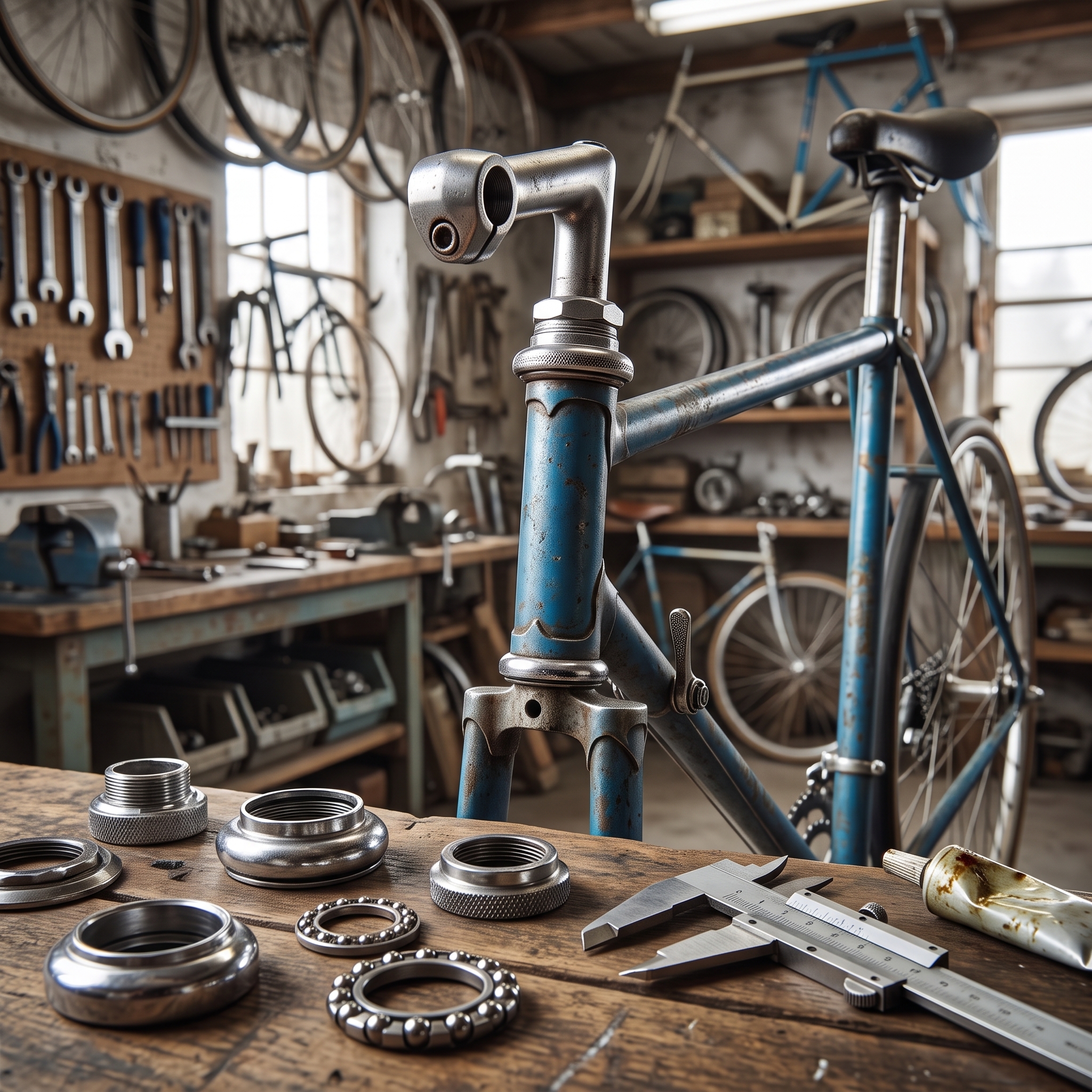
Owning an old or vintage road bike doesn't mean giving up on a well-functioning headset. Here's how to identify the system fitted to your bike and replace it with confidence.
Browse our range of road bike headsets and our vintage racing bike range in stock.
1. How do I know if my bike has a threaded or threadless headset?
- On a threaded headset, typical of older bikes, you'll see a locknut visible just above the stem;
- On a threadless headset (Aheadset), more modern, the stem clamps directly onto a smooth steerer, with no visible nut.
If your bike dates from before the mid-1990s, it's very likely fitted with a threaded system.
2. The 1-inch threaded headset: the standard on older bikes
On a threaded headset, the stem screws directly into the fork steerer, with no expander. A 1-inch diameter is almost universal on road bikes built before the threadless system became widespread. This standard is still produced today, which makes replacing a faulty threaded headset much easier — see the different systems explained on our road bike headset page.
Good to know: contrary to popular belief, the 1-inch threaded standard remains widely available today, unlike some other, more specific parts found on older bikes.
3. How to identify your old headset's dimensions
- The outer diameter of the frame's head tube;
- The fork steerer diameter, almost always 1 inch on older bikes.
If a reference is still legible on the existing cups, it makes identification easier. Unlike modern integrated headsets, threaded standards have changed very little over the decades.
4. Replacing the headset on an old bike: precautions to take
Replacement follows the same broad steps as on a modern bike (removing the fork, extracting the cups, cleaning, fitting, adjusting), detailed in our headset bearing article. A few extra precautions apply:
- Old cups are sometimes seized or slightly rusted: gentle removal, possibly after applying a penetrating oil, avoids damaging the head tube;
- A steel frame is generally more forgiving than a modern carbon frame, but still deserves careful handling, especially on a collectible bike;
- Since the 1-inch threaded standard is still widely produced, parts availability generally isn't an issue.
5. Should you switch from a threaded to a threadless (Aheadset) system?
Conversion kits exist, but the job is significant: it generally requires replacing both the fork (a threaded steerer isn't compatible with a threadless system) and the stem. For simple maintenance or restoring a bike to working order, it's usually better to keep the original threaded system and replace it like-for-like if worn.