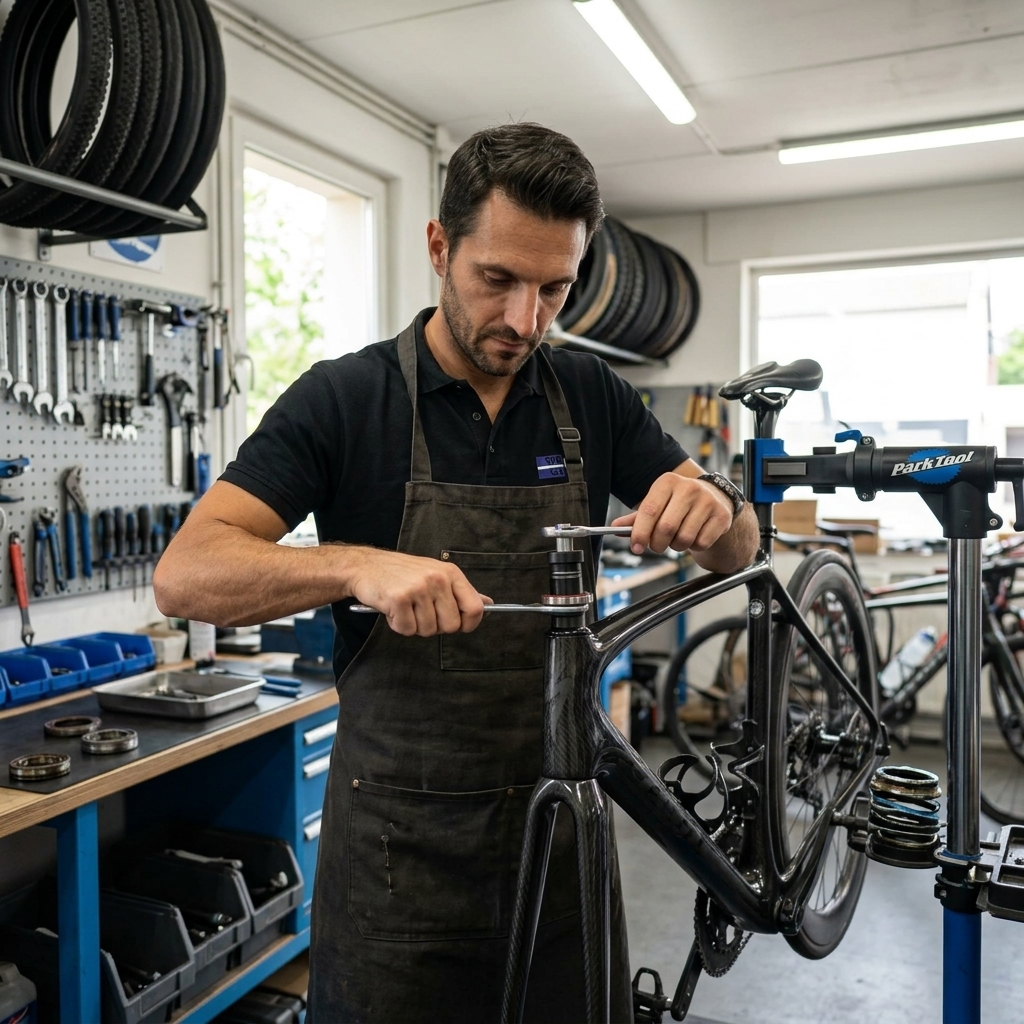
The headset bearing is a discreet but essential wear part: it lets the fork pivot freely and it directly affects your steering precision. Here's how to identify, choose and replace it.
Browse our range of road bike headsets and bearings in stock.
1. What is a headset bearing and what does it do?
Inside a headset, the bearing is the moving part that allows the fork steerer to rotate inside the frame's head tube. It works together with the cups, which hold it in place, and the seals/washers, which provide the bearing surface against the fork. Unlike the cups, which are static, the bearing constantly absorbs the friction from steering as well as the shocks transmitted by the road — which is why it's the first part to wear out.
2. The different types of headset bearings
Classic caged ball bearing
Historically, threaded headsets used loose balls held in a metal cage, in direct contact with the cups. This system, still found on some vintage bikes, needs more frequent maintenance.
Sealed cartridge bearing
This is today's standard on almost all modern road bikes. The balls are enclosed in a sealed cartridge protected by a seal: less maintenance, better resistance to moisture, and generally a longer service life.
Ceramic bearing
A premium option: the ceramic bearing replaces steel balls with ceramic ones, which are harder and less prone to corrosion. The main benefit is smoother rotation.
Good to know: in the vast majority of cases, you can replace just the worn bearing without changing the entire headset, provided the cups are still in good condition.
3. How to identify your headset bearing's dimensions
Before buying, you need three measurements: the inner diameter (which receives the fork steerer), the outer diameter and the bearing's thickness, plus its contact angle (usually 36° or 45° depending on the cups). The most reliable method is to remove the old bearing and note its reference, or measure it directly with callipers.
4. How to choose your road bike headset bearing
Several criteria come into play:
- The frame standard: 1" threaded, 1"1/8 threadless, semi-integrated or integrated;
- Compatibility with your bike brand, especially on high-end aero frames;
- Material quality: standard steel, stainless steel or ceramic;
- Budget, keeping in mind a good sealed bearing remains an inexpensive part given its impact on handling.
| Type | Maintenance | Durability | Indicative price |
|---|---|---|---|
| Loose balls | Frequent | Average | from £5 |
| Sealed cartridge | Low | Good | from £8 |
| Ceramic | Low | Very good | from £22 |
If your frame is from a well-known brand (Canyon, Trek, Specialized...), check the exact compatibility before ordering: our headset compatibility guide by bike brand lists the most common standards.
5. What are the signs of a worn headset bearing?
A tired bearing shows several symptoms:
- a stiff spot felt when turning the bars, especially noticeable in the straight-ahead position;
- play at the front of the bike, felt by pulling the brake lever and rocking the bike back and forth;
- a creaking noise when braking or over rough road surfaces;
- less precise steering, with a vague feeling through corners.
Note: these signs can also come from a simple adjustment issue rather than actual wear. Check the star-nut/expander preload before replacing the bearing.
6. How to replace a road bike headset bearing
- Remove the fork: take off the front wheel, loosen and remove the stem, then pull the fork out of the frame.
- Extract the old bearings and, if needed, the cups, using a suitable removal tool.
- Clean thoroughly the head tube and the fork steerer.
- Fit the new bearings and, if needed, press in new cups, making sure they're properly aligned.
- Grease lightly the bearing surfaces before reassembly.
- Reassemble the fork and stem, setting the preload via the star-nut/expander before torquing the stem to spec.
Tools needed: Allen keys, torque wrench, cup removal tool, headset press, bearing grease.