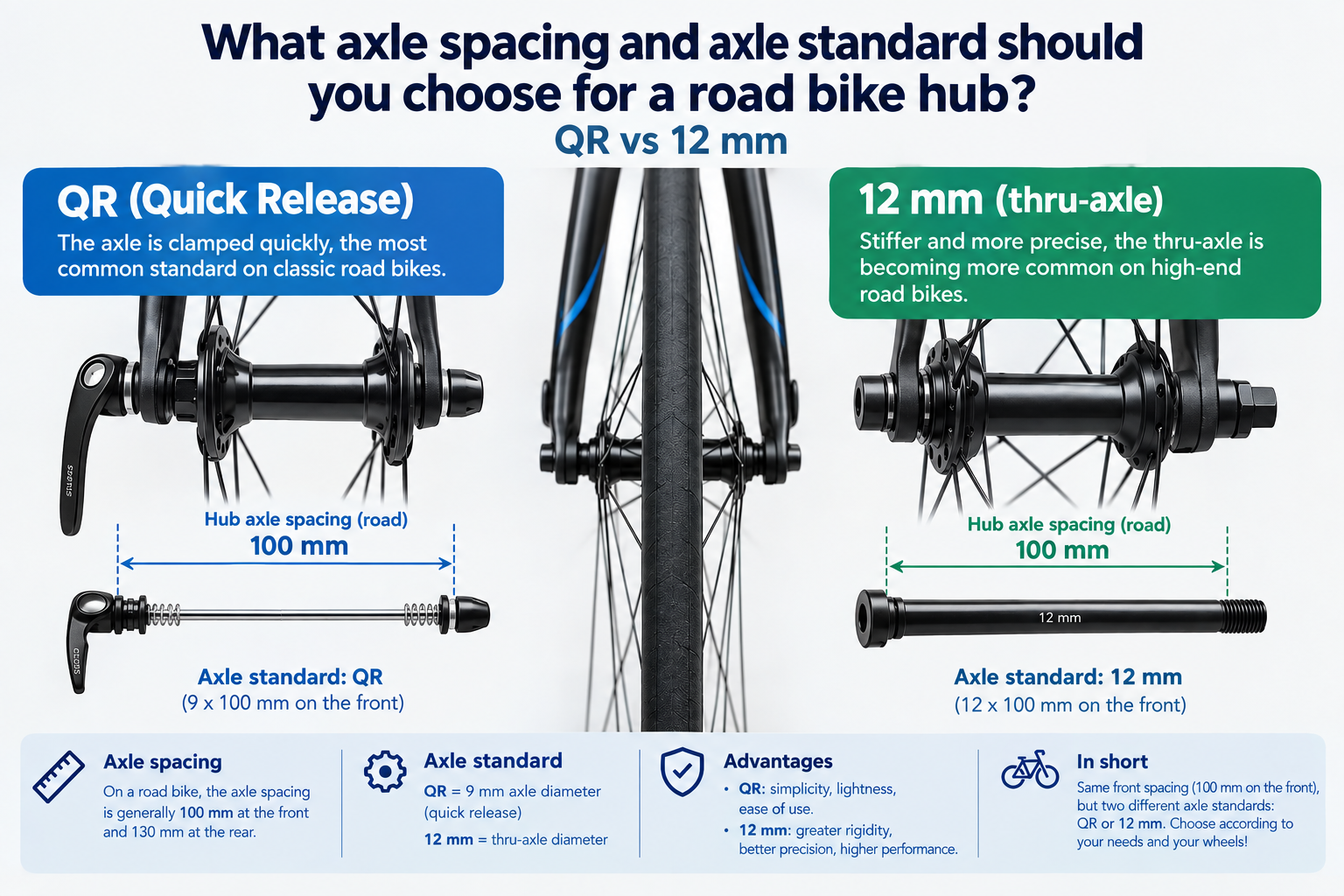
A hub that doesn't fit the frame, annoying side-to-side play: most of these mishaps come down to confusion between axle spacing and axle standards. Checking compatibility only takes a few minutes once you know what to look for. Here's how.
Browse our selection of hub road bike and quick release and axle road bike in stock.
1. Axle spacing and standard: what are we talking about?
Two separate concepts determine whether a hub is compatible with a road bike frame:
- Axle spacing (or dropout spacing) is the distance between the two dropouts on the frame (or fork) that hold the hub axle, measured in millimetres.
- Axle standard refers to the wheel attachment system: axle diameter, length, and mechanism (quick release or thru-axle).
2. Quick release: the historic standard
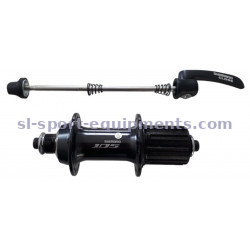
Quick release (QR) is the historic road bike system: a thin skewer running through the hub, clamped by a cam lever on the side of the frame. On road bikes, the skewer diameter is typically 9 mm at the front and 10 mm at the rear. This standard is still common on older road bikes, vintage bikes, and some entry-level rim-brake models.
3. Thru-axle: the modern standard
The thru-axle has become the norm on modern road bikes, especially those fitted with disc brakes. It's a thicker axle (typically 12 mm in diameter, front and rear on road bikes) that screws directly into the frame, without an external cam lever. Its main advantages: significantly higher lateral stiffness, more precise wheel alignment, and better handling of disc-brake forces.
4. What axle spacing for a road bike?
| Configuration | Front spacing | Rear spacing | Typical brake type |
|---|---|---|---|
| Quick release (QR) | 100 mm (9 mm axle) | 130 mm (10 mm axle) | Rim brakes |
| Thru-axle | 100 mm (12 mm axle) | 142 mm (12 mm axle) | Disc |
Worth noting: these values are the most common on the road bike market, but some specific frames or forks may differ. When in doubt, measuring your frame directly is the most reliable method.
5. How to check compatibility before buying a hub?
Three checks are enough to rule out incompatibility:
- Measure your frame's axle spacing, front and rear separately
- Identify your bike's axle standard (quick release or thru-axle) and its diameter
- Check the brake type: a rim-brake hub isn't designed to accept a disc rotor, and vice versa
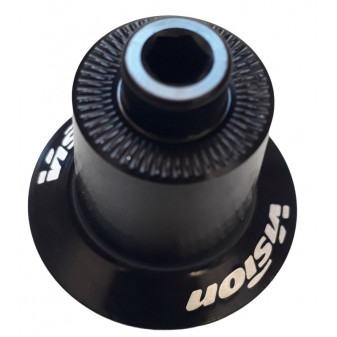
If your setup doesn't exactly match the hub you want, adapters exist for some conversions (for example, an adapter that converts a 9x135 mm axle to a 12x142 mm axle on certain Mavic hubs).
6. What if my hub isn't compatible with my frame?
- Use an axle adapter, when the hub is designed to accept one
- Switch to a different hub that exactly matches your frame's standard — the only reliable option when no adapter is available
For our full range of quick releases, thru-axles and adapters, see our page Quick release and axle road bike.