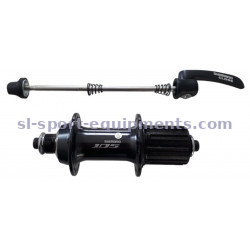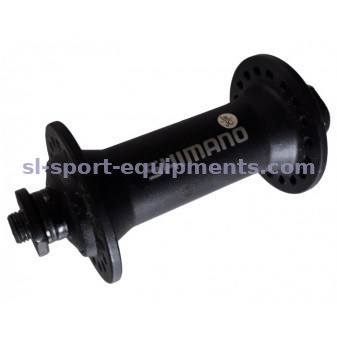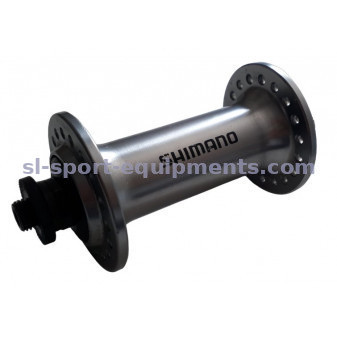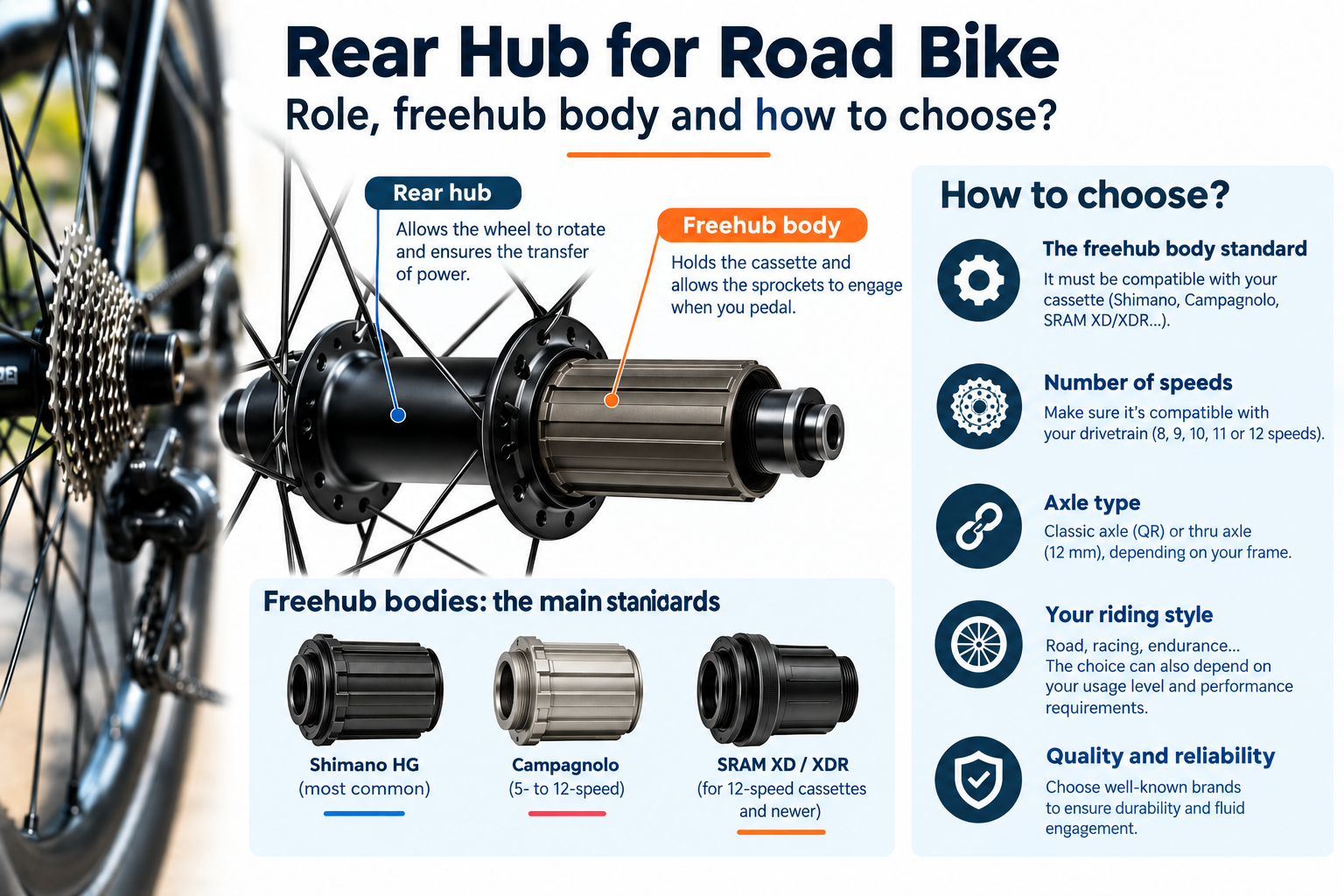
The rear hub is probably the most underrated component of a road bike wheel. Discreet, it nonetheless absorbs the full power of your pedalling and directly determines efficiency, responsiveness on acceleration, and the lifespan of your wheel. Here's everything you need to know to choose the right one.
Browse our selection of hub road bike, front and rear, as well as our wheel road bike and quick release and axle road bike pages.
1. What is a road bike rear hub?
The rear hub is the central part of the rear wheel, around which the spokes are arranged. Unlike the front hub, which simply allows free rotation, the rear hub performs a dual function: it lets the wheel spin, and it transmits the power generated by pedalling to the wheel via the cassette. This second function is what makes it more complex, more mechanically stressed, and slightly heavier than its front counterpart.
2. The components of a rear hub
A quality rear hub relies on three inseparable technical elements:
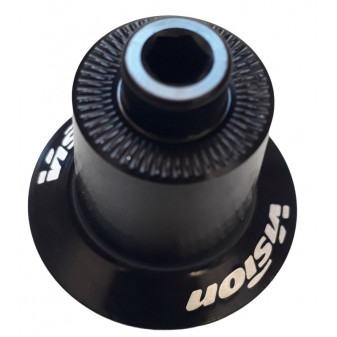
The freehub body
This is what distinguishes a rear hub from a front hub. It receives the cassette and transmits pedalling power to the wheel via a ratchet mechanism.
The bearings
- Cup-and-cone bearings: simple to adjust and maintain, but require regular play checks
- Sealed cartridge bearings: more weatherproof, virtually maintenance-free, but must be replaced entirely when worn
- Ceramic bearings: reserved for high-end hubs, they reduce friction at a higher cost
The axle and frame compatibility
The axle runs through the hub and secures it to the rear dropouts. It must match your bike's standard exactly: classic quick release or modern thru-axle.
3. Freehub body: which standard for which drivetrain?
This is the most important compatibility point — and the main source of buying mistakes. The freehub body must match your cassette's standard exactly:
| Standard | Compatible brands | Typical use |
|---|---|---|
| Shimano/SRAM HG | Shimano, SRAM (up to 11-speed) | The most widespread, all uses |
| SRAM XDR | SRAM 12-speed road | Recent SRAM groupsets (Rival, Force, Red AXS) |
| Campagnolo | Campagnolo (10, 11, 12-speed) | Campagnolo groupsets only |
Good to know: on many modern hubs, the freehub body can be swapped independently of the rest of the hub. It's therefore sometimes possible to change only the freehub body to switch standards, rather than buying a whole new hub.
4. The number of engagement points
The freehub body includes a ratchet mechanism whose number of engagement points determines how quickly power is transferred to the wheel on acceleration. The higher this number (36, 54, or even more than 100 points on some high-end models), the more immediate the power delivery, with no lag. This factor is especially decisive in racing, sprinting, and on hilly terrain. For casual or relaxed sportive riding, a more modest number remains perfectly adequate and often more affordable.
5. Which axle spacing and standard?
Two checks are essential before any purchase:
- Axle spacing: generally 130 mm with quick release (older bikes or rim brakes) or 142 mm with a 12 mm thru-axle (modern standard, disc brakes)
- Brake type: a rim-brake hub is not designed to accept a disc rotor, and vice versa
For more detail on axle and quick release standards, see our article Which axle spacing and standard for a road bike hub.
6. How to choose based on your riding style
| Riding style | Priorities |
|---|---|
| Racing / criterium | Light weight, fast engagement, ceramic bearings |
| Sportive / long distance | Reliability, quality bearings, good weather sealing |
| Gravel / versatility | Robustness, disc compatibility, thru-axle |
| Casual riding | Standard hub, easy to maintain, good value |
Also check compatibility with your drivetrain groupset (Shimano, SRAM or Campagnolo), since the freehub body is never universal.
7. New or used: which option for a rear hub?
Since a rear hub is a relatively straightforward mechanical part to inspect, used is a perfectly viable option to reduce your budget or find an older reference no longer available new. At SL Sport equipments, every used rear hub is rated on a scale of 1 to 10 based on its actual condition, and checked before shipping. To learn more about our inspection process, see our article Used road bike hub.