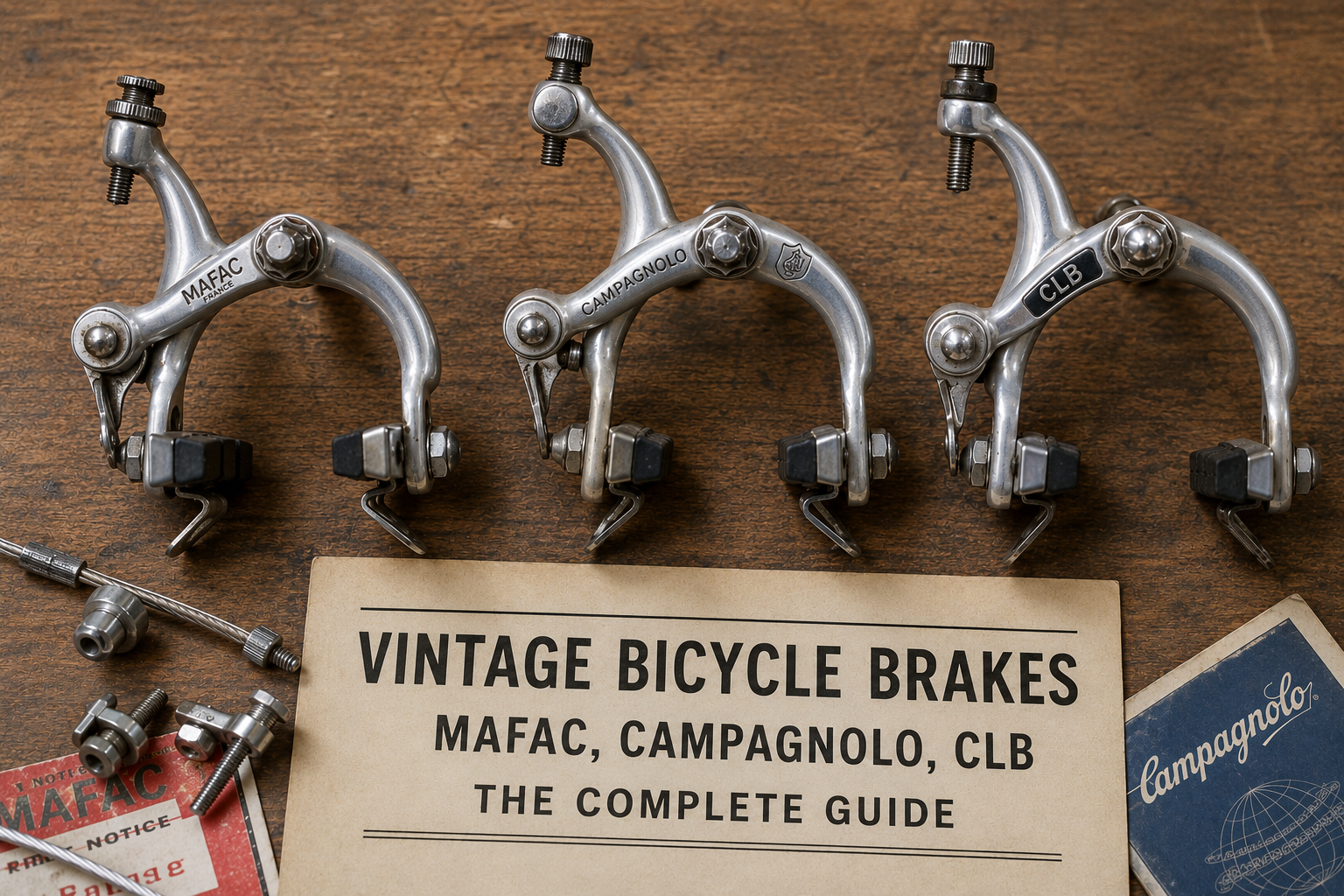
Before the current dominance of Shimano and SRAM, European road bike braking was led by a handful of iconic brands, many of them French. Mafac, Campagnolo and CLB each left their mark on their era with different technical approaches. This guide introduces these brands, highlights their specific features, and provides practical advice for anyone looking to restore or maintain a period-correct braking system.
For a comprehensive overview of modern road bike braking systems, see our complete road bike brake guide.
1. Centerpull brakes, the dominant technology of the era
Before side-pull brakes became widespread, most European road bikes were equipped with centerpull brakes, also known as "centerpull" brakes. This system, popularized in particular by Mafac, distributes braking force differently: the cable splits into two strands that simultaneously actuate both arms of the brake caliper from the center, via a bridge mounted on the frame or fork.
This design differs from modern side-pull brakes, where a single cable directly actuates one arm, which then moves the second arm through a pivot mechanism. Understanding this basic difference makes it easier to appreciate the specific characteristics of each brand presented below.
Key takeaway: centerpull brakes are not a "worse" system, but simply a different approach that was consistent with the manufacturing standards of the time. When properly adjusted, they remain fully functional today.
2. Mafac, the French benchmark in bicycle braking (1950-1980)
Mafac, an acronym for Manufacture Arvernoise de Freins et Accessoires pour Cycles, established itself as a leading name in bicycle braking between 1950 and 1980. Rooted in the Auvergne region of France, the brand played a major role in making the Clermont-Ferrand–Saint-Étienne area a true hub of the French bicycle touring industry.
Its most iconic models, such as the Racer and Course, were fitted to millions of French and European bicycles for almost forty years. Mafac also produced widely used brake levers, as well as dedicated tool kits for maintaining its own braking systems.
The brand's decline began in the 1980s, when the practicality of side-pull brakes, promoted first by Campagnolo and then by Shimano, became widely established on the market. Mafac attempted to follow this trend with several variants, but failed to regain the reliability that had built its reputation, leading to the brand's gradual disappearance.
3. Campagnolo, Italian precision
Unlike Mafac, Campagnolo historically focused more heavily on competition and mechanical precision. Its side-pull calipers, particularly the Record and Super Record ranges, played a major role in shifting the market toward this technology from the 1980s onward.
This broader market shift explains why more recent road bikes from the "vintage" era, dating from the late 1980s, are more commonly found with Campagnolo side-pull brakes than bikes from previous decades, when centerpull brakes still dominated the market.
4. CLB, another major French name
Less well documented than Mafac but equally sought after by restorers, CLB was another major French name in vintage bicycle braking, a contemporary of and direct competitor to Mafac in the centerpull segment. Its calipers feature distinctive mounting characteristics and brake pad cartridges, generally shorter than those used by Mafac, an important detail to check before replacing the brake pads.
5. Identifying and maintaining vintage brakes
Identifying the brand and model
A few visual clues can help quickly identify a vintage brake: the overall shape of the caliper body, the markings often engraved or molded directly onto the part, and the brake pad mounting system, which varies significantly from one brand to another.
The recurring problem of brake pads hardening with age
By far the most common cause of poor braking performance or squeaking on a vintage bicycle is the original rubber brake pads, which harden over time and lose their grip. This is exactly the phenomenon described in our article about road bike brakes that squeak or rub. The good news is that several manufacturers, including Kool-Stop, now produce replacement brake pads compatible with most vintage calipers, making it possible to restore satisfactory braking performance without modifying the original mechanism.
Key takeaway: before suspecting the caliper or the brake bridge, always check the condition and flexibility of the brake pads. On a vintage brake, they are responsible for the vast majority of braking problems encountered.
Adjustment and maintenance
When properly adjusted, these vintage brakes are still capable of providing entirely satisfactory braking for touring use. The adjustment process remains similar to that of modern rim brakes: centering the caliper, adjusting cable tension, and setting the angle of the brake pads in relation to the rim.
6. Should you restore or replace a vintage brake on an old road bike ?
Several criteria can help you decide between restoration and replacement:
- Aesthetic and historical consistency: on an older frame, keeping a period-correct brake preserves a strong sense of authenticity, which is often a decisive factor for collectors.
- The actual condition of the existing parts: a functional caliper fitted with new brake pads is often a better option than a complete replacement.
- Availability of compatible replacement parts: the availability of replacement brake pads makes restoration much easier compared with other, rarer wear components.
- Project budget: restoration is generally more economical than replacing the entire system with a modern one, which would often also require modifications or replacement of the frame.
7. FAQ — Vintage bicycle brakes: Mafac, Campagnolo, CLB
What is a centerpull brake?