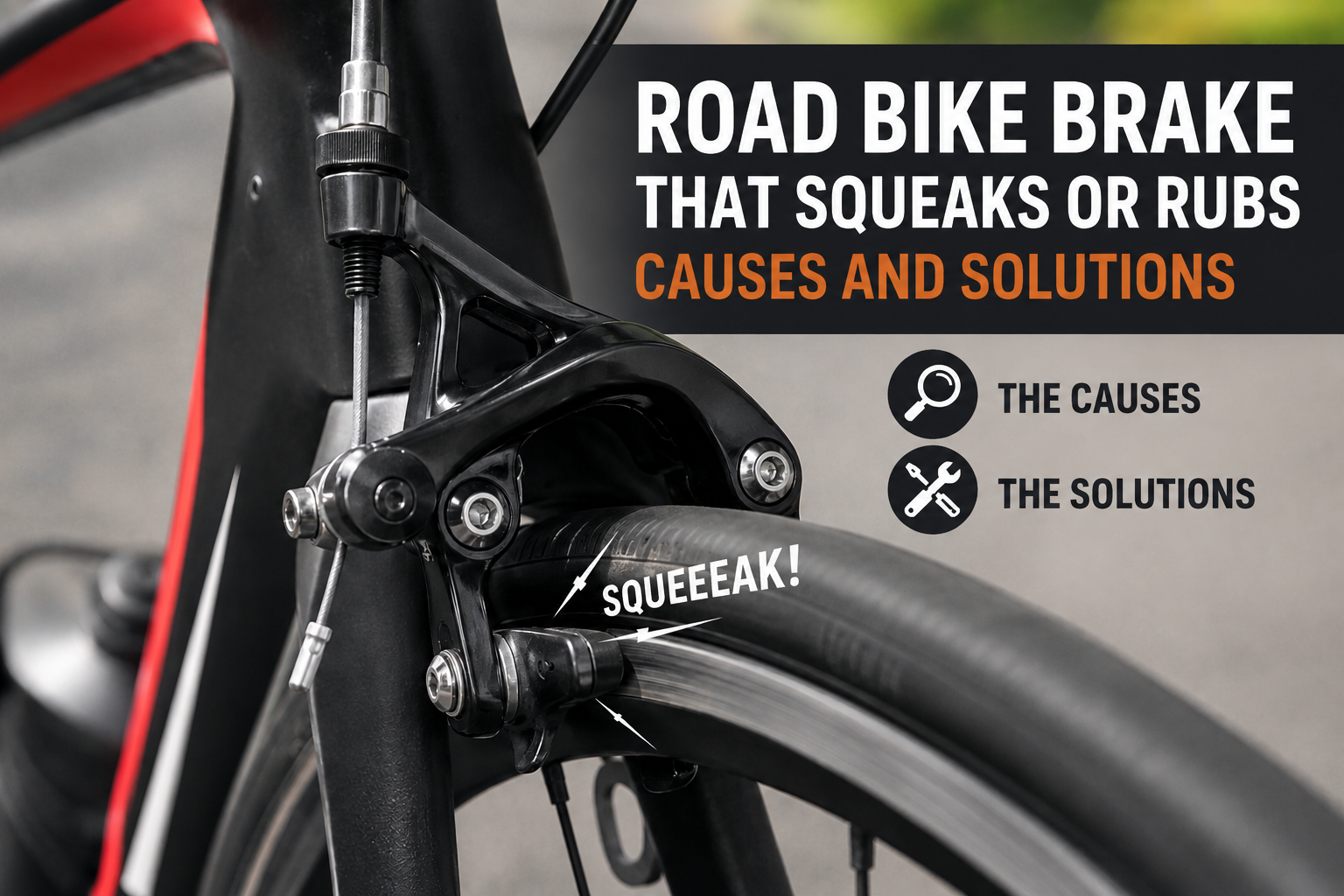
A high-pitched squeak when braking or a constant rubbing sensation, even when the brake lever is released, are two common but rarely insignificant symptoms. Ignoring this type of noise often means allowing premature wear to develop, or even losing braking power when you need it most. The good news: most cases can be resolved with a simple adjustment or cleaning, without replacing any parts. This guide will help you identify the exact cause depending on your braking system and the specific noise you hear.
For a complete overview of road bike braking systems, see our complete road bike brake guide. If you are still unsure which system to choose, our disc brakes vs. rim brakes comparison explains their key differences.
1. Squeaking or rubbing: two symptoms, two different diagnoses
Before going any further, it is important to make a distinction: an occasional squeak that is only audible when you pull the brake lever does not have the same cause as continuous rubbing that can be heard even when the wheel is spinning freely and the brake lever is released. The former generally points to a material-related issue (contamination, wear or bedding-in), while the latter is usually related to alignment or centering.
Key point: always start by identifying which of these two symptoms you are experiencing before looking for the cause. This will prevent you from removing the wrong component or cleaning a disc that actually only needs to be re-centered.
2. My disc brake rubs constantly
Slightly warped disc (most common cause)
A slightly warped disc, often caused by an impact, a crash or improper storage, will rub against one of the brake pads with every wheel revolution, producing a characteristic rhythmic noise. A slightly warped disc can be straightened using a disc truing tool, gradually correcting the deformed areas.
Caliper misaligned after removing the wheel
This is the easiest cause to fix and the first one to check. After removing and reinstalling the wheel, the caliper may end up slightly misaligned with the disc, causing continuous rubbing on one side. Loosening the caliper mounting bolts slightly, squeezing the brake lever while holding it firmly, and then tightening the bolts again will often automatically center the caliper.
Wheel not properly secured in the axle
Less common but quick to check first: a wheel that is not tightened sufficiently or is not properly seated in the axle can slightly shift the disc in relation to the caliper. Simply checking that the axle is properly tightened can sometimes solve the problem without any further intervention.
3. My disc brake squeaks when braking
Brake pads contaminated with oil or chain degreaser
This is one of the most common causes of squeaking with disc brakes. Even a small amount of lubricant or chain degreaser getting onto the disc or brake pads can reduce grip and produce a high-pitched, unpleasant noise every time you brake.
Glazed brake pads after prolonged braking
A long descent or prolonged braking under heavy load can cause the brake pads to overheat, glazing their surface. This hardened, smooth surface provides less grip and often produces a characteristic squeaking noise, along with reduced braking power.
New disc and brake pads not yet bedded in
Temporary squeaking on a new braking system is nothing to worry about: the disc and brake pads need a bedding-in period, usually a few dozen kilometres with repeated, progressive braking, before the surfaces are properly bedded in and work together effectively.
4. My rim brake squeaks or rubs
Brake pads incorrectly positioned (incorrect "toe-in" angle)
A brake pad positioned perfectly parallel to the rim tends to vibrate and squeak when braking. A slight angle, known as "toe-in", with the front of the pad positioned slightly closer to the rim than the rear, will usually correct this issue by eliminating the vibration responsible for the noise.
Dirty rim or brake pads hardened with age
Brake residue accumulated on the rim, or brake pads that have hardened over time and lost their original flexibility, reduce grip and frequently cause squeaking. Cleaning the rim and visually checking the flexibility and condition of the brake pads will quickly help identify this cause.
Misaligned caliper or loose cable
As with disc brakes, a misaligned rim brake caliper can cause rubbing on one side of the rim. A brake cable that has become loose over time can also create play and vibration when braking, which can be corrected by simply readjusting the cable tension.
5. 3-step diagnostic method
To accurately identify the cause before taking action, a three-step method can be applied to both braking systems.
- Free-spin test, wheel off the ground: spin the wheel by hand without applying the brake. If rubbing occurs at this stage, it points to an alignment issue (misaligned caliper, warped disc or improperly secured wheel).
- Loaded test, progressive braking: gradually pull the brake lever and observe when the noise appears. A squeak that only occurs halfway through the lever travel or towards the end of the braking action is more likely to indicate a material-related issue (contamination, glazing or wear).
- Visual gap check: inspect the gap between the brake pads and disc, or between the rim brake pads and rim, around the entire circumference of the wheel. An uneven gap confirms a centering or warping issue rather than a surface-related problem.
6. Quick solutions to try before replacing a part
Before considering replacement, several free or low-cost solutions can resolve most cases:
- Centering the caliper: it only takes a few minutes and requires no specific tools beyond an Allen key.
- Cleaning with isopropyl alcohol: use it to degrease a disc or slightly contaminated brake pads. Avoid other solvents, which could damage the materials or leave residues.
- Lightly sanding contaminated brake pads: fine-grit sandpaper can remove the thin contaminated surface layer as a temporary fix.
- Adjusting the brake pad angle: slightly loosen the brake pad, adjust the "toe-in" angle, then retighten while checking the alignment.
Important: avoid any contact between chain lubricant and the brake disc during routine bike maintenance. Protect the disc with a cloth if you are lubricating the chain nearby, as contamination is one of the most common and easiest causes of brake squeaking to prevent.
7. When to replace rather than adjust
Some signs indicate that a simple adjustment will not be enough and that it is time to replace the component:
- Brake pads or brake shoes are below the minimum wear thickness recommended by the manufacturer.
- The disc is visibly warped beyond what can be corrected by manual truing.
- Brake shoes are hardened, cracked or deeply glazed and do not regain their grip after cleaning.
- Squeaking or rubbing persists after trying all of the quick solutions above.
Once these limits have been reached, replacing the affected component remains the most reliable solution for restoring quiet and effective braking. Browse our complete range of road bike brake shoes, brake discs and brake pads to equip your bike.