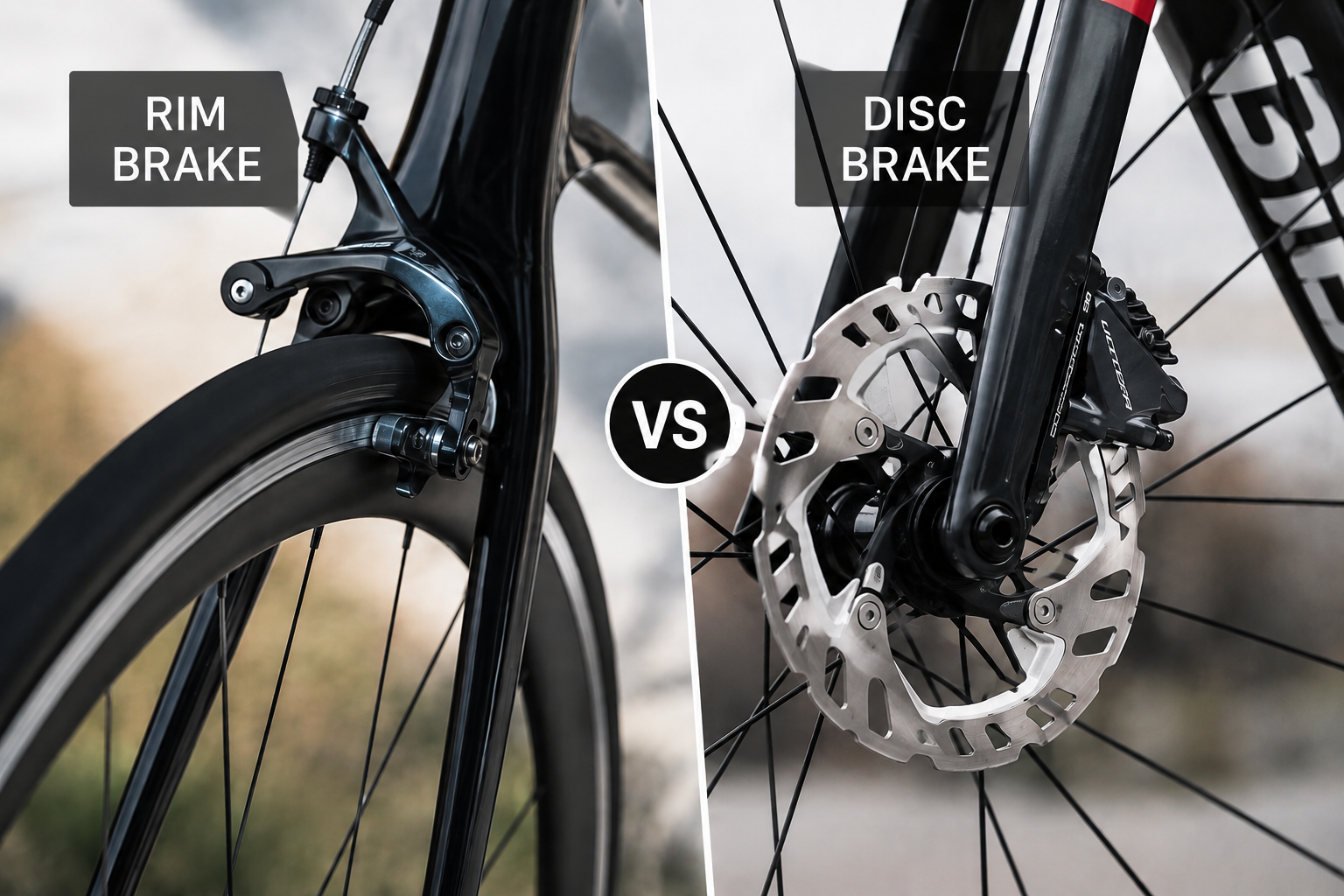
The road bike market has changed dramatically in just a few years. While rim brakes had dominated for decades, more and more manufacturers now offer their ranges exclusively with disc brakes, and some have even completely phased out rim brakes on certain models. That said, rim brakes are far from obsolete: they remain the choice of many cyclists, and for good reason. So, should you switch to disc brakes or stay faithful to rim brakes? The answer depends less on trends than on your riding style, your budget and your priorities.
For a complete overview of road bike braking systems (types, adjustment and maintenance), check out our complete road bike brake guide.
1. How the two braking systems work
The principle behind rim brakes has remained virtually unchanged since the early days of cycling: when you pull the brake lever, a cable draws two brake pads toward the rim. The resulting friction slows the wheel down. Disc brakes work differently: a metal rotor is attached to the hub, and a caliper fitted with brake pads clamps onto it when you brake, in a way similar to a car braking system. The brake can be operated by a mechanical cable or, more commonly today, by a hydraulic system.
Key takeaway: disc brakes completely separate the braking system from the rim material, whereas rim brakes apply braking force directly to the rim. This difference explains almost all of the performance differences discussed below.
2. Braking power and modulation: which system brakes better ?
This is the criterion that weighs most heavily in the decision. Disc brakes provide greater braking power and, above all, much more consistent performance regardless of the conditions. In the rain, the difference becomes particularly obvious: the braking surface of a disc remains protected from water and road spray, whereas a wet rim quickly loses braking efficiency until the pads clear the water and grip the surface properly.
Rim brakes remain perfectly satisfactory in dry weather, particularly with aluminum rims. With carbon rims, however, they require more caution: carbon rims heat up quickly during prolonged braking, which can reduce the available braking power at the worst possible moment, typically at the end of a long descent. Disc brakes do not present this issue because they are completely independent of the rim material.
In short, if you frequently ride in the rain, in mountainous areas, or with carbon wheels, disc brakes have a clear advantage. For predominantly summer riding with aluminum rims, rim brakes remain more than capable.
3. Weight: the argument still in favor of rim brakes
This is one of the last strongholds of rim brakes. A complete system (calipers and cables) remains lighter than an equivalent disc brake setup, which has to include the rotors themselves, larger calipers, and, for hydraulic versions, brake fluid and hoses. The difference is generally between 300 and 500 grams, depending on the configurations and component ranges being compared.
This gap tends to narrow at the high end, where manufacturers offer very lightweight disc brake systems, but these versions remain expensive. For climbers or racers who count every gram, rim brakes therefore retain a clear advantage. For the vast majority of cyclists, however, this difference is difficult to notice in everyday riding.
4. Maintenance: rim brake simplicity vs. disc brake complexity
Maintaining rim brakes
Maintaining a rim brake system is simple and requires no special tools: visually checking for wear, cleaning the braking surface, and replacing the brake pads when the wear indicator groove disappears. Any cyclist with basic mechanical skills can handle it themselves with an Allen key and a few minutes of work.
Maintaining disc brakes
Disc brakes require a little more care. The brake pads wear faster but are easy to replace. Hydraulic systems, however, require periodic bleeding (approximately once or twice a year) when the lever feels spongy or the lever travel increases. This is a more technical operation that can sometimes discourage cyclists who do not have the necessary equipment. You should also check the rotor for warping and prevent any contamination with oil or grease, which can reduce the brake pads' grip.
Important: contaminating disc brake pads with oil or incorrectly applied chain degreaser can significantly reduce braking grip. Always keep lubricants away from the brake rotors and calipers.
For more information about this technical aspect, check out our road bike brake adjustment and maintenance guide.
5. Tire and wheel compatibility
Disc brakes remove a limitation that cyclists using rim brakes know all too well: maximum tire width. Rim brake calipers generally limit the usable tire width to around 25 mm, whereas disc brakes allow you to fit much wider tires, 28, 30, or even 32 mm on some frames, without compromising braking performance. This is a major advantage for riders who enjoy long-distance sportive rides or mixed road-and-gravel outings, where wider tires provide greater comfort and grip.
Another advantage of disc brakes is that, since the braking surface is no longer located on the rim, the rim does not wear out over time. This extends its lifespan and removes any constraints related to choosing between aluminum or carbon wheels.
6. Budget: which system costs more?
When buying a bike or brake system, a disc brake setup generally costs more than an equivalent rim brake system, with the difference potentially reaching several hundred euros depending on the range. Over time, however, the picture is more nuanced: rim brake pads are inexpensive to replace but eventually wear down the rim itself, which will sooner or later need to be replaced. Disc brake pads cost slightly more to purchase and wear out faster, but they preserve the rim indefinitely. Over several years of intensive use, the difference in overall maintenance costs therefore tends to narrow.
7. Which brake system should you choose based on your riding profile ?
| Rider profile | Recommendation | Why |
|---|---|---|
| Beginner, recreational riding | Disc brakes | Easier to use, increased safety, predictable braking in all conditions |
| Racer looking for the lowest possible weight | Rim brakes | Significant weight savings, particularly useful in the mountains |
| Sportive, long-distance and all-weather riding | Disc brakes | Consistent braking power in the rain and during prolonged descents |
| Budget-conscious rider, DIY maintenance | Rim brakes | Lower purchase and maintenance costs, easy to service without specialist tools |
| Bike already equipped with rim brakes and carbon rims | Rim brakes + carbon-specific brake pads | Avoid an expensive conversion if the existing system meets your needs |
8. Can you convert a rim-brake bike to disc brakes ?
No, not simply by changing the calipers. The frame and fork must have been designed from the outset to accommodate the specific mounting points required for disc brakes, and the wheels must have compatible hubs. A complete conversion would therefore require changing the frame, fork and wheels, which in most cases makes buying a new bike a more sensible investment than converting the existing one.
Things to check before changing your braking system: frame and fork compatibility, whether your wheels have suitable hubs, and sufficient clearance for the caliper and rotor. Our road bike brakes page provides more details on these key considerations.