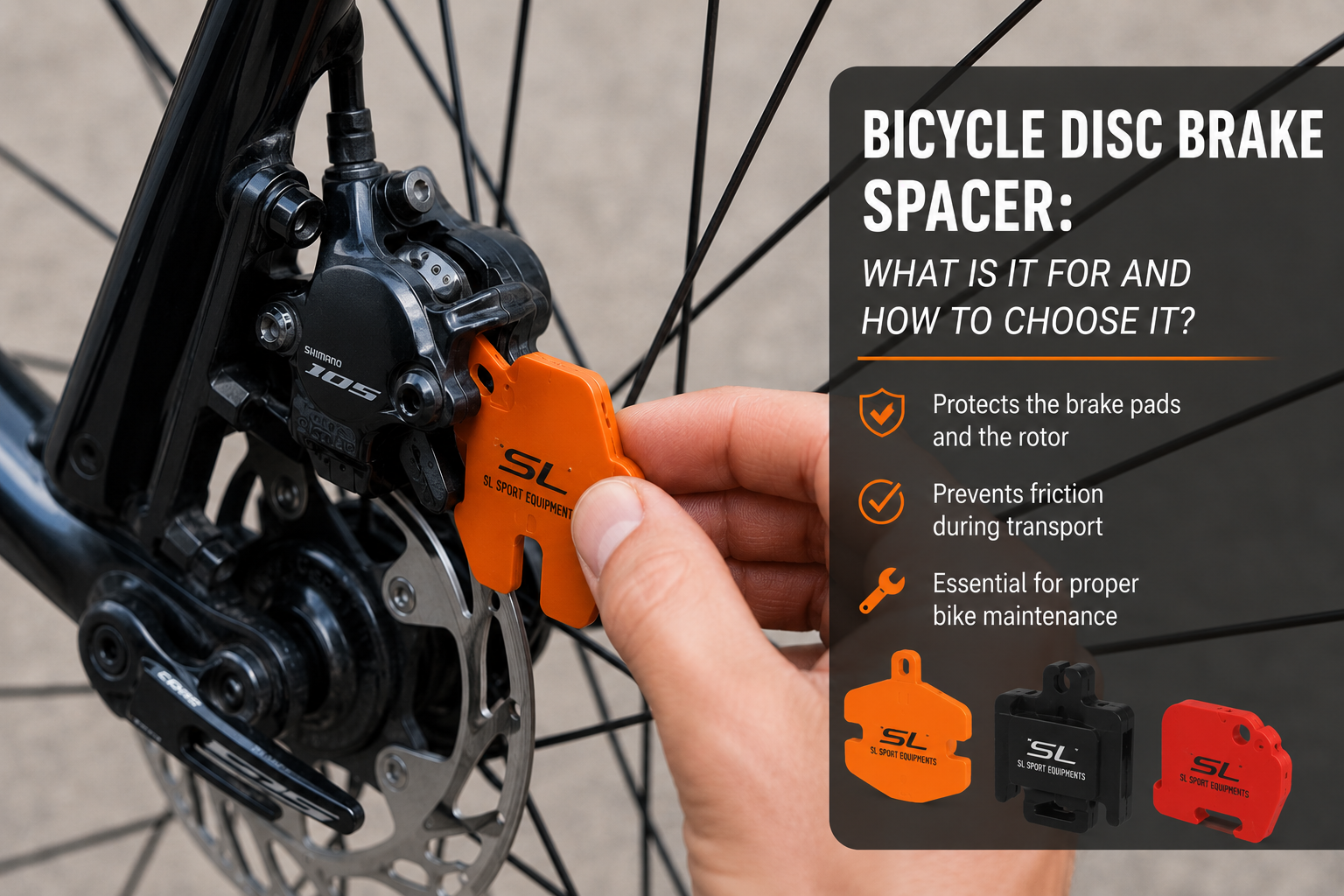
Have you just received your new bike or wheel, and are you wondering about the small plastic piece wedged between the brake pads of your caliper? This piece, known as a disc brake pad spacer, is not packaging to be thrown away: it has a specific purpose, and ignoring it can leave your bike unusable at the worst possible moment. This guide explains exactly what it is for, when to use it, and how to choose one if you need to replace it.
For a complete overview of road bike braking systems, see our complete road bike brake guide.
1. What is a disc brake pad spacer ?
A disc brake pad spacer is a small part, usually made of rigid plastic or thick cardboard depending on the brand, inserted between the two brake pads of a brake caliper. Its shape matches the space normally occupied by the disc, allowing it to maintain the correct spacing when the wheel is removed.
Don't confuse the two: a disc brake pad spacer has nothing to do with a pedal cleat, which attaches to the underside of your cycling shoe for clip-in pedals. The two parts simply share the same name, which explains much of the confusion surrounding the term.
2. Why this small part is essential
On a hydraulic brake system, pulling the brake lever pushes fluid into the caliper, causing the pistons to move inward and bring the brake pads closer together. In normal use, the disc positioned between the pads limits this movement to the exact clearance required. But if the wheel has been removed and the brake lever is pulled without anything between the pads, nothing stops the pistons: they move as far inward as their travel allows.
As a result, when the wheel is reinstalled, the gap between the brake pads may be too narrow for the disc to pass through, causing the disc to hit or rub heavily against them. The bike then becomes unusable until the pistons have been pushed back to their original position.
Important: never pull a hydraulic brake lever when the wheel is removed unless a spacer is correctly positioned between the brake pads. This is the most common cause of accidentally closed brake pads, particularly when assembling a new bike delivered with the wheels removed.
3. When to use it
Transporting and storing a bike without its wheels
When transporting a bike by car or plane, or simply storing it for an extended period with the wheels removed, the spacer prevents any problems if the brake lever is accidentally pulled, for example while handling the bike inside a transport bag or case.
Temporarily removing a wheel
During a repair, tire change, or routine maintenance requiring the wheel to be removed, it is easy to accidentally pull the brake lever while handling the bike. Inserting the spacer before starting any work eliminates this risk.
New bike delivered with the wheels removed
This is the most common situation when buying a bike online: the bike arrives with the wheels removed for shipping, and a spacer is already positioned in each caliper by the manufacturer or seller. It should only be removed when the wheel is permanently reinstalled.
4. What to do if the brake lever has been pulled without the spacer (a common mistake)
Don't worry: in the vast majority of cases, this mistake is not irreversible. The pistons can generally be pushed back manually using a flat plastic or metal tool (such as a tire removal lever or brake pad spreader) inserted carefully between the two brake pads, gradually applying pressure to both sides to separate them evenly.
If the pistons resist strongly, appear to be stuck, or you notice a fluid leak around the caliper, it is best not to force them and to have the work carried out by a bike shop. Forcing a seized piston can damage the seal and result in a more expensive repair than simply returning the pistons to their original position.
5. How to choose the right disc brake pad spacer
| Type of spacer | Recommended use | Points to watch |
|---|---|---|
| Universal plastic spacer | The most common option, compatible with the majority of calipers on the market | Check that the thickness is suitable for your brake pad spacing |
| Manufacturer-specific spacer | High-end hydraulic systems with proprietary brake pad spacing | Always use the original spacer or one recommended by the manufacturer |
| Emergency alternative (folded cardboard) | Temporary use if the original spacer has been lost, before replacing it | Temporary solution only; it should not be used permanently |
In most cases, a universal plastic spacer is more than sufficient and can easily be found for just a few euros. If you are unsure whether it is compatible with your system, check the reference of your brake calipers before ordering, or choose an original spacer from the same manufacturer.
6. Mechanical vs hydraulic spacers: a common confusion to avoid
With a mechanical disc brake operated by a cable, there is no risk of the pistons closing irreversibly because there is no hydraulic circuit. In this case, the spacer serves only as protection during transport, helping to prevent the brake pads from becoming contaminated or deformed.
With a hydraulic brake, on the other hand, the spacer has a genuinely functional purpose and is not simply a precaution: it is what prevents the incident described above. Identifying the type of braking system fitted to your bike therefore helps you determine whether using a spacer is simply convenient or actually essential.