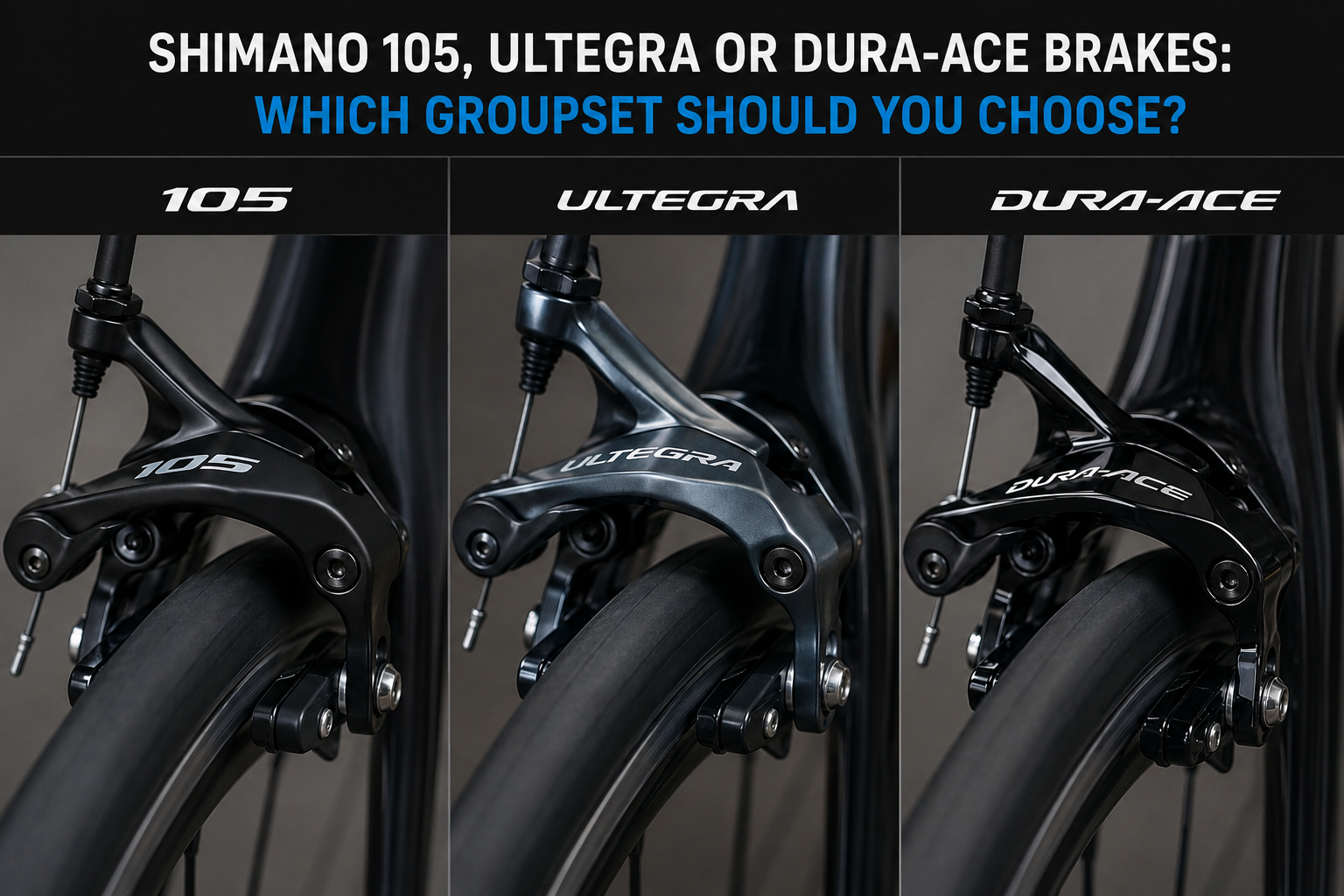
Shimano holds a dominant position in road bike equipment, with three tiered groupsets that have shaped the market for decades: 105, Ultegra and Dura-Ace. In recent years, the performance gap between these three levels has narrowed considerably, making the choice sometimes more strategic than obvious. This article focuses on what really sets these three groups apart when it comes to braking, which is often the most misunderstood aspect of Shimano's hierarchy.
For a complete overview of road bike braking systems, check out our complete road bike brake guide.
1. The three Shimano groupsets at a glance
105 remains the most accessible groupset in Shimano's road range. Long perceived as a technical entry-level option, it now benefits from technologies that were previously reserved for higher-end levels. Ultegra sits between performance and price, making it a popular choice among demanding cyclists and amateur racers. Dura-Ace, meanwhile, remains the flagship groupset used at WorldTour level, with an absolute focus on reducing weight and maximizing performance.
Key takeaway: all three groupsets share the same operating architecture, very similar ergonomics and a high degree of component compatibility. This is not a minor detail: it means that mixing components between groupsets is often possible, particularly for maintenance or a gradual upgrade.
2. Braking power: is the difference really noticeable ?
This is the most misunderstood aspect of Shimano's hierarchy. Contrary to a common misconception, maximum braking power between 105 and Ultegra is very similar, and can even be identical depending on the groupset generation. The main differences lie in lever feel, lever travel and modulation, rather than in the raw braking force available at the caliper.
In practical terms, a cyclist who rides in the city, on hilly routes and takes part in one or two sportives a year can already benefit fully from the braking power of 105 without feeling limited. A rider who tackles major mountain passes and combines fast descents, heavy loads or wet conditions will benefit more from Ultegra, if only for the additional confidence in corners provided by better modulation.
3. Mechanical or Di2: a more decisive choice than the groupset level
Switching from mechanical braking and shifting to electronic Di2 has a greater impact on the overall riding experience today than moving from one groupset level to another within the Di2 range. All three groupsets are now available in 12-speed Di2 versions, which fundamentally changes the picture compared with the previous hierarchy, when only the top-end groupset benefited from electronic shifting.
Between 105 Di2 and Ultegra Di2, response times remain very similar, to the point that the difference is difficult to perceive during a sprint or a change of pace in a group. Choosing between Di2 groupset levels is therefore more about weight and finishing details than any significant difference in braking performance or shifting precision.
Important: mechanical and electronic components cannot be mixed within the same groupset. If you are considering upgrading to Di2, plan to replace the shifters, derailleurs and battery as a complete system rather than attempting a partial upgrade.
4. Weight and materials: where the extra cost is really justified
Weight differences between the groupsets are mainly explained by the materials used. Ultegra and Dura-Ace levers feature carbon-fiber-reinforced plastic supports and carbon levers, while 105 uses glass-fiber-reinforced plastic and aluminum, which are heavier. On the cassettes, Dura-Ace uses titanium for the larger sprockets, a lighter and more expensive material than the steel used on 105 and Ultegra.
These material differences have the greatest impact on the overall weight of the complete groupset, and relatively little impact on pure day-to-day braking performance. For a climber or racer looking to save every possible gram, the additional cost of Dura-Ace is clearly justified. For regular non-competitive riding, however, the weight difference is difficult to notice on the road.
5. Ergonomics and additional features
Beyond pure braking performance, Ultegra and Dura-Ace add features that are particularly useful for intensive or competitive riding: additional buttons on the shifters for customized controls, bike computer control directly from the levers, and compatibility with satellite shifters installed elsewhere on the handlebars. These options provide real comfort during long training rides or races, but remain less important for recreational riding or occasional sportives.
6. Budget: the gap between groupsets quickly adds up
Shimano's pricing structure follows a clear progression: each step up the range represents a significant increase in purchase price, whether for a complete groupset or simply for the brakes. The same applies to wear parts: brake pads, cables and consumables are significantly less expensive for 105 than for Ultegra or Dura-Ace.
For regular, non-competitive riding, these accumulated maintenance costs often have a greater impact on the overall budget than any potential gain in braking performance. This is a strong argument in favor of 105 for cyclists who ride frequently but do not have competitive goals.
7. Which groupset should you choose for your riding profile?
| Riding profile | Recommendation | Why |
|---|---|---|
| Recreational riding, city riding, hilly routes | Shimano 105 | More than enough braking power, lower maintenance costs |
| Regular sportives, major mountain passes | Shimano Ultegra | Better modulation on loaded descents, good weight-to-price ratio |
| Racing, minimum weight | Shimano Dura-Ace | Lightest materials, premium finishes, WorldTour standard |
| Tight budget, frequent maintenance | Shimano 105 | Significantly cheaper wear parts over the long term |