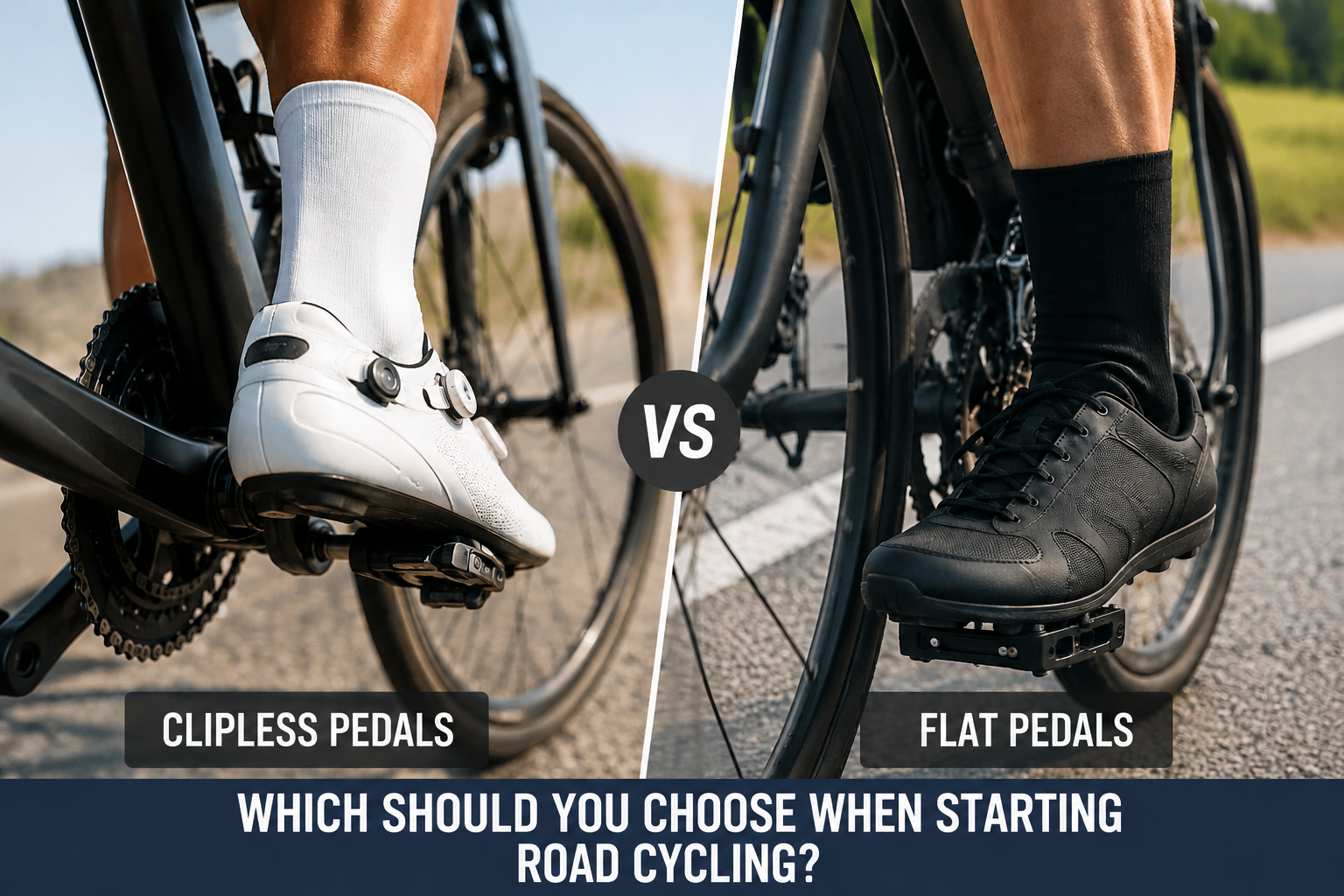
This is one of the most common questions among cyclists discovering road cycling: should you switch straight away to clipless pedals, or is it better to start with simpler flat pedals? Many riders hesitate, torn between the desire to get off to a good start with "serious" equipment and the fear of falling because of clipping in. The good news is that there is no wrong choice here, only a matter of learning pace. This guide will help you decide based on your profile.
For all the criteria to consider when choosing road bike pedals once you have selected your system, see our complete road bike pedal guide.
1. Clipless pedals and flat pedals: what are we talking about ?
A clipless pedal works with a cleat attached to the sole of a dedicated cycling shoe: when you press your foot onto the pedal, the cleat automatically clips in and keeps your foot firmly attached. To release your foot, you simply need to rotate your heel outward.
A flat pedal has no attachment system: the shoe simply rests on the pedal surface without being attached. Your foot can be placed on or removed from the pedal at any time, without requiring any particular movement.
A useful clarification: road bike flat pedals differ from the flat pedals used for mountain biking or urban cycling, which are often smaller and sometimes equipped with a toe clip (a strap that partially holds the foot in place). On a road bike, flat pedals are generally wider to provide better support despite the absence of a retention system.
2. The advantages of clipless pedals
- More efficient power transfer: because the foot is securely attached to the pedal, there is no energy loss caused by slipping, including during the upward phase of the pedal stroke, which improves overall pedaling efficiency.
- Consistent foot position: the cleat always provides the same point of contact, helping you maintain a repeatable position from one ride to the next, which is useful for long-term comfort.
- The standard on almost all road bikes beyond entry-level models: this makes it much easier to find compatible equipment, including second-hand, where the range of clipless pedals and cleats remains very broad.
3. The advantages of flat pedals
- Complete freedom of foot position, with no adjustment period required: simply place your foot on the pedal and start pedaling, without having to learn any particular reflex.
- Compatible with any shoes, with no additional investment in dedicated cycling shoes, unlike clipless pedals, which require shoes with compatible cleats.
- Reassuring in heavy traffic or in the city, since instant foot release is inherent to their design: there is no risk of remaining attached to the pedal in the event of a sudden stop.
Key takeaway: riding with flat pedals is absolutely not limited to beginners. Many experienced cyclists choose them for commuting or for relaxed road cycling, without focusing on performance.
4. The question of falling: what you really need to know
The main concern associated with clipless pedals is the risk of falling when clipping in. It is useful to put this fear into perspective: falls related to clipless pedals almost always occur at very low speed, while stopped or just as the cyclist needs to put a foot down (at a traffic light, when stopping, or following an unexpected loss of balance). They almost never happen while riding at normal speed.
The reason is simple: for a beginner, the unclipping reflex has not yet become automatic. The brain still has to "think" about rotating the heel to release the foot, which takes a fraction of a second too long in a situation where an immediate reaction is required. This delay naturally disappears with practice, once the movement becomes automatic.
One often overlooked aggravating factor is setting the release tension too high from the outset, which makes the movement even more difficult for a beginner. Our article how to adjust the release tension on your clipless pedals explains in detail how to avoid this common mistake during your first rides.
5. Learning how to clip in and unclip safely
A few simple tips can help you get through this learning phase without any problems:
- Practice while stationary first, with the bike held against a wall or placed on a work stand, before attempting the movement while riding.
- Start with the minimum release tension, then gradually increase it once you have mastered the movement (see our dedicated article on release tension adjustment).
- Choose a "reflex" foot from the start for unclipping — the foot you will systematically put on the ground when stopping — and stick to it consistently.
- Take your first rides on open, quiet terrain, away from traffic, such as an empty parking lot or a quiet cycle path, before riding in real-world conditions.
6. Our recommendation based on your profile
- You are completely new to cycling: both flat pedals and clipless pedals set to minimum release tension are perfectly valid options. The choice mainly depends on your willingness to learn a new movement.
- You are already used to cycling (city riding, mountain biking) but are new to road cycling: you can switch directly to clipless pedals, as the adjustment period will generally be short thanks to your existing riding experience.
- You are aiming for performance or long-distance rides quickly: clipless pedals are recommended, as the improvement in pedaling efficiency becomes noticeable quite quickly as your riding volume or intensity increases.
In any case, you can absolutely start with flat pedals and switch to clipless pedals later, without this being considered a delay or a poor initial choice. Many cyclists follow this gradual progression without any issues.