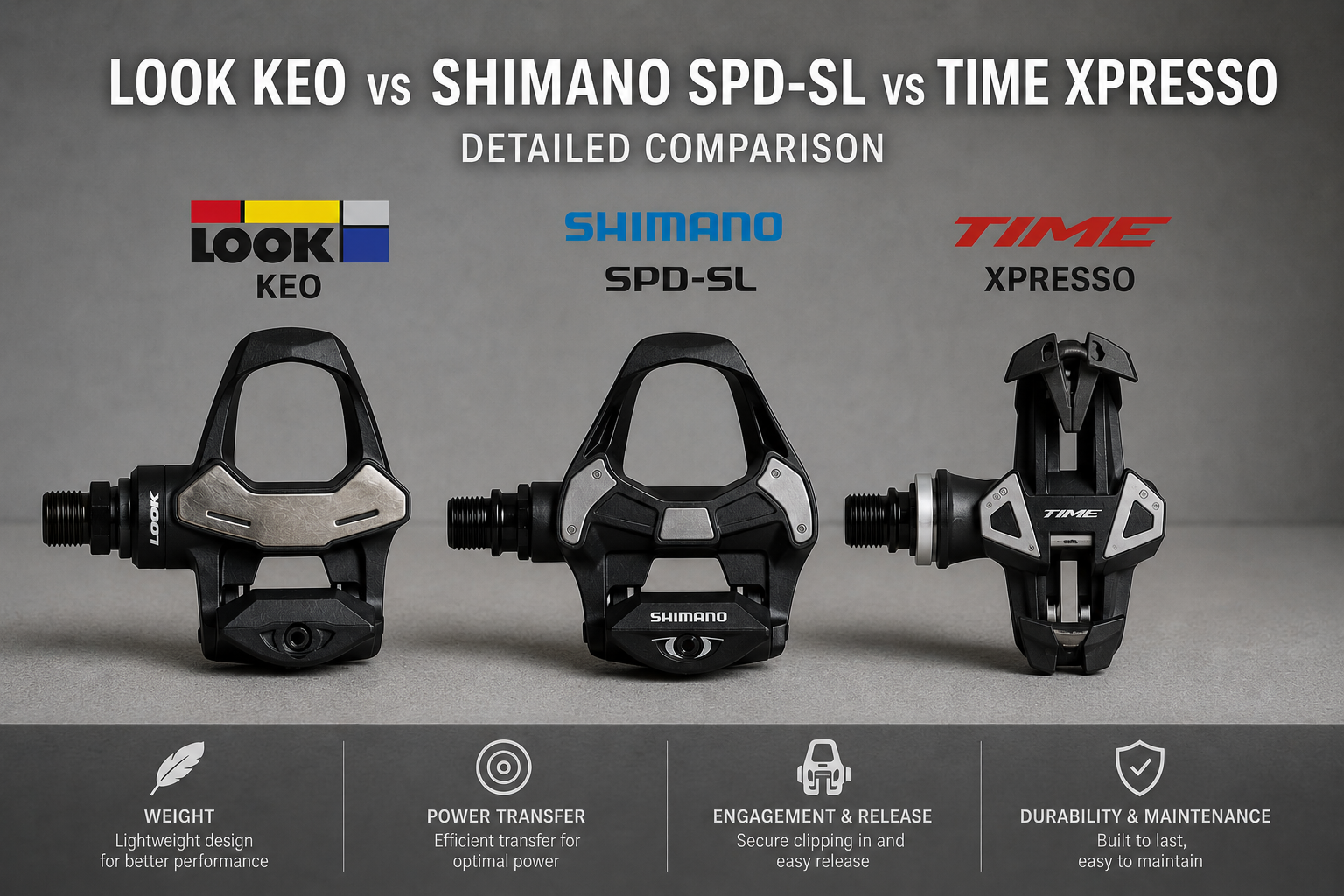
Look, Shimano and Time remain the three historic brands in the road clipless pedal market, and each has made a different design choice: Look focuses on support surface, Shimano on universal standardization, and Time on angular float and joint comfort. None of the three is objectively better than the others in absolute terms: the right choice mainly depends on your cycling profile and priorities. This comparison examines each criterion one by one to help you make your choice.
For general criteria when choosing road pedals (weight, threading, maintenance), see our complete road bike pedal guide.
1. The three philosophies at a glance
Before going into detail on each criterion, here is an overview of the three systems.
| Criterion | Look Keo | Shimano SPD-SL | Time Xpresso |
|---|---|---|---|
| Philosophy | Retention and large support surface | Standardization and durability | Angular float and joint comfort |
| Cleat angular float | 0°, 4.5° or 9° depending on the cleat | 0°, 2° or 6° depending on the cleat | Built-in natural float |
| Key strength | Stiff feel when sprinting | Wide availability and widespread adoption | Long-distance comfort |
Key takeaway: in a nutshell, Look prioritizes retention, Shimano universal standardization, and Time joint comfort. Each section below explains why, and to what extent this distinction holds true in real-world use.
2. Retention and support surface
Look Keo stands out with a wide platform beneath the cleat, maximizing the contact surface between the shoe and the pedal. This design promotes a stiff feel and direct power transfer, particularly appreciated during sprints or high-intensity efforts out of the saddle.
Shimano SPD-SL uses a slightly more restricted support surface, but this is offset by a design that has been proven over numerous generations of groupsets, providing a reliable and consistent feeling of support, without surprises, regardless of the range selected.
Time Xpresso uses a thinner cleat than its two competitors, in line with its angular-float philosophy: priority is given to freedom of movement rather than maximum support stiffness. This can result in a slightly less "direct" feel during all-out sprints, without being a disadvantage for the vast majority of riding applications.
3. Angular float and joint comfort
This is the most significant differentiating factor between the three brands. Look Keo and Shimano SPD-SL each offer several interchangeable cleats depending on the desired amount of angular float: from 0° (fixed position) up to 9° with Look or 6° with Shimano for more pronounced float. Time Xpresso, on the other hand, incorporates natural float directly into the design of its asymmetric cleat, without requiring you to choose between several references depending on the desired degree of freedom.
This criterion has a direct impact on joint comfort, particularly for cyclists who have already experienced knee tension. We cover this subject in detail, across all brands, in our article knee pain in road cycling: the role of pedals and cleats, which is worth reading if this is your main priority when choosing a system.
4. Weight and aerodynamics
At entry-level and mid-range levels, the three brands offer fairly similar weights, with differences mainly determined by the materials used for the pedal body (composite or aluminum). The differences become more noticeable at the high end: the carbon versions from each brand (Look Keo Blade Carbon, Shimano Dura-Ace SPD-SL, Time Xpro or Xpresso 15) all aim to reduce weight to a similar extent, using carbon blades and titanium axles or advanced composite materials.
Aerodynamics remains a secondary consideration for road pedals compared with the frame, wheels or rider position: all three brands have optimized the profiles of their high-end models, but the actual difference between them on this specific criterion remains marginal for the vast majority of riding applications.
5. Price and parts availability
On the new-bike market, prices remain broadly comparable between the three brands at equivalent performance levels. Differences are more noticeable when it comes to parts availability, particularly replacement cleats. Shimano benefits from very widespread use on new bicycles for many years, resulting in strong availability on the used market and for spare parts. Look follows a similar pattern, with generally good availability.
Time, although less widely represented as original equipment on current new bikes, remains reasonably well represented on the used market, particularly with the Iclic generation, which is still widely in circulation, although the choice of references is somewhat more limited than with its two competitors.
6. Shoe and cleat compatibility
Good news for anyone hesitating between the three brands: Look Keo, Shimano SPD-SL and Time Xpresso all use a 3-bolt cleat mounting system on the sole, a standard shared by almost all road cycling shoes on the market.
| System | Number of mounting holes | Shoe compatibility |
|---|---|---|
| Look Keo | 3-bolt | Any road cycling shoe using the 3-bolt standard |
| Shimano SPD-SL | 3-bolt | Any road cycling shoe using the 3-bolt standard |
| Time Xpresso | 3-bolt | Any road cycling shoe using the 3-bolt standard |
This 3-bolt standard is different from the 2-bolt system (such as SPD) used on MTB pedals and some urban cycling pedals, which is not compatible with the road cleats discussed here.
7. Which system is best for which type of cyclist?
- Beginner or budget-conscious cyclist: all three brands offer reliable entry-level options at reasonable prices; availability on the used market, often greater for Shimano and Look, can influence the choice just as much as the brand itself.
- Regular recreational cyclist: all three systems are suitable. The choice then mainly comes down to your preferred feeling of retention (firmer with Look, more versatile with Shimano, more flexible with Time) rather than objective performance criteria.
- Racer or sprinter: the large support surface of Look Keo or the proven reliability of Shimano SPD-SL are often preferred for the feeling of stiffness during sprints and out-of-the-saddle efforts.
- Cyclist with joint sensitivity: the built-in float of Time Xpresso is a genuine technical advantage, which we explore further in our dedicated article on knee pain in road cycling.
None of these profiles is exclusive: the same cyclist can easily switch from one system to another as their riding evolves, without this calling their previous choices into question.