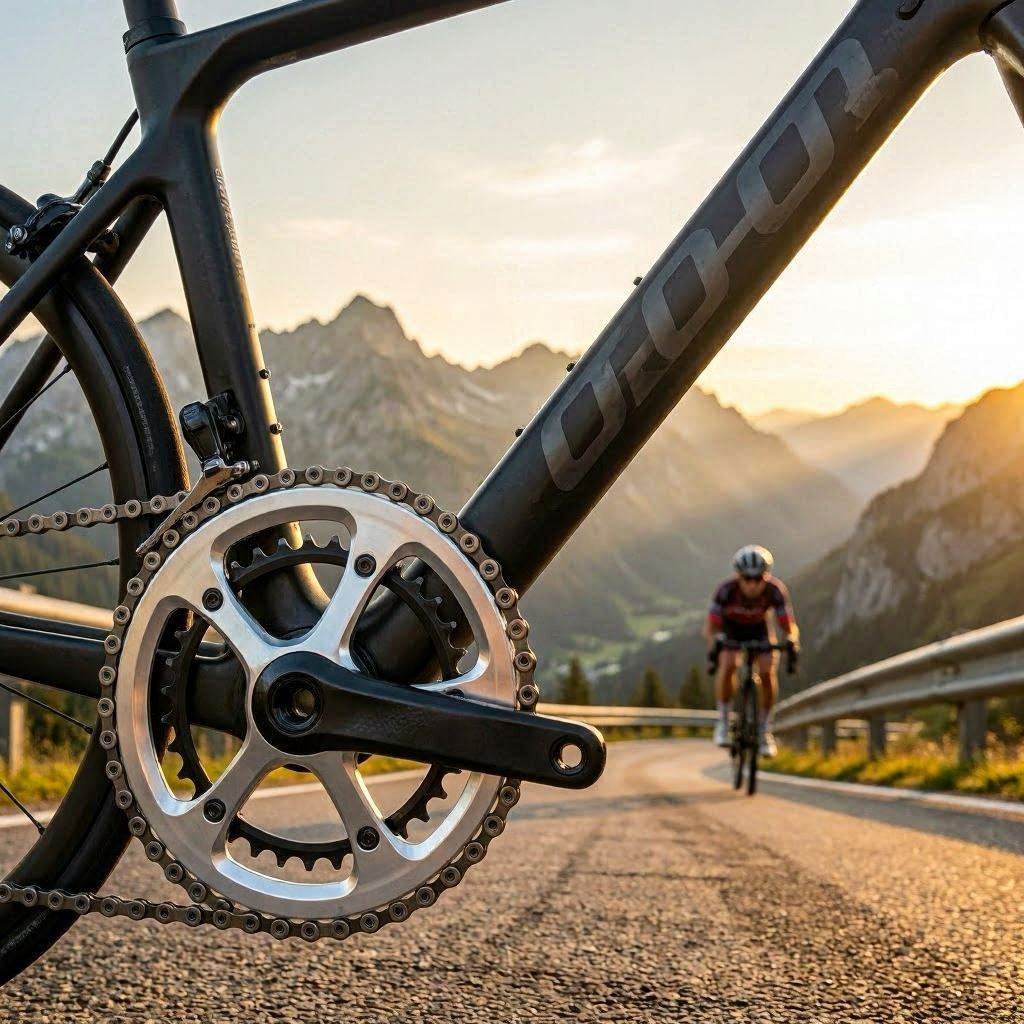
The compact 50/34 chainring setup has become the standard configuration on the vast majority of modern road bikes. It has almost entirely replaced the old double 53/39 standard by offering more accessible gearing — essential for mountain riding, long-distance rides and cyclists who are not professional sprinters. But what exactly is a compact chainring? Is it right for you? And how do you choose between Shimano, SRAM, Stronglight and the rest?
This guide answers all those questions: definition, real-world gear developments, rider profiles, a brand comparison of the best road bike chainrings available, and fitting advice.
1. What is a compact 50/34 chainring?
A compact crankset is fitted with two chainrings: a 50-tooth outer ring and a 34-tooth inner ring. The gap between the two (16 teeth) is larger than on the old double standard (53/39, a 14-tooth gap), which amplifies the difference in gear development between the two chainrings.
All modern compact chainrings use the 110 mm 4-arm BCD — the universal standard for road cranksets since 2012 (Shimano, SRAM, Campagnolo compact). It is also this BCD that makes it possible to go as low as 34 teeth: with the old 130 mm 5-arm standard, the minimum tooth count was 38 T. For more on this key parameter, see our guide to road bike chainring BCD.
Key point: a compact chainring is not a single chainring — it is a configuration of two chainrings (50 T + 34 T). In practice, both chainrings can be bought and replaced separately. You can order just the outer ring (50 T) or just the inner ring (34 T) depending on which one is worn.
2. Real gear developments: what can you do with a 50/34?
Gear development is the distance travelled per pedal revolution in a given gear. It depends on the chainring, the sprocket and the wheel circumference (approximately 2.096 m for a 700×25 C tyre).
| Chainring / Sprocket | 11 T | 13 T | 15 T | 19 T | 25 T | 28 T | 32 T |
|---|---|---|---|---|---|---|---|
| 50 T (outer ring) | 9.52 m | 8.06 m | 6.99 m | 5.52 m | 4.19 m | 3.74 m | 3.27 m |
| 34 T (inner ring) | 6.48 m | 5.49 m | 4.76 m | 3.75 m | 2.85 m | 2.54 m | 2.23 m |
Developments in metres per pedal revolution (700×25 C tyre, 2096 mm circumference). Green = extreme gear ratios. Yellow = very easy climbing gears.
What this means in real speed at 90 rpm
- 50 T × 11 T → 9.52 m/rev × 90 rpm = 51.4 km/h — sufficient for fast descents and sprint finishes
- 50 T × 15 T → 6.99 m/rev × 90 rpm = 37.7 km/h — typical flat road cruising pace
- 34 T × 25 T → 2.85 m/rev × 90 rpm = 15.4 km/h — accessible mountain col climbing
- 34 T × 32 T → 2.23 m/rev × 90 rpm = 12.0 km/h — very steep climb, equivalent to a triple chainset
Good to know: the 34 T + 32 T combination gives a development of 2.23 m — virtually identical to the lowest gear of a traditional triple chainset. This pairing makes high-mountain cols accessible without ever feeling like you are spinning in thin air.
3. Who is the compact 50/34 chainring for?
| Profile | Compact 50/34 suitable? | Why |
|---|---|---|
| Beginner or returning cyclist | ✅ Ideal | Accessible easy gears, no getting stuck on climbs |
| Sportive cyclist, long rides | ✅ Very well suited | Versatility on flats and mountains without sacrificing speed |
| Climber, living in a hilly area | ✅ Recommended | 34 T + big cassette = cols accessible at any power level |
| Triathlete, long solo efforts | ✅ Good choice | 50 T adequate on the bike leg, 34 T useful on rolling courses |
| Cyclist riding mainly on the flat | ⚠️ Semi-compact 52/36 preferable | 52 T gives more development without sacrificing climbs |
| Sprinter, criterium competitor | ❌ Standard 53/39 or semi-compact | 50 T may limit at very high sprint speeds |
| Cyclist with knee pain | ✅ Suitable (+ oval recommended) | Easier gearing reduces joint stress |
4. Compact 50/34 vs semi-compact 52/36 vs standard 53/39
There are three main double chainring configurations for road bikes. Here are their concrete differences:
| Configuration | Outer ring | Inner ring | BCD | Max speed (90 rpm, 11 T) | Min speed (90 rpm, 32 T) | Ideal profile |
|---|---|---|---|---|---|---|
| Compact | 50 T | 34 T | 110 mm | 51.4 km/h | 12.0 km/h | Beginners, climbers, sportive riders |
| Semi-compact | 52 T | 36 T | 110 mm | 53.5 km/h | 12.7 km/h | Experienced sportive riders, rouleurs |
| Standard | 53 T | 39 T | 130 mm | 54.6 km/h | 13.8 km/h | Competitors, sprinters |
Speeds calculated on 700×25 C tyres. Green row = best choice for the majority of sportive cyclists.
Key point: the difference in maximum speed between a compact (51.4 km/h) and a standard (54.6 km/h) is 3.2 km/h at 90 rpm. In practice, this gap is rarely noticeable for cyclists who do not regularly sprint above 50 km/h. The difference in minimum development, however, is crucial for mountain cols and long climbs.
5. Shimano compact chainrings
Shimano has offered compact chainrings across its entire road range since 2012. All share the same 110 mm 4-arm BCD, making them interchangeable with one another.
Shimano 105 — compact chainring
The market benchmark for value and availability. The Shimano 105 compact is available everywhere, at low cost, and offers solid durability with 6061 alloy. The HG tooth profile is optimised for fast, quiet shifting. Available separately (50 T outer ring or 34 T inner ring), allowing you to replace only the worn chainring.
Strengths: unbeatable price, universal availability, compatible with all Shimano cranksets post-2012.
Limits: 6061 alloy is heavier and slightly less wear-resistant than the 7075 used in the Ultegra.
Ideal for: any cyclist looking for a reliable, economical replacement.
Shimano Ultegra — compact chainring
The best value in the Shimano range. CNC-machined 7075 alloy brings a noticeable weight saving (~10 g on the outer ring) and better wear resistance. Tooth profiles are identical to the 105 but machining quality is superior — you feel it in the smoothness of front shifts on long climbs where chainring changes are frequent.
Strengths: superior durability, precise machining, optimised weight, perfect availability.
Limits: slightly more expensive than 105; the performance gain is barely perceptible for non-competitive riders.
Ideal for: regular sportive cyclists who want the best from Shimano without Dura-Ace pricing.
6. SRAM compact chainrings
SRAM also offers a compact 50/34 range on its mechanical groupsets (110 mm BCD, compatible with Shimano). Note: SRAM AXS groupsets use a different 107 mm BCD — AXS compact chainrings are not 50/34 but 46/33 or 48/35 depending on the model.
SRAM AXS warning: if you have a SRAM AXS groupset (Rival AXS, Force AXS, Red AXS), your crankset uses 107 mm DUB BCD. Replacement compact chainrings are different from 110 mm models — check your crankset BCD before ordering. See our guide to chainring BCD.
SRAM Rival / Force compact (mechanical)
Compatible with 110 mm BCD Shimano cranksets: a SRAM Rival compact chainring can replace a Shimano 105 compact and vice versa. The Yaw tooth profile is optimised for the SRAM front derailleur but works perfectly with a Shimano derailleur. Availability is slightly lower than Shimano through general distributors.
Strengths: universal 110 mm compatibility, good value.
Limits: lower availability, more often sold bundled with the crankset than individually.
Ideal for: cyclists with a mechanical SRAM groupset or seeking an alternative to Shimano.
7. Third-party alternatives: Stronglight, Spécialités TA, Rotor
Third-party brands are often overlooked but sometimes offer the best value on the market — and above all a much wider choice of tooth counts than OEM brands. Useful if you want a 48 T, 46 T or even a 32 T inner ring.
Stronglight & Spécialités TA — compact
These historic French brands offer 7075 CNC alloy chainrings of comparable quality to Shimano Ultegra, for a price typically 30–40% lower. Their key advantage: an unrivalled range of tooth counts. You can find inner rings of 30, 32, 33, 34, 36 or 38 T, and outer rings of 44, 46, 48, 50 or 52 T — tooth counts simply unavailable from OEM brands. Compatibility with Shimano, SRAM and Campagnolo 110 mm cranksets is explicitly documented.
Strengths: best value on the market, widest tooth count range, premium 7075 quality.
Limits: less visible in mainstream retail, available mainly through specialist cycle shops.
Ideal for: any cyclist seeking a specific tooth count (e.g. 48/32 or 50/32) or the best value for money.
Rotor Q-Rings compact — oval 50/34 chainring
Rotor is the world reference for oval chainrings. Its Q-Rings are available in compact configuration (50 T and 34 T) with 110 mm BCD, directly compatible with Shimano and mechanical SRAM cranksets. The 10% ovality improves pedalling fluidity on climbs and reduces joint stress — a particularly noticeable benefit on mountain cols with the 34 T inner ring. For the full picture on oval chainrings, see our article on oval road bike chainrings.
Strengths: improved pedalling smoothness, reduced knee pain, 110 mm compatible.
Limits: higher price, 2–4 week adaptation period required, OCP setting to perform.
Ideal for: climbers, triathletes, cyclists suffering from joint pain.
8. Full comparison table
| Brand / Model | BCD | Material | Weight OR (50 T) | Available tooth counts | Price / ring | Avail. |
|---|---|---|---|---|---|---|
| Shimano 105 MID | 110 mm 4-arm | 6061 alloy | ~95 g | 34, 36, 38, 50, 52 T | €20–40 | ⭐⭐⭐⭐⭐ |
| Shimano Ultegra HIGH | 110 mm 4-arm | 7075 CNC alloy | ~85 g | 34, 36, 38, 50, 52 T | €40–70 | ⭐⭐⭐⭐⭐ |
| Shimano Dura-Ace TOP | 110 mm 4-arm | 7075 alloy / Carbon | ~60–70 g | 34, 36, 50, 52, 54 T | €80–150 | ⭐⭐⭐⭐ |
| SRAM Rival/Force MID | 110 mm 4-arm | 6061 alloy | ~95 g | 34, 36, 50, 52 T | €25–55 | ⭐⭐⭐⭐ |
| Stronglight / TA MID | 110 mm 4-arm | 7075 CNC alloy | ~85–100 g | 30–38 T (IR), 44–52 T (OR) | €15–60 | ⭐⭐⭐⭐ |
| Rotor Q-Rings HIGH | 110 mm 4-arm | 7075 CNC alloy | ~90 g | 34, 36, 50, 52 T (oval) | €65–120 | ⭐⭐⭐⭐ |
OR = outer ring · IR = inner ring · Green rows = best value for money in each category.
9. Compatibility and fitting
What to check before buying
- Crankset BCD: all modern compact cranksets use 110 mm 4-arm BCD. If your crankset is older (130 mm 5-arm), a 34 T inner ring is not possible — see our guide to road bike chainring BCD.
- Number of speeds: an 11-speed chainring may not be compatible with a 12-speed chain. Always check the chainring datasheet.
- Front derailleur: confirm your derailleur accepts a 50 T outer ring (virtually all modern derailleurs do). If you are switching from a 53 T to a 50 T, a minor cage height adjustment may be needed.
- Cassette: to get the most out of the 34 T in the mountains, pair it with a cassette with a largest sprocket of 28, 30 or 32 T.
Do I need to replace both chainrings at the same time?
No, unless both are worn simultaneously. The outer ring (50 T) wears faster because it is used constantly on the flat. The inner ring (34 T) wears more slowly as it is only engaged on climbs or at low speed. In practice, you will often replace the outer ring 2 to 3 times before needing to change the inner. Use each chain replacement as an opportunity to inspect the tooth condition on both rings.
Practical tip: to check chainring wear, look at the tooth profile head-on. Symmetrical and pointed teeth = chainring in good condition. Hook-shaped or shark-fin teeth (asymmetric, leaning to one side) = chainring to replace. A worn chain accelerates chainring wear significantly — replace your chain every 2,000 to 3,000 km to extend the life of your chainrings. See also our guide on when to replace a road bike chainring.
10. FAQ — Compact 50/34 road bike chainring
Road bike chainring guides — further reading
- Road bike chainring — full category
- How and when to replace a road bike chainring
- Double or triple road bike chainring: which to choose?
- Road bike chainring BCD: complete guide
- Oval road bike chainring: advantages and compatibility
- Shimano, SRAM or Campagnolo: which to choose?
- Bike gear ratio calculation and gear ratio chart
- How to recognize wear on a road bike chainring ?
- Road bike crankset