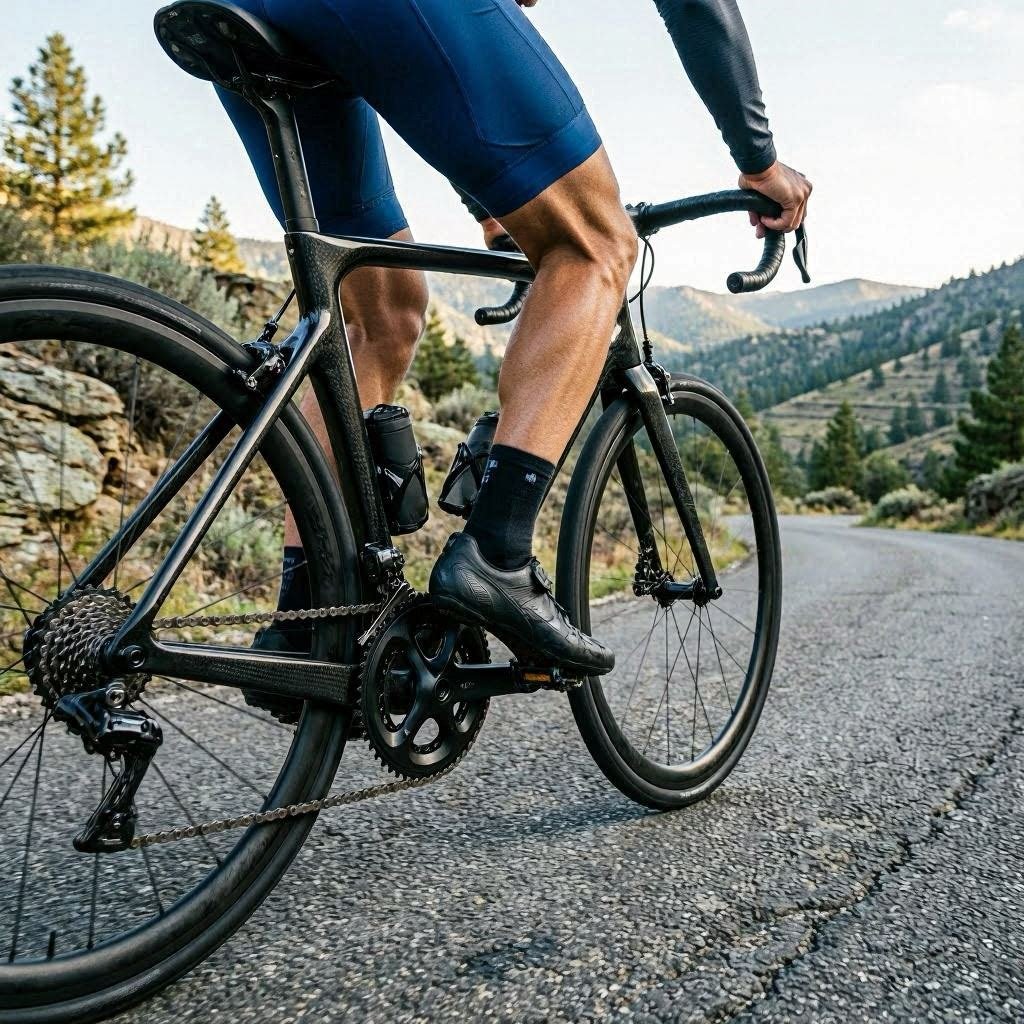
The oval road bike chainring has divided cyclists for decades. After an early wave of enthusiasm in the 1980s with Shimano Biopace, oval chainrings made a strong comeback in 2012 when Bradley Wiggins and Christopher Froome won the Tour de France using Osymetric chainrings. Since then, every season has reignited the debate: marketing gimmick or real biomechanical advantage?
The truth, as often, is more nuanced than advertising claims. Oval chainrings don’t perform miracles, but they do offer real benefits for certain cyclist profiles — and none for others. This guide explains how they work, what they bring on the road, and how to know if they are right for you.
1. How does an oval chainring work?
To understand oval chainrings, we must first look at pedal stroke mechanics. Power output is not constant during a full rotation. It is highest when the cranks are horizontal, where leg force is most effectively applied. It drops near zero when the cranks are vertical — the so-called dead spots.
A round chainring applies constant resistance throughout the rotation. An oval chainring instead adapts resistance to the rider’s natural power output, easing through dead spots by reducing effective radius and increasing leverage where power is highest. The result is smoother pedalling and more even force distribution.
Ovality levels: from 10% to 20%
| Model | Brand | Ovality | Recommended cadence | Ideal rider profile |
|---|---|---|---|---|
| Q-Rings | 10 % (+5 % / −5 %) | 10% | From 70 rpm | All-round cyclists, climbers, triathletes |
| QXL | 16 % | 16% | 80–90+ rpm | High-cadence riders |
| TwinCam | Profil extrême (~17–20 %) | ~17–20% | 90–100+ rpm | Elite and powerful riders |
The more pronounced the ovality, the stronger the effect — but also the higher the required cadence.
2. Benefits of oval chainrings on the road
Smoother pedalling and reduced fatigue
Most users report not higher speed, but improved comfort. Smoother cadence reduces muscular and joint strain, especially over long distances.
An advantage in climbing
In climbs, cadence naturally drops. Oval chainrings help smooth power delivery through dead spots, making sustained climbing feel more efficient.
Lower joint stress
By reducing peak force at critical angles, oval chainrings may reduce knee and hip stress for some riders.
Ideal for triathlon and solo efforts
Steady-state efforts benefit most from ovalization, making it popular in triathlon and time trials.
3. Drawbacks and limitations
Scientific debate
Performance gains remain debated. Manufacturer studies often lack independent validation, while academic work (e.g. from Franche-Comté University) suggests highly individual results.
Adaptation period
Expect 2–4 weeks of adjustment before feeling fully comfortable.
More demanding setup for extreme ovality
Highly oval profiles may require careful front derailleur tuning and can produce chain noise at low cadence.
Higher cost
Oval chainrings are generally more expensive than standard models or Shimano-compatible round chainrings.
4. Oval vs round chainrings
| Riding profile | Oval chainring | Round chainring |
|---|---|---|
| Climbers | Recommended | Works well |
| Triathletes | Recommended | Works well |
| Long-distance riders | Often beneficial | Works well |
| High-cadence cyclists | Try it | Very good |
| Group riding | Limited benefit | Better suited |
| Sprinters | Not ideal | Recommended |
In summary: if you ride a lot solo, enjoy the mountains, already have a decent cadence, and are looking to improve your comfort over longer distances, an oval chainring is definitely worth considering. If you frequently vary your pace, are a sprinter, or are new to road cycling, a good quality round road bike chainring will be more suitable.
5. Compatibility checks
Before buying, check:
BCD (bolt circle diameter)
Most common standards are 110 mm and 130 mm. Compatibility is essential.
Drivetrain speed
Ensure compatibility with 10, 11 or 12-speed systems from Shimano, SRAM or Campagnolo.
Front derailleur setup
Moderate ovality usually works with standard setups; extreme profiles may require fine tuning.
6. Main oval chainring brands
Rotor — the accessible benchmark
Most popular and accessible option, especially Q-Rings (10% ovality).
Osymetric — the pros choice
Highly pronounced ovality used by elite riders, including Tour de France winners.
AbsoluteBLACK — the competition alternative
Lightweight CNC-machined performance-oriented chainrings.
Stronglight BioConcept — accessible oval
Accessible entry-level oval chainrings.
A French pioneer in oval chainrings for cyclists, Stronglight offers the BioConcept with a moderate profile and a more accessible price point than Rotor. A good starting point for trying out oval chainrings without a significant financial commitment.
FAQ — Oval road chainrings
Conclusion
Oval chainrings are not a universal revolution, but a useful tool for specific riders: climbers, triathletes and endurance cyclists. For most users, Q-Rings remain the most versatile entry point.
For others, a high-quality round chainring remains the most rational choice.