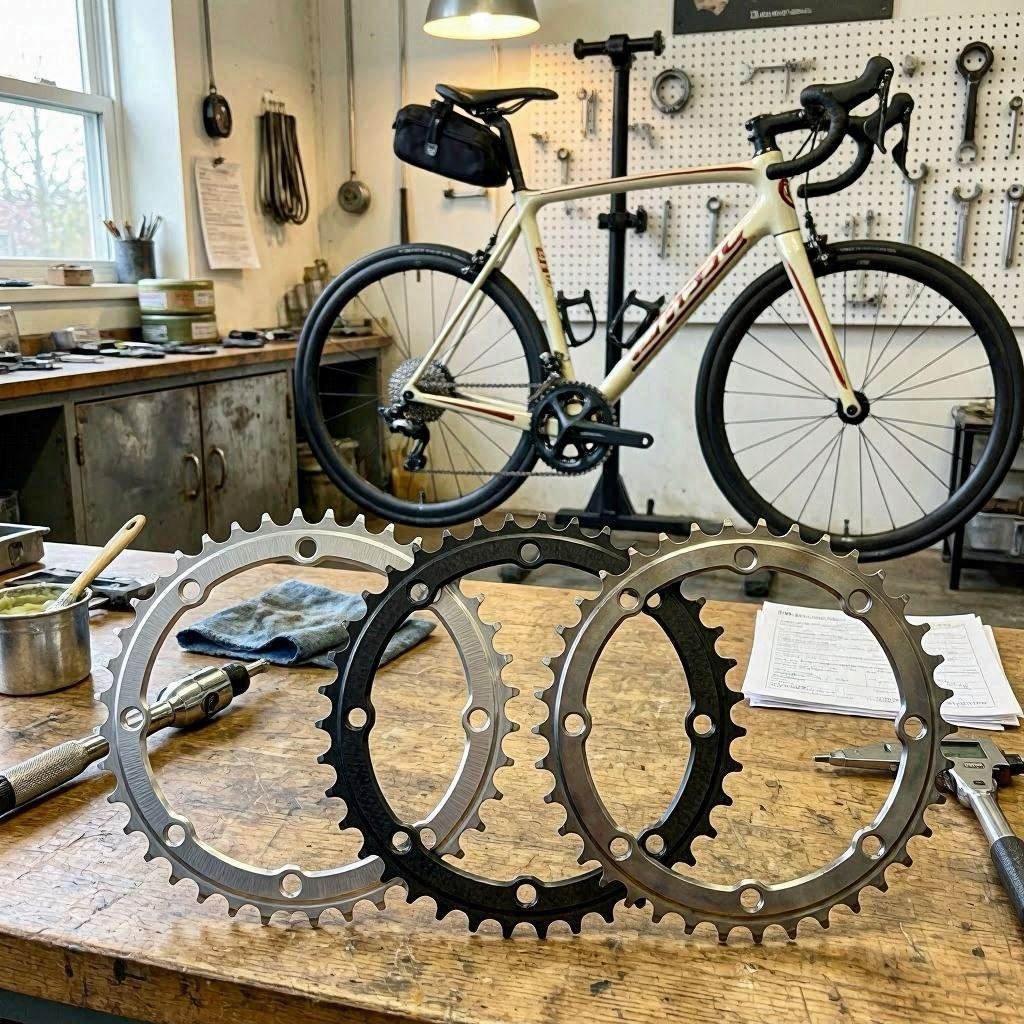
Your road bike chainring is worn and needs replacing. You can stick with the original brand — or switch to an alternative. But between Shimano, SRAM, Campagnolo and third-party manufacturers, how do you find your way? Choosing a chainring comes down to more than just the BCD: material, weight, available tooth counts, unit price and availability all play a role.
This comparison focuses exclusively on the chainring itself — not the complete groupset. That is precisely the information missing from most websites: real-world specs, weight to the gram, price per unit, and which range suits which rider profile.
1. What to compare before choosing a chainring
Five criteria determine the choice of a replacement chainring. They must be checked in order — the first two are absolute deal-breakers:
- BCD and number of arms — the absolute constraint. If the BCD does not match, the chainring will not fit. See our complete guide to road bike chainring BCD.
- Number of speeds — an 11-speed chainring is not interchangeable with a 12-speed chain.
- Required tooth count — OEM brands do not always cover intermediate tooth counts.
- Material — aluminium 6061 (entry-level), 7075 (mid/high), carbon (competition).
- Budget — from €15 (basic aluminium) to €200 (high-end carbon).
Key point: Shimano mechanical and SRAM mechanical chainrings (110 mm BCD, 4-arm) are interchangeable. SRAM AXS chainrings (107 mm BCD) form a separate standard, incompatible with all others. Campagnolo chainrings are not compatible with standard Shimano/SRAM cranksets.
2. Shimano road chainrings
Shimano is the dominant manufacturer — more than 3 in 4 road bikes are spec'd with it. Its philosophy: high-quality machined aluminium, maximum spare parts availability, and a clear range hierarchy. All Shimano road cranksets since 2012 use the 110 mm 4-arm BCD, which greatly simplifies replacement.
Shimano 105
The undisputed benchmark for the all-round cyclist. The 6061 alloy is not as light as 7075, but reliability and durability are solid. Spare parts availability is excellent worldwide. Compatible with all Shimano cranksets post-2012 and all 110 mm SRAM mechanical cranksets.
Strengths: unbeatable price, universal availability, straightforward replacement.
Limits: heavier than Ultegra, 6061 alloy wears faster than 7075.
Ideal for: regular cyclists looking for reliable, budget-friendly replacement.
Shimano Ultegra
CNC-machined 7075 aluminium delivers a noticeable weight saving (~10 g on a 50 T ring) and better wear resistance than the 105. The Ultegra is the choice of the vast majority of serious sportive cyclists: it delivers performance close to Dura-Ace for less than half the price.
Strengths: the best value in the Shimano range, highly durable 7075 alloy.
Limits: slightly more expensive than 105, though the performance gap justifies it.
Ideal for: regular sportive cyclists, long-distance enthusiasts, riders in training.
Shimano Dura-Ace
The pinnacle of the Shimano range, used in the World Tour. Carbon versions weigh under 65 g for a 50 T ring — a real saving over the Ultegra, but at a significantly higher price. Spare parts availability is good but lower than the 105 or Ultegra. R9200 models (12s) are slightly harder to source than R9100 (11s).
Strengths: minimum weight, cutting-edge technology, premium look.
Limits: high price, carbon more vulnerable to impacts, availability varies by tooth count.
Ideal for: competitors, lightweight climbers, riders who want the best from Shimano.
3. SRAM road chainrings
SRAM is the market innovator. The American brand popularised the single chainring on road bikes and introduced a new BCD standard with its AXS groupsets. Critical point: SRAM mechanical groupsets (110 mm BCD) and AXS groupsets (107 mm BCD) use mutually incompatible standards. Always check your groupset BCD before ordering.
Warning: if your groupset is SRAM AXS (Rival AXS, Force AXS, Red AXS), your crankset uses a 107 mm DUB BCD — incompatible with 110 mm chainrings. A Shimano or mechanical SRAM chainring will not fit. See our guide to chainring BCD to identify your standard.
SRAM Rival / Force (mechanical)
SRAM mechanical chainrings share the 110 mm BCD with Shimano: they are interchangeable with the entire Shimano 105 / Ultegra / Dura-Ace modern range. Their tooth profile (Yaw Technology) is optimised for quiet shifting with a SRAM chain, but also works with Shimano chains. Spare parts availability is slightly lower than Shimano.
Strengths: universal 110 mm compatibility, good value for money.
Limits: spare parts availability slightly lower than Shimano.
Ideal for: cyclists with a mechanical SRAM groupset seeking an OEM or alternative tooth count replacement.
SRAM Red (mechanical)
The lightest chainring in the SRAM mechanical range, available in heavily lightened 7075 alloy or carbon. 110 mm BCD compatible, it fits any Shimano or mechanical SRAM crankset. Spare parts availability is more limited than the lower ranges — often sold bundled with the crankset rather than as a standalone part.
Strengths: among the lowest weights in the mechanical segment, premium finish.
Limits: limited availability, high price for a mechanical chainring.
Ideal for: competitors using an 11s SRAM mechanical groupset.
SRAM Rival / Force / Red AXS
AXS chainrings use the 107 mm DUB BCD — a SRAM-exclusive standard incompatible with all 110 mm chainrings. In return, SRAM offers an extended tooth count range (33 to 54 T depending on the model) and some of the lowest weights on the market. Always identify your exact groupset before ordering: a Rival AXS is a different product from a mechanical Rival despite the similar name.
Strengths: minimum weight, extended tooth count range, cutting-edge technology.
Limits: incompatible with 110 mm, high price, replacement restricted to 107 mm chainrings only.
Ideal for: cyclists running a SRAM AXS groupset only.
4. Campagnolo road chainrings
Campagnolo has embodied Italian excellence since 1933. Its chainrings stand out for manufacturing quality, premium materials and attention to aesthetics. The brand is however more at home in the world of competition than in everyday replacement — lower availability and higher prices than Shimano at equivalent spec levels.
Good to know: Campagnolo uses two different BCD standards depending on the crankset generation. Standard 5-arm cranksets (older generation) use 135 mm BCD — incompatible with Shimano/SRAM. Compact 4-arm cranksets (post-2008) use 110 mm BCD — potentially compatible with Shimano/SRAM with care. Identify your generation before any order.
Campagnolo Chorus
The Chorus is the entry point to Campagnolo quality: carefully machined 7075 alloy, flawless finish and legendary durability. The tooth count range (34 to 50 T) is slightly narrower than Shimano. Availability through specialist retailers is reasonable, but lower than Shimano at general retailers. An excellent chainring for riders loyal to the Italian brand.
Strengths: superior build quality, exceptional durability, refined aesthetics.
Limits: maximum tooth count limited to 50 T, narrower availability, pricier than Shimano Ultegra.
Ideal for: Campagnolo-equipped cyclists who refuse to compromise on quality.
Campagnolo Record & Super Record
The Record and especially the Super Record represent the pinnacle of Italian drivetrain engineering — carbon versions weigh under 60 g for a 50 T ring. In competition, these chainrings are used by World Tour teams equipped with Campagnolo. Their spare parts availability is the lowest in this comparison: sourced primarily through authorised Campagnolo dealers.
Strengths: exceptional weight, prestige finish, competition-level performance.
Limits: very high price, limited availability, rarely found in immediate stock.
Ideal for: competitors on a high-end Campagnolo groupset, collectors.
5. Third-party alternatives: Stronglight, Spécialités TA, Rotor
OEM brands do not always offer the intermediate tooth counts you need (38 T, 44 T…), and their high-end pricing can be off-putting. That is where third-party manufacturers come in — often more accessible, sometimes superior in value for money.
Stronglight, Spécialités TA & Miche
Stronglight and Spécialités TA are the two historic French chainring brands. Their ranges cover 110 mm and 130 mm BCD with a tooth count choice that often exceeds OEM brands — especially for intermediate tooth counts (32 T, 34 T, 36 T, 38 T, 40 T…) and legacy standards. CNC 7075 alloy machining quality is comparable to Shimano Ultegra for a price typically 30–40% lower.
Strengths: best value for money on most tooth counts, unrivalled tooth count range, compatibility with Shimano/SRAM/Campagnolo explicitly documented.
Limits: less well-known than Shimano, available mainly through specialist cycle retailers.
Ideal for: any cyclist seeking a tooth count unavailable from an OEM brand, or wanting the best value for money.
Rotor — oval chainring specialist
Rotor is the world reference for oval road chainrings. Its Q-Rings (10% ovality) and QXL (16%) are available in 110 mm BCD (compatible Shimano/SRAM mechanical), 107 mm (compatible SRAM AXS) and 130 mm (older generation). It is one of the very few brands covering all three road standards with oval chainrings — see our full article on oval road bike chainrings.
Strengths: only oval manufacturer covering 110/107/130 mm, impeccable quality.
Limits: higher price than equivalent round chainrings, adaptation period required.
Ideal for: climbers, triathletes, cyclists experiencing knee pain.
6. Full comparison table
| Brand / Range | BCD | Material | Weight (50 T) | Tooth counts | Indicative price | Avail. |
|---|---|---|---|---|---|---|
| Shimano 105 MID | 110 mm 4-arm | 6061 alloy | ~95 g | 34–52 T | €20–40 | ⭐⭐⭐⭐⭐ |
| Shimano Ultegra HIGH | 110 mm 4-arm | 7075 CNC alloy | ~85 g | 34–52 T | €40–70 | ⭐⭐⭐⭐⭐ |
| Shimano Dura-Ace TOP | 110 mm 4-arm | Alloy / Carbon | ~60–70 g | 34–54 T | €80–150 | ⭐⭐⭐⭐ |
| SRAM Rival/Force mech. MID | 110 mm 4-arm | 6061 alloy | ~95 g | 34–52 T | €25–55 | ⭐⭐⭐⭐ |
| SRAM Red mech. HIGH | 110 mm 4-arm | 7075 alloy / Carb. | ~70–80 g | 34–52 T | €70–130 | ⭐⭐⭐ |
| SRAM AXS (DUB) TOP | 107 mm 4-arm | Alloy / Carbon | ~55–75 g | 33–54 T | €90–180 | ⭐⭐⭐⭐ |
| Campagnolo Chorus HIGH | 110 mm 4-arm | Premium 7075 alloy | ~90 g | 34–50 T | €50–90 | ⭐⭐⭐ |
| Campagnolo Record/SR TOP | 110 mm 4-arm | Alloy / Carbon | ~55–75 g | 34–52 T | €100–200 | ⭐⭐ |
| Stronglight / TA MID | 110 / 130 mm | 7075 CNC alloy | ~80–100 g | 32–53 T | €15–60 | ⭐⭐⭐⭐ |
| Rotor Q-Rings HIGH | 107 / 110 / 130 mm | 7075 CNC alloy | ~75–95 g | 34–54 T | €65–130 | ⭐⭐⭐⭐ |
⭐ = spare parts availability. Green rows = best value for money in each category.
7. Which chainring for your rider profile?
| Profile / Use | Recommendation | Why |
|---|---|---|
| Tight budget (≤ €30) Leisure riding, routine maintenance |
Shimano 105 or Stronglight/TA | Proven reliability, maximum availability, minimum price |
| Regular sportive cyclist 2–4 rides/week, long distances |
Shimano Ultegra R8000/R8100 | 7075 alloy, optimal weight/durability, excellent availability |
| Competitor / climber Racing, events, weight-conscious |
Shimano Dura-Ace or SRAM Red AXS | Minimum weight, cutting-edge technology |
| Knee pain / mountain climber | Rotor Q-Rings (oval) | 10% ovality, reduced joint stress |
| Tooth count unavailable from OEM (e.g. 38 T, 44 T, 46 T) |
Stronglight or Spécialités TA | Widest tooth count range on the market, unbeatable value |
| Campagnolo loyalist Chorus / Record / Super Record crankset |
Campagnolo Chorus or Spécialités TA | Italian quality or certified third-party alternative |
| Running SRAM AXS | SRAM AXS DUB or Rotor (107 mm) | Only chainrings compatible with 107 mm BCD |
Our overall recommendation: for the vast majority of cyclists running a Shimano or mechanical SRAM groupset, the Shimano Ultegra R8100 or a Stronglight/TA 7075 chainring are the most rational choices — excellent value, maximum durability, rock-solid availability. Shimano Dura-Ace or SRAM Red are only justified when every gram counts. Campagnolo remains in its premium niche for brand loyalists.
8. FAQ — Road bike chainring: Shimano, SRAM or Campagnolo?
Road bike chainring guides — further reading
- Road bike chainring — full category
- How and when to replace a road bike chainring
- Double or triple road bike chainring: which to choose?
- Road bike chainring BCD: complete guide
- Compact 50/34 road bike chainring: the complete guide to choosing the right one
- Bike gear ratio calculation and gear ratio chart
- Vintage road bike chainring
- Oval road bike chainring: advantages and compatibility
- Road bike crankset