Not all inner tubes are equal: the material they're made from determines their weight, durability and price. Butyl, latex or TPU each have their own strengths and trade-offs. Here's a comparison to help you choose the material best suited to your road riding.
Browse our range of road bike inner tubes in stock.
1. Butyl: the most common material
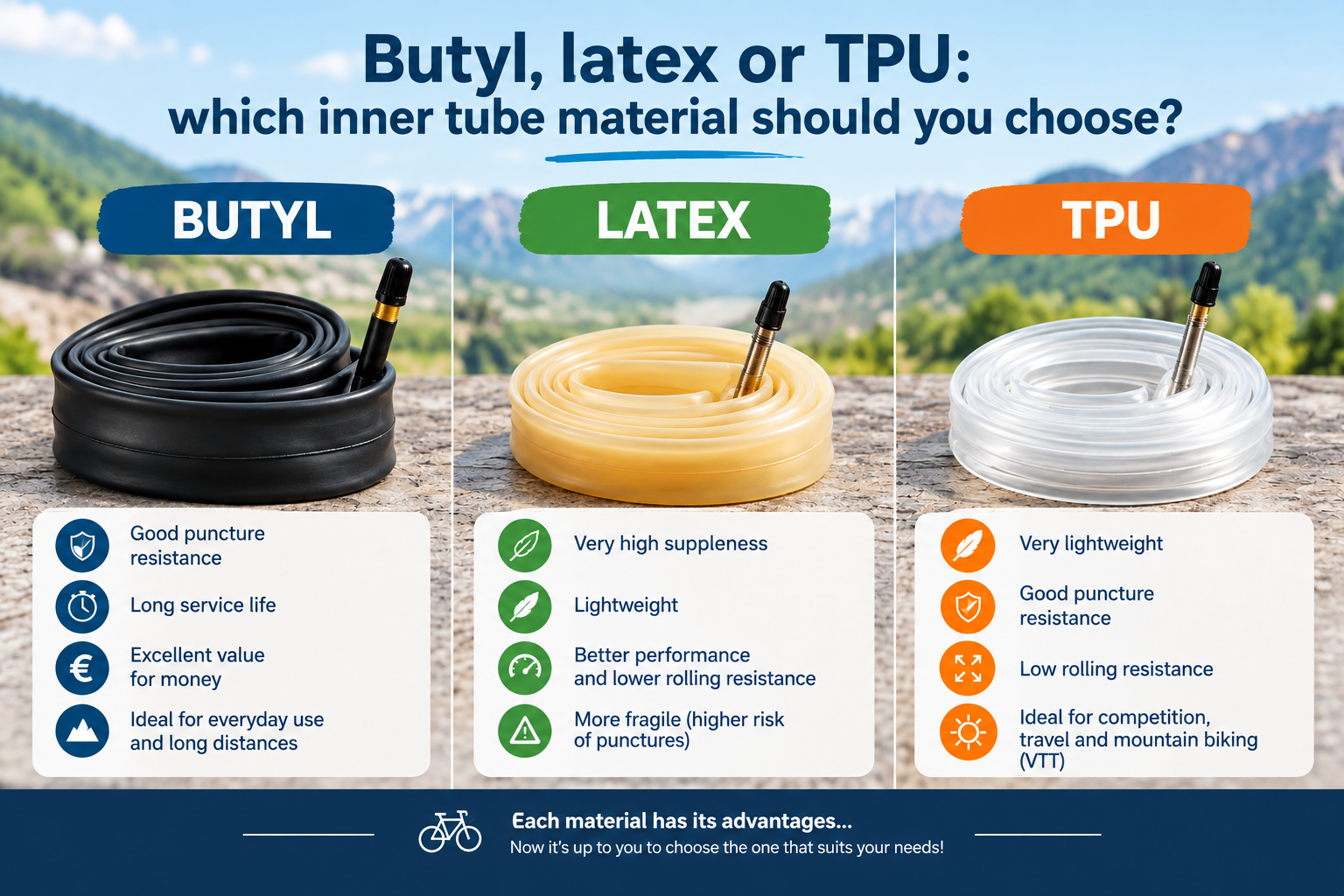
Butyl is the standard material found on the vast majority of entry-level and mid-range inner tubes. It's a synthetic rubber known for its durability and good air retention: a butyl tube holds pressure longer than a latex one, meaning fewer top-ups are needed.
Its main trade-off is weight: butyl remains the heaviest of the three materials, making it a solid choice for everyday or leisure riding, but less ideal if lightness is a priority.
2. Latex: lightness and a smoother ride
Latex is a more supple and elastic material than butyl. This elasticity reduces rolling resistance, resulting in a livelier pedalling feel and better absorption of road surface irregularities.
In exchange, a latex inner tube loses pressure faster than a butyl one: topping up before every ride is generally recommended. It's also more fragile against tears, and its price is significantly higher than a classic butyl tube.
3. TPU: the newest material
TPU (thermoplastic polyurethane) is a more recent arrival on the road and gravel bike market. Its main strength is a very low weight, often two to three times lighter than an equivalent butyl tube. Once deflated and folded, a TPU tube is also much more compact, making it an excellent choice as a spare tube in a saddle bag.
This weight and compactness advantage comes at a price: TPU tubes are the most expensive of the three materials, and patching them can be trickier, sometimes requiring specific patches designed for this material.
Good to know: TPU is particularly well suited as a spare inner tube in a saddle bag, thanks to how little space it takes up once folded — a real advantage when space is tight alongside your multi-tool and mini pump.
4. Comparison of the three materials
| Criterion | Butyl | Latex | TPU |
|---|---|---|---|
| Weight | Standard | Light | Very light |
| Price | Affordable | High | Highest |
| Pressure retention | Good | Lower (frequent top-ups) | Good |
| Durability | Robust | More fragile | Robust but needs specific repair |
| Recommended use | Everyday, leisure riding | Racing, performance | Spare tube, sportives |
5. Which material should you choose for your riding
- Everyday riding, training, leisure: butyl remains the most reliable and economical choice.
- Racing, chasing lightness and performance: latex offers a genuine improvement in feel, at the cost of more regular maintenance.
- Compact spare tube, sportives, gravel: TPU stands out thanks to its low weight and small folded size.