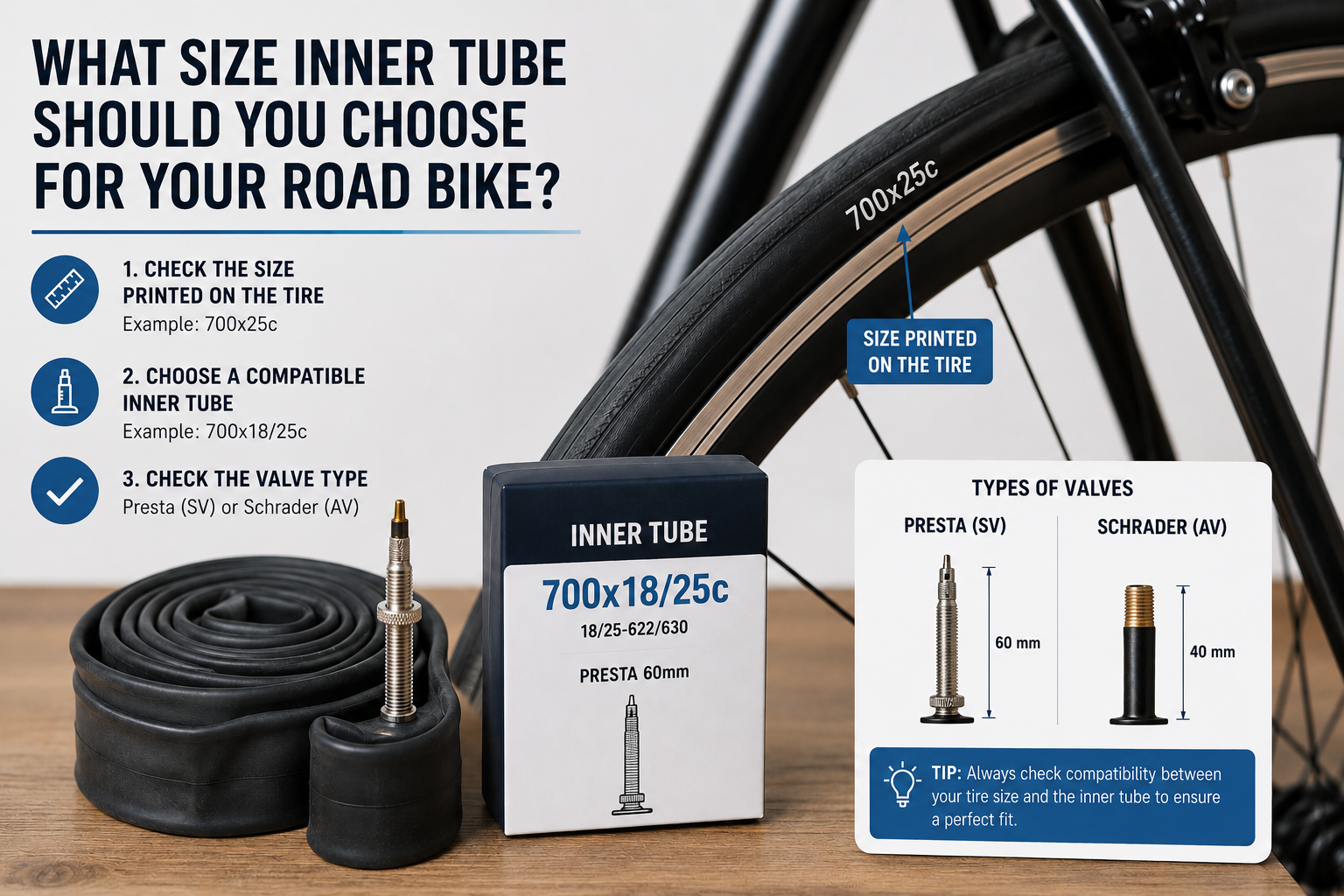
Getting the wrong inner tube size is one of the most common mistakes cyclists make, beginners and experienced riders alike. Between the markings on the tyre sidewall, compatibility ranges and ETRTO standards, it's easy to get lost. Here's how to read the right information and choose the correct inner tube size for your road bike, without any risk of a mounting error.
Browse our full range of road bike inner tubes in stock.
1. How to read the size on your tyre's sidewall
Before buying an inner tube, the first step is to check the sidewall of your tyre. You'll find a marking such as 700x25C, which contains all the information you need:
- 700 refers to the wheel diameter in millimetres, the near-universal standard for road bikes;
- 25 indicates the tyre width in millimetres;
- C is an older ETRTO code, still commonly used out of habit on many road tyres.
Reading this correctly is essential: it's what determines the size of road bike inner tube you need to order, not the other way round. Never estimate the tyre width "by eye".
2. The most common inner tube sizes for road bikes
The table below summarises the most frequent correspondences between tyre size and the matching inner tube range:
| Tyre size | Matching inner tube range |
|---|---|
| 700x18 to 23C | 700x18-23 |
| 700x20 to 28C | 700x20-28 (the most common) |
| 700x23 to 28C | 700x23-28 |
| 700x25 to 32C | 700x25-32 (gravel / wide road) |
You'll notice most inner tubes cover a range of sections rather than a single, precise size. That's good news: it means a single inner tube reference can fit several tyre widths, which greatly simplifies your choice and saves you from having to stock a different reference for every tyre.
3. Understanding the ETRTO standard and inner tube tolerance
This ability of inner tubes to cover a range of sizes comes down to the material itself: latex and butyl are both elastic materials that stretch naturally. A 700x20-28 inner tube can therefore deform slightly to fit both a 20mm and a 28mm tyre, without losing effectiveness.
That elasticity does have a limit, though. Fitting a tube sized for a 25mm tyre onto a 32mm or wider tyre creates a real risk of weakening through over-stretching: the tube works outside its intended range, which increases the risk of puncture and shortens its lifespan.
Watch out: if you're unsure between two sizes, always choose the tube whose range covers your tyre's section, rather than one at the low or high end of its tolerance. Always check the ETRTO range printed on the sidewall or the tube's packaging before buying.
4. 700c vs 650: don't get it wrong
700c is the standard diameter on the vast majority of modern road bikes, regardless of the tyre width fitted. Some models, however, remain equipped with a 650 diameter (650b or 650c): vintage bikes, triathlon bikes, or small frame sizes, where a smaller wheel diameter helps adjust the geometry.
These two diameters are not interchangeable: a 700 inner tube cannot be fitted to a 650 wheel, and vice versa. If your bike is fitted with 650 wheels, double-check this before ordering — this is the case with our Michelin Air Comp Ultra Light 650x18/23C reference, currently in stock.
5. What to do if you're unsure between two sizes
- Check the marking on the tyre sidewall before buying an inner tube
- If in doubt, choose a wide-range tube (e.g. 700x20-28) rather than a narrow, precise size
- Also check the valve type and length in addition to the size
- Keep the original packaging of the inner tube: the compatibility range is always printed on it
Good to know: if you ride with several tyre widths depending on the season — 23mm for racing, 28mm for touring, for instance — a wide-range tube such as the 700x20-28 saves you having to keep several different references in your saddle bag.