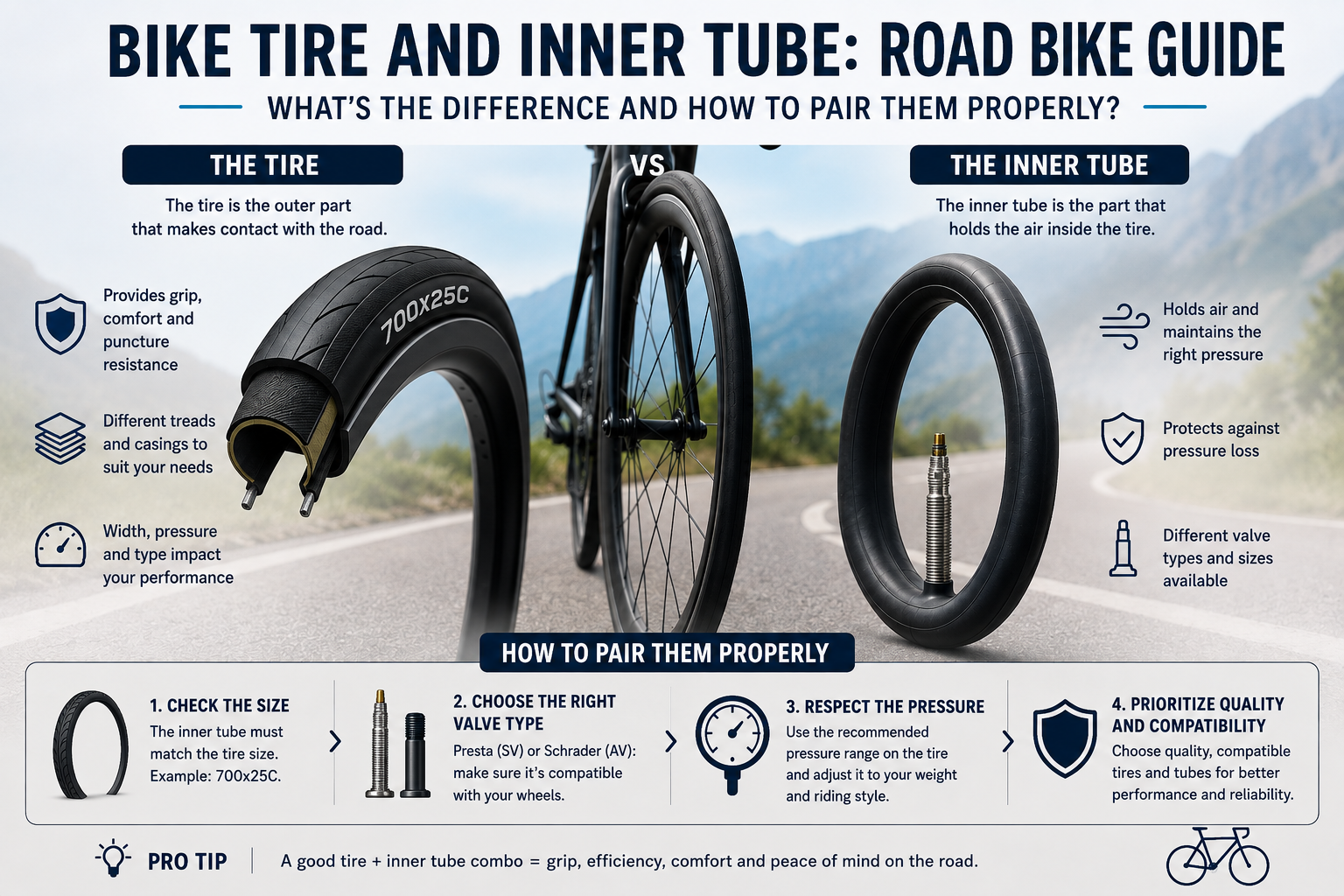
Confusing a tyre with an inner tube is a common mistake among beginner cyclists — yet these two parts have neither the same role nor the same selection criteria. Understanding the difference is essential to avoid a puncture or a botched fitting job. Here's how to properly pair them on your road bike.
Browse our range of road bike inner tubes and road bike tyres in stock.
1. Tyre vs inner tube: two distinct roles
On a road bike, the tyre and the inner tube work together but don't perform the same function. The road bike tyre is the outer element in direct contact with the road: it provides grip, rolling resistance and traction when cornering or braking. The inner tube, meanwhile, is a rubber tube placed inside the tyre, against the road bike wheel. Inflated to high pressure, it gives the tyre its shape and keeps it rigid.
In short: without an inner tube (or a tubeless system as a substitute), a tyre simply cannot hold its pressure against the rim. The two parts are inseparable, but they wear out, are chosen and are replaced differently.
2. Technical differences between tyre and inner tube
The table below summarises the main differences between these two components:
| Criterion | Tyre | Inner tube |
|---|---|---|
| Role | Grip, contact with the road | Maintaining pressure |
| Material | Rubber + textile or kevlar casing | Butyl, latex or TPU |
| Wear cause | Progressive wear with mileage | Puncture or tear |
| Replacement frequency | Roughly every 3,000 to 5,000 km | Depends on punctures, no fixed schedule |
| Price range | £15 to £55 | £2 to £13 |
The tyre therefore accounts for most of your wheel maintenance budget, while the inner tube remains an inexpensive wear part — though one that can leave you stranded in an instant if it punctures.
3. How to properly pair tyre and inner tube
Section (width)
The inner tube must match the section range printed on the tyre's sidewall. For example, a tyre marked 700x25C requires an inner tube compatible with a range such as 700x20-28C. Most inner tubes cover a range of sections rather than a single size, which simplifies the choice.
The valve
The Presta valve, thin and threaded, is the norm on almost all road bikes. Valve length should be matched to the rim profile: a classic low-profile rim only needs a 40 to 42mm valve, while a high-profile carbon rim (40 to 60mm) needs a longer valve, 60 to 80mm, so that the thread protrudes enough to properly attach the pump head.
Diameter
700c is the standard on almost all current road bikes. Only certain vintage or triathlon models use a 650 diameter, which then requires a specific inner tube.
Watch out: fitting an inner tube that's too narrow into a wide tyre creates a risk of over-stretching and weakening the rubber. Conversely, an oversized tube in a narrow tyre encourages pinching during fitting — the leading cause of a puncture right after a repair. Always check the range printed on the tyre sidewall or the tube's packaging before buying.
4. Inner tube or tubeless: does a tyre always need a tube?
It depends on the type of tyre fitted on your wheel:
- Tube-type (classic) tyre: always needs an inner tube to hold pressure.
- Tubeless-ready tyre: can be fitted without an inner tube, using sealant and a dedicated tubeless valve, but can also accept a classic inner tube as a backup.
For a full comparison of the pros and cons of each solution, see our dedicated road bike inner tube page, which details the selection criteria between inner tube and tubeless.
Good to know: even with tubeless tyres, it's recommended to carry a spare inner tube on your rides. It's simpler and quicker to fit than a tubeless repair in the event of a large puncture, and can also help out another cyclist who forgot theirs.
5. Our advice for avoiding mistakes
- Always check the section match between the tyre and the inner tube before buying
- Check the valve type (Presta or Schrader) and its length according to your rim profile
- Never force a tube that's too small into a wide tyre
- Always carry a spare inner tube matched to your tyres on your rides