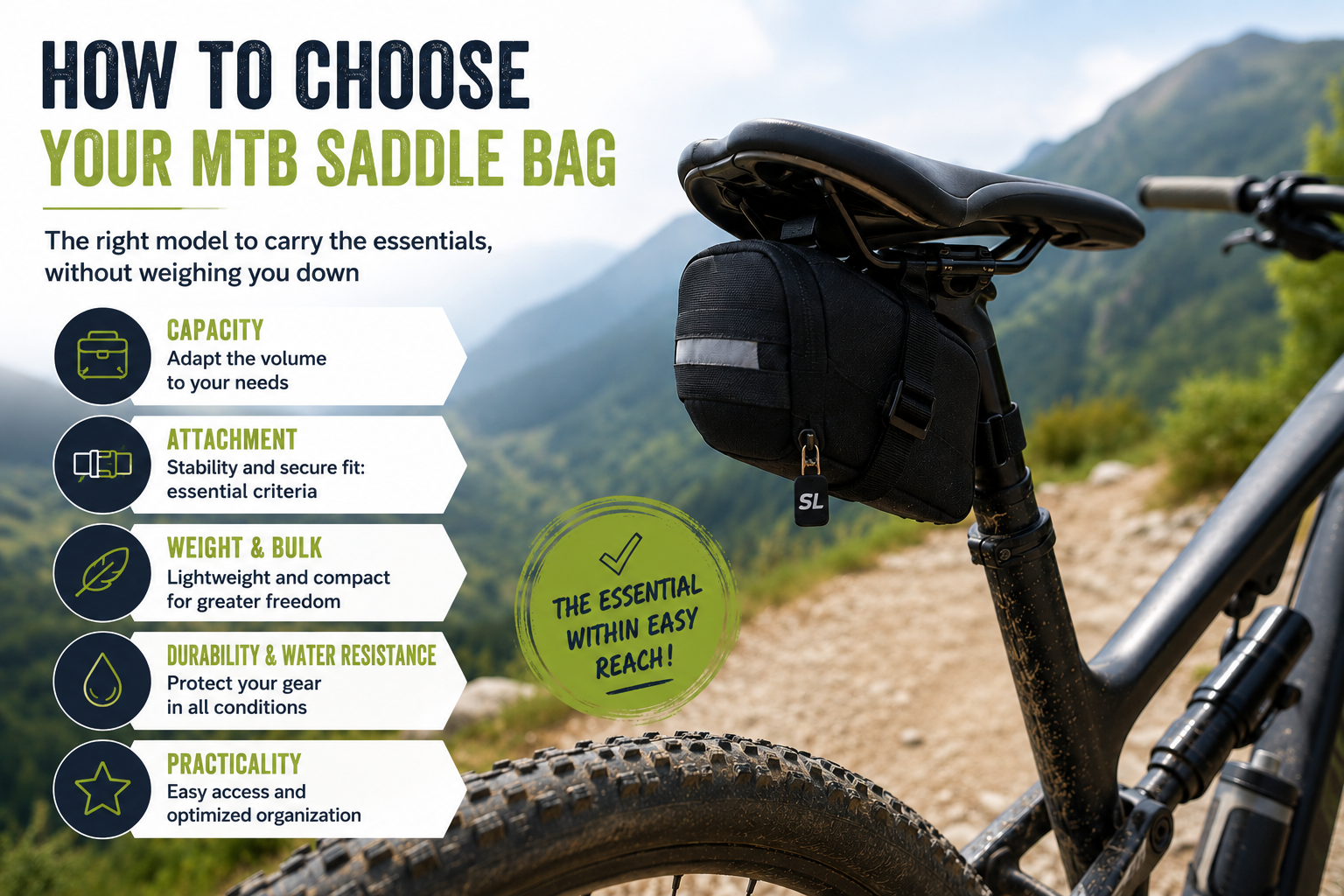
Getting stuck in the middle of a trail with no tool or spare tube is one of the most common mishaps in mountain biking — and one of the easiest to avoid. A saddle bag lets you carry just the essentials without a backpack. Here's what to look for when choosing one.
Browse our MTB saddle bag in stock, as well as our full MTB saddle range.
1. What is an MTB saddle bag for
A saddle bag lets you carry a minimal repair kit — an inner tube or tubeless repair kit, tyre levers, a multi-tool, a mini pump — without needing to wear a backpack. On shorter rides, it's a genuine comfort upgrade: less weight on your back, less sweating, and the peace of mind of never setting off without the essentials.
2. The criteria for choosing your MTB saddle bag
Size and volume
A small bag (0.5 to 1 litre) is enough for a minimal kit on short rides. For longer rides or more comprehensive tools (a spare tube, a fuller multi-tool, a snack), a bag of 1.5 to 2 litres or more is preferable.
The mounting system
Three main types exist:
- Classic straps, simple and affordable, but requiring careful adjustment to avoid any sway.
- Rail hooks, offering a more stable and quicker fit.
- Quick-release systems (tool-free/magnetic), letting you remove the bag without any tools — handy if you switch between several bikes or want to detach it easily when parked.
Waterproofing
For regular off-road use, look for waterproof or water-resistant materials and seams: rain, a stream crossing, or simply mud splashing up, the bag's contents (often electronics or moisture-sensitive) need to stay protected.
Stability
On technical terrain, a poorly secured bag starts to swing, which is as annoying as it is noisy. Check for compression straps or an anti-sway system, particularly important if you ride Enduro or All Mountain.
Point of caution with a dropper post: the internal mechanism of the post sometimes leaves less usable space under the saddle. Check the compatibility of the bag you're considering with this type of post before buying, especially for rail-hook mounts.
3. What to pack in your MTB saddle bag
A typical kit for a standard ride:
- An inner tube matching your wheels (or a tubeless repair kit)
- A set of tyre levers
- A multi-tool with Allen keys (handy for retightening a clamp or stem mid-ride)
- A mini pump or a CO2 cartridge with adapter
- A patch kit
Always match the contents to the actual size of your bag rather than forcing a bulky kit into too small a bag, which risks damaging the closures or creating uncomfortable sway.
4. Saddle bag or backpack: which to choose?
A saddle bag is perfectly suited to short-to-medium rides with light autonomy needs. A backpack remains preferable for long rides that require an integrated water reservoir, extra clothing or food. The two solutions aren't mutually exclusive: many riders combine a small saddle bag for basic tools with a backpack for everything else, particularly on all-day rides.