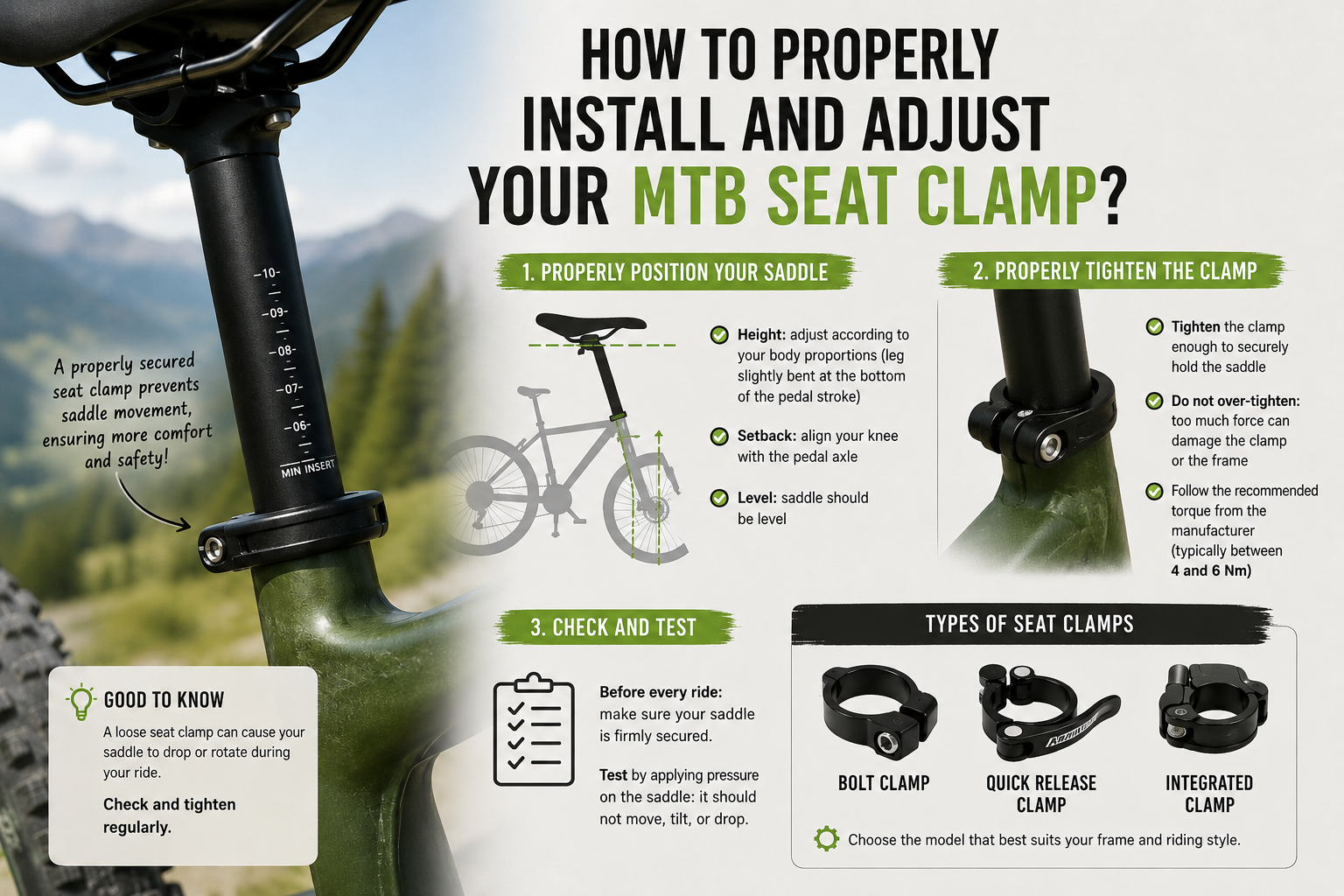
An over-tightened clamp risks damaging the post or the frame; an under-tightened one lets the saddle slip down while pedalling. Between the two lies a simple job that's often poorly understood. Here's how to properly position, tighten and maintain your MTB seatpost clamp.
Browse our full range of MTB seatpost clamps in stock.
1. What the clamp does and why the right choice matters
The seatpost clamp holds the post in place at the height you've set, by clamping the frame's seat tube. It's a simple but essential part: it's what keeps all your height, setback and tilt adjustments stable once you're riding.
Watch out for two different diameters: clamp diameter refers to the diameter of the frame's seat tube, not the diameter of the seatpost itself. These are two separate measurements that need to be checked independently before buying. For the full breakdown of MTB diameters, see our guide which seatpost diameter does my MTB need.
2. How to properly position and tighten your MTB seatpost clamp
- Clean the seat tube before fitting, to remove any dirt or debris that could throw off the clamping.
- Position the clamp just above the top of the seat tube, neither too high (risk of cracking the tube if overtightened) nor too low (insufficient grip on the post).
- Tighten progressively, in a cross pattern if the clamp has several bolts, to spread pressure evenly.
The tightening torque is generally stated directly on the clamp or in the frame's manual. Using a torque wrench is strongly recommended, particularly on a carbon frame, where over-tightening can cause invisible cracks.
3. What to do if the clamp is slipping
A saddle that gradually drops while pedalling is one of the most common problems. The most frequent causes:
- Insufficient tightening torque: retighten to the recommended value.
- A dirty or accidentally greased seat tube or post: contact must remain dry (or treated with friction paste on carbon, see next section) to guarantee grip.
- A worn clamp or one with the wrong diameter: a clamp that's too wide for the seat tube will never clamp effectively, no matter how much torque you apply.
If slipping persists despite correct tightening and a clean tube, applying an assembly paste (metal) or friction paste (carbon) at the post/frame contact point resolves the vast majority of remaining cases.
4. Should you grease an MTB seatpost clamp ?
Essential distinction to know: a metal seatpost can be lightly greased when inserted into the frame, which makes fitting and removal easier and prevents seizing. However, never grease a carbon post or frame: grease makes the surfaces slide against each other, preventing effective clamping even at maximum torque. On carbon, always use a specific friction paste, designed to increase grip rather than reduce it.
5. When to replace your MTB seatpost clamp
A few signs should lead you to replace your clamp rather than persist with tightening:
- Visible cracks on the clamp itself.
- Damaged threading, a bolt that spins freely or that can no longer hold the recommended torque.
- Advanced corrosion on a metal clamp exposed to the elements.
If replacing it, be sure to check your frame's seat tube diameter before ordering a new clamp.