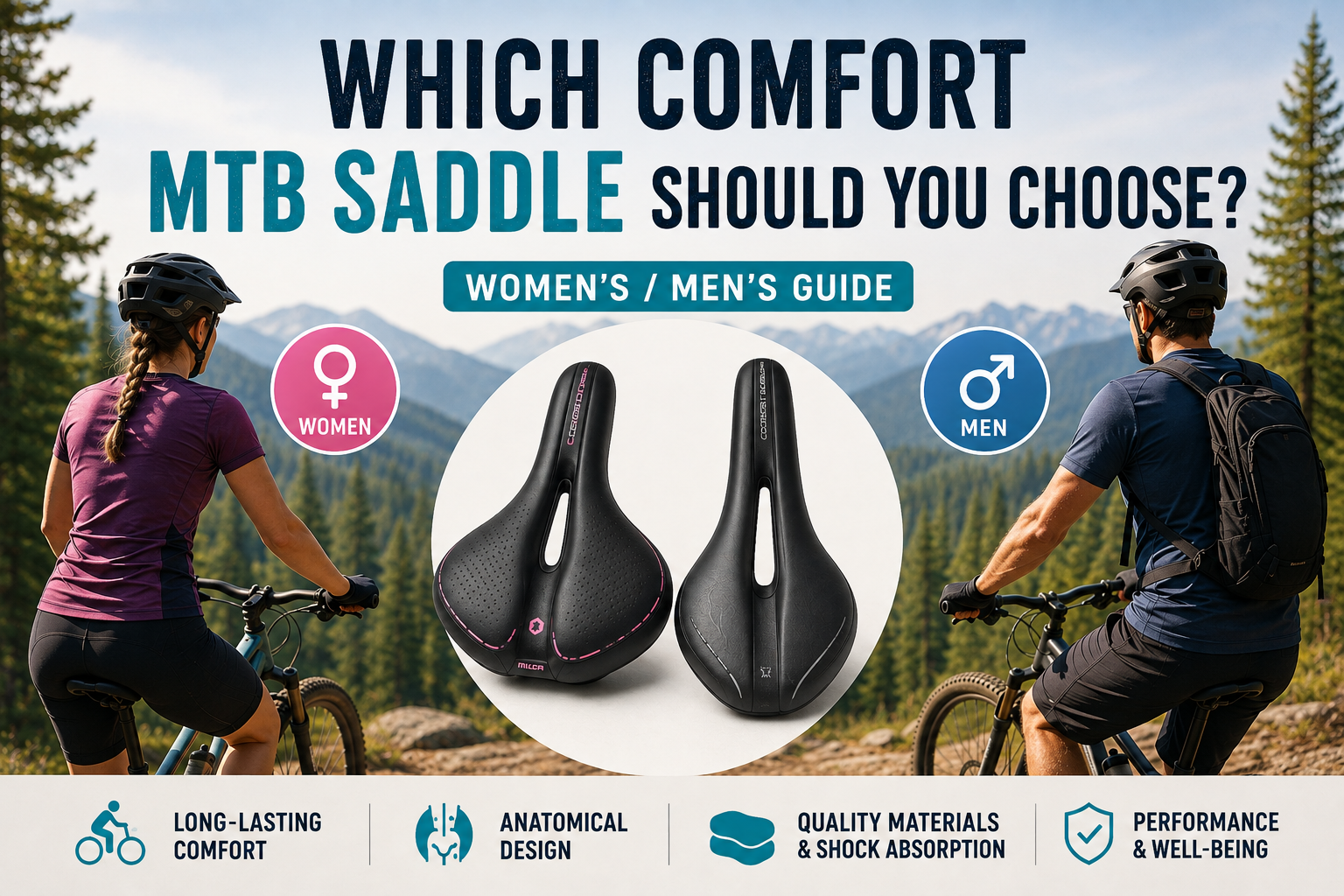
"The softer, the more comfortable" is probably the most common myth when choosing a mountain bike saddle — and also the most misleading. Real comfort depends first on width, shape and your riding style, well before how thick the padding is. This guide helps you choose an MTB saddle genuinely suited to your body, whether you're a man or a woman, and to your riding style.
Browse our full range of MTB saddles in stock, including our dedicated enduro MTB saddle selection.
1. Why comfort isn't (only) about padding
A comfortable MTB saddle isn't necessarily the most padded one. In fact, it's often the opposite: overly thick, overly soft foam compresses under body weight, concentrating pressure instead of spreading it, and can create painful pressure points after just a few kilometres.
Real comfort depends first and foremost on three factors, in this order of importance: the saddle's width (matched to your sit bone spacing), its shape (linked to your riding position) and finally the padding, which fine-tunes the feel once the first two criteria are right.
2. The key criteria for a comfortable MTB saddle
Width
This is the most decisive criterion. A saddle that's too narrow doesn't properly support your sit bones (the bones your weight rests on when seated), while one that's too wide causes chafing on the thighs. Standard width is around 130-135 mm, with wider options available for wider hips.
Shape
Three broad shape families exist, each suited to a different riding style and position:
- Rounded: optimal weight distribution, ideal for long rides or casual riding.
- Semi-rounded: versatile, reduces chafing, suited to enduro, all-mountain and downhill alike.
- Flat: for aggressive riding with frequent position changes (competitive XC in particular).
Padding: classic foam or gel MTB saddle
The choice between classic foam and a gel insert mainly depends on how long your rides are:
- A gel MTB saddle offers very noticeable immediate comfort on short rides or urban/casual use, thanks to how it absorbs individual impacts.
- Firmer, denser foam is generally preferable for long distances: it deforms less over time and avoids the "bottoming out" effect that overly soft gel can create after several hours in the saddle.
Worth remembering: gel isn't a universal comfort fix. It partly compensates for a poorly matched width or shape, but never replaces them. Always get the width and shape right first, then choose your padding type.
Central channel
Many comfortable MTB saddles feature a central cutout that reduces pressure on the perineal area. This feature is particularly recommended for long or frequent rides, regardless of your level.
3. Comfortable MTB saddles for women: the specifics
Women-specific MTB saddles exist because the average sit bone spacing tends to be wider in women than in men, which justifies specific widths and shapes. This is only a statistical tendency, though: individual measurement always takes priority over gender when choosing.
On a "women's saddle" product page, check first for:
- The stated width, often slightly wider than unisex or men's models.
- A cutout or central channel, common on this type of model.
- A sometimes shorter length, to give more clearance to the front of the thigh in the pedalling position.
4. Comfortable enduro MTB saddles: balancing comfort and control
On an enduro mountain bike, the saddle needs to stay comfortable over long climbs while remaining unobtrusive and easy to get past on descents. This calls for a few adjustments compared to a purely leisure-oriented saddle:
- A shorter profile, for better rider mobility during technical sections.
- Medium to firm padding, which absorbs terrain vibration without hurting power transfer or creating instability while riding.
Find our full recommendations on our enduro MTB saddle category.
5. How to test saddle comfort before buying
A saddle's real comfort is never judged in the first 5 minutes: it's over time, after several rides, that any pressure points reveal themselves. A few practical tips:
- Try several saddles in-store if possible, sitting in your actual riding position on a bike.
- Give a new saddle at least 2 to 3 rides before making a final judgement: your body needs time to adapt.
- Check the return policy before buying online: at SL Sport Equipments, you have 14 days after receipt to return a product that doesn't suit you.
A poor setup can make a good saddle feel uncomfortable. Before blaming your saddle, check its height, setback and tilt: see our guide How to set up your MTB saddle to rule out this common cause of discomfort.
6. Summary table by riding style
| Riding style | Recommended width | Recommended padding |
|---|---|---|
| Leisure / touring | Standard to wide, depending on body type | Comfortable foam, gel possible on short rides |
| All Mountain / Trail | Standard (~130-135 mm) | Medium-firm foam, central channel recommended |
| Enduro / Downhill | Standard, shorter profile | Medium to firm foam, priority on mobility |
| Competitive cross-country | Standard to narrow | Firm foam, flat shape, priority on efficiency |