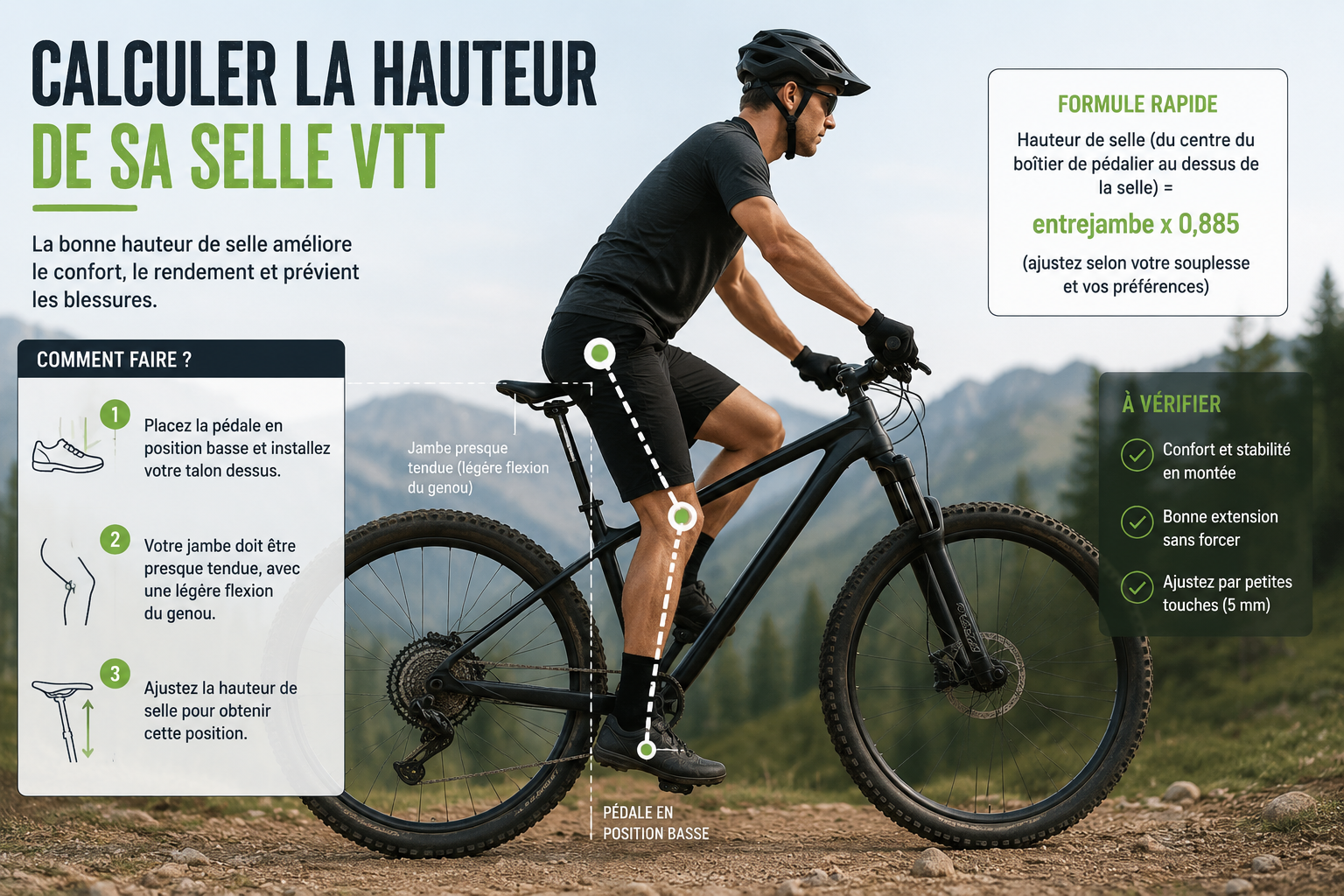
An incorrect saddle height is one of the leading causes of lost pedalling efficiency and knee pain on a mountain bike. Use the calculator below to get a reliable starting height in 30 seconds, then fine-tune it using our detailed manual method further down this page.
1. The MTB saddle height calculator
Not sure how to measure your inseam? Follow the method detailed in the next section before entering your measurement.
2. How to measure your inseam length
The accuracy of the calculation depends entirely on this measurement. Here's the most reliable method, which you can do on your own in a few minutes:
- Stand with your back against a wall, barefoot or wearing your usual cycling shoes, feet about 15-20 cm apart (natural pedalling stance).
- Place a rigid book between your legs, spine facing up, and push it firmly upward until it touches your crotch (as a saddle would).
- Get someone to help you measure the distance from the floor to the top of the book, using a tape measure.
Accuracy tip: repeat the measurement 2 to 3 times and take the average. A gap of just a few millimetres in your inseam can be enough to shift the final result by several millimetres.
3. The calculation formula explained
The calculation is based on a formula popularised in road cycling by Greg LeMond: saddle height = inseam × 0.883. This coefficient gives a position optimised for pure pedalling efficiency, but it doesn't translate directly to mountain biking.
On a mountain bike, height should be slightly reduced compared to road cycling, for several reasons: more standover clearance, a more dynamic riding position, and the need to quickly get the saddle out of the way on descents. The coefficient to apply therefore varies by discipline:
| Riding style | Indicative coefficient | Rationale |
|---|---|---|
| Cross-country (XC) | × 0.875 | Position close to road cycling, priority on pedalling efficiency |
| All Mountain / Trail | × 0.85 | Balance between climbing efficiency and descending manoeuvrability |
| Enduro / Downhill (DH) | × 0.80 | Priority on standover clearance and manoeuvrability, saddle often dropped on descents |
These coefficients are indicative, based on common experience from MTB bike fitting. They're an excellent starting point, but they don't replace fine-tuning based on how it actually feels on the trail.
4. Verify and fine-tune the result
Once the calculated height is set on your bike, confirm it with the heel method: place the pedal at the bottom of the stroke, rest your heel on it — your leg should be nearly straight. Switch back to your normal riding position (ball of the foot on the pedal): your knee should form an angle of roughly 25 to 30° at the bottom of the pedal stroke.
For the full breakdown of this method, plus setback and tilt adjustments, check out our guide How to set up your MTB saddle: height, setback and tilt.
5. Special cases
Dropper post: the height calculated here matches your optimal pedalling position (saddle "up"). With a dropper post, this height remains your reference setting for climbing and flat sections; the lowered position for descents is handled separately via the handlebar remote, without changing this base setting.
Non-standard proportions: if your leg-to-torso ratio is outside the average, the calculator's result remains a solid starting point, but trail testing always trumps theory. Don't hesitate to adjust in small 5 mm increments.