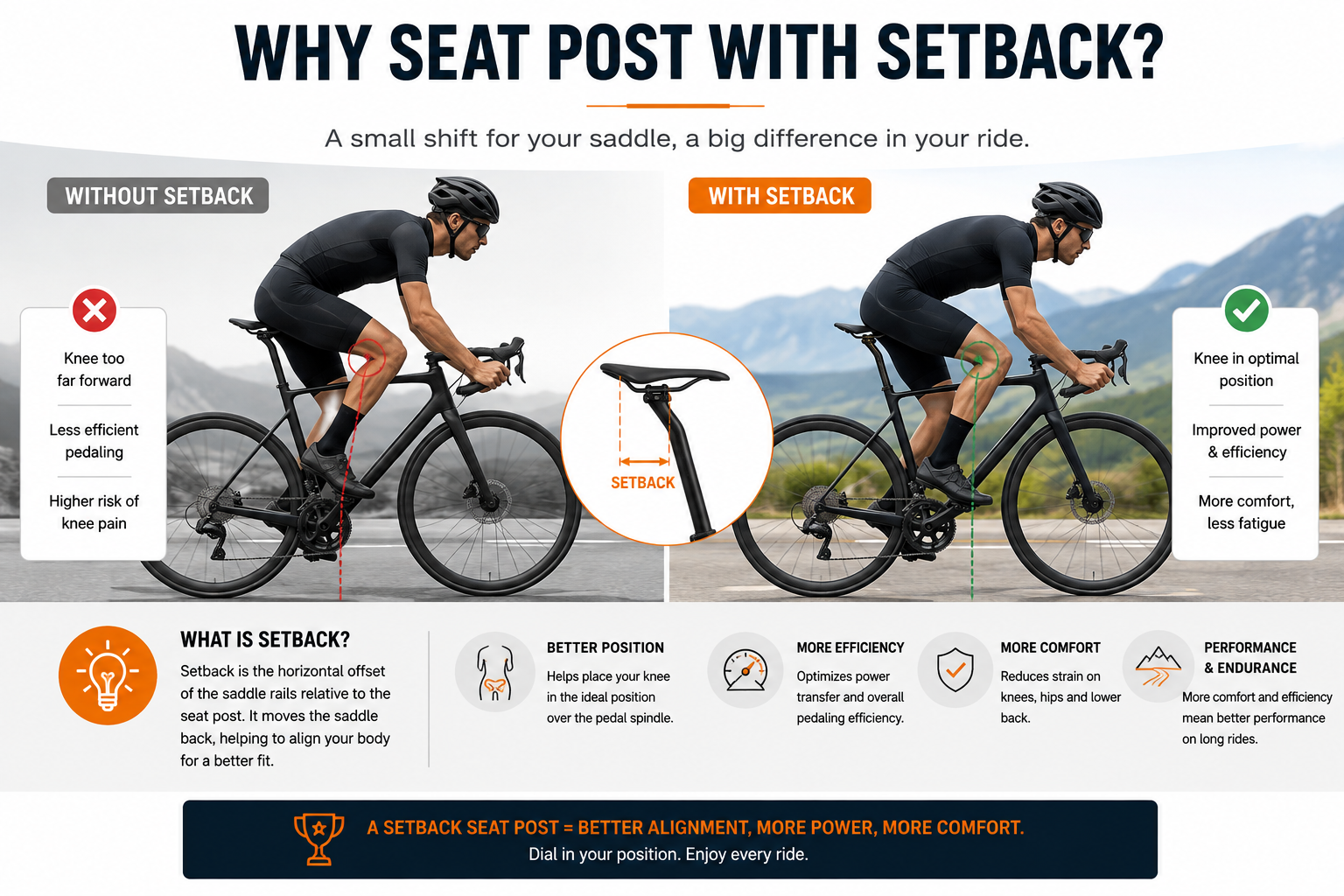
A setback seatpost — also called an offset seatpost — is one of the simplest ways to fine-tune your position on a road bike seatpost without changing the frame itself. But "setback", "offset" and "zero-offset" get used loosely, and picking the wrong one can throw off your knee alignment and your pedalling efficiency. This guide focuses on one question only: what a setback seatpost is, why road cyclists choose one, and how to measure the setback you already have.
1. What is a setback (offset) seatpost?
A setback seatpost is a seatpost whose saddle clamp sits behind the centreline of the seat tube, rather than directly above it. This horizontal distance between the two axes is called the setback (UK/US) or offset, and it's expressed in millimetres — on road bikes, it's typically between 15 mm and 25 mm.
In practice, a setback post lets the saddle sit further back than a straight, "zero-offset" post would, for the same seat tube angle. It's a small mechanical detail, but on a road bike it has a direct effect on knee position over the pedal spindle and on how your weight is split between saddle and handlebar over a long ride.
À retenir : setback and offset describe the same thing. On road bike product pages, the value is usually listed simply as "offset" — that's what you'll see filtered by 0, 10, 20 or 25 mm in our road bike seatpost catalogue.
2. Why road cyclists choose a setback seatpost
On a road bike, a setback seatpost exists to let the saddle move further back than the seat tube alone would allow — useful whenever your proportions or riding style call for a position the frame's geometry can't provide on its own. Three effects matter most on the road:
- Position adjustment: extra rearward travel on top of what the saddle rails already allow — often the difference between "almost right" and correctly fitted for taller riders or those with a longer femur relative to their torso.
- Improved comfort: a saddle set further back reduces pressure through the hands, arms and shoulders, since less weight sits on the front of the bike. Over long road distances, that means less fatigue and a lower risk of strain from an awkward reach.
- Optimised pedalling efficiency: moving the saddle rearward changes the alignment between hip, knee and ankle through the pedal stroke, which for many riders improves power transfer — one reason fitters check saddle setback whenever they check saddle height.
More setback isn't automatically better: it needs to match your body proportions and your road bike's own seat tube angle, which is exactly what sections 3 and 4 cover.
3. Setback vs zero-offset vs forward-offset: which one fits your frame?
Road bike seatposts aren't limited to a single design. Depending on the brand and the frame, you'll find setback (positive offset), zero-offset (straight, or "inline") and, more rarely, forward-offset (negative offset) posts:
| Type | Typical setback | Best suited to | Effect on position |
|---|---|---|---|
| Setback (offset) | 15–25 mm | Riders needing a more rearward saddle position; road frames with a steeper seat tube angle; taller riders or longer femur | Opens hip angle, shifts weight off the hands, often improves long-distance road comfort |
| Zero-offset (straight / inline) | 0 mm | Riders whose knee-over-pedal-spindle position is already correct with the saddle rails alone; road frames with a slacker seat tube angle; time-trial and triathlon set-ups | Keeps the saddle directly above the seat tube; more precise, less forgiving fit window |
| Forward-offset (negative) | −15 to −20 mm | Riders who need the saddle further forward than the seat tube allows; some TT/triathlon set-ups | Closes hip angle, moves weight forward, aids a more aggressive aerodynamic road position |
Conseil : the right choice depends on your current knee-over-pedal-spindle (KOPS) alignment, not on the post alone. If you're already correctly positioned with your current post, switching offset without adjusting saddle fore-aft will move your position — measure first (section 5).
4. Setback and your road bike's seat tube angle
How much setback you actually need is closely tied to your road frame's seat tube angle, which varies by geometry family:
- Endurance / sportive geometry frames often use a steeper seat tube angle, precisely so that a setback post can bring the saddle back to a comfortable, more upright position without the bike feeling cramped.
- Race / aero geometry frames tend to run a slacker seat tube angle, which is part of why some race-oriented posts ship as zero-offset — the frame geometry already places the saddle further back relative to the bottom bracket.
- Vintage road frames often use non-standard tube diameters (26.4 mm, for example) alongside a specific expected setback — worth checking against our road bike seatpost diameter guide before ordering.
À éviter : assuming a higher-offset post will automatically "fix" a position issue. If your frame's seat tube angle is already steep, adding a large setback can push the saddle further back than intended and open your hip angle too much — check the measurement in the next section before you swap.
5. How to measure your seatpost setback
Before ordering a replacement, measure the setback you currently have:
- Drop a plumb line from the tip of the saddle nose (or from the saddle rail clamp) straight down to the ground.
- Measure the horizontal distance between that plumb line and the centre of the seatpost where it enters the frame.
- Compare with the post's stated offset — usually stamped on the post or listed on the product page — then fine-tune the saddle's fore-aft position on the rails from there.
Diameter and insertion length matter just as much as offset for a correct fit: check our guides on how to measure the diameter of a seat post and what size seat post before you buy — an offset post that's the wrong diameter simply won't clamp in the frame.
6. Setback seatposts at SL Sport Equipments
Our road bike seatpost range is filterable directly by offset (0, 10, 18, 20, 25 or 30 mm), so you can shortlist by setback before comparing diameter and brand. Every second-hand post — setback or zero-offset — goes through the same inspection detailed on the main road bike seatpost category page (visual check, thread verification, diameter measurement); for setback posts specifically, we also confirm the actual offset matches what's listed and check the saddle clamp mechanism for play. Each post then gets a condition rating from 1 to 10, shown on the product page, and you have 14 days to return it if it doesn't fit once it arrives.