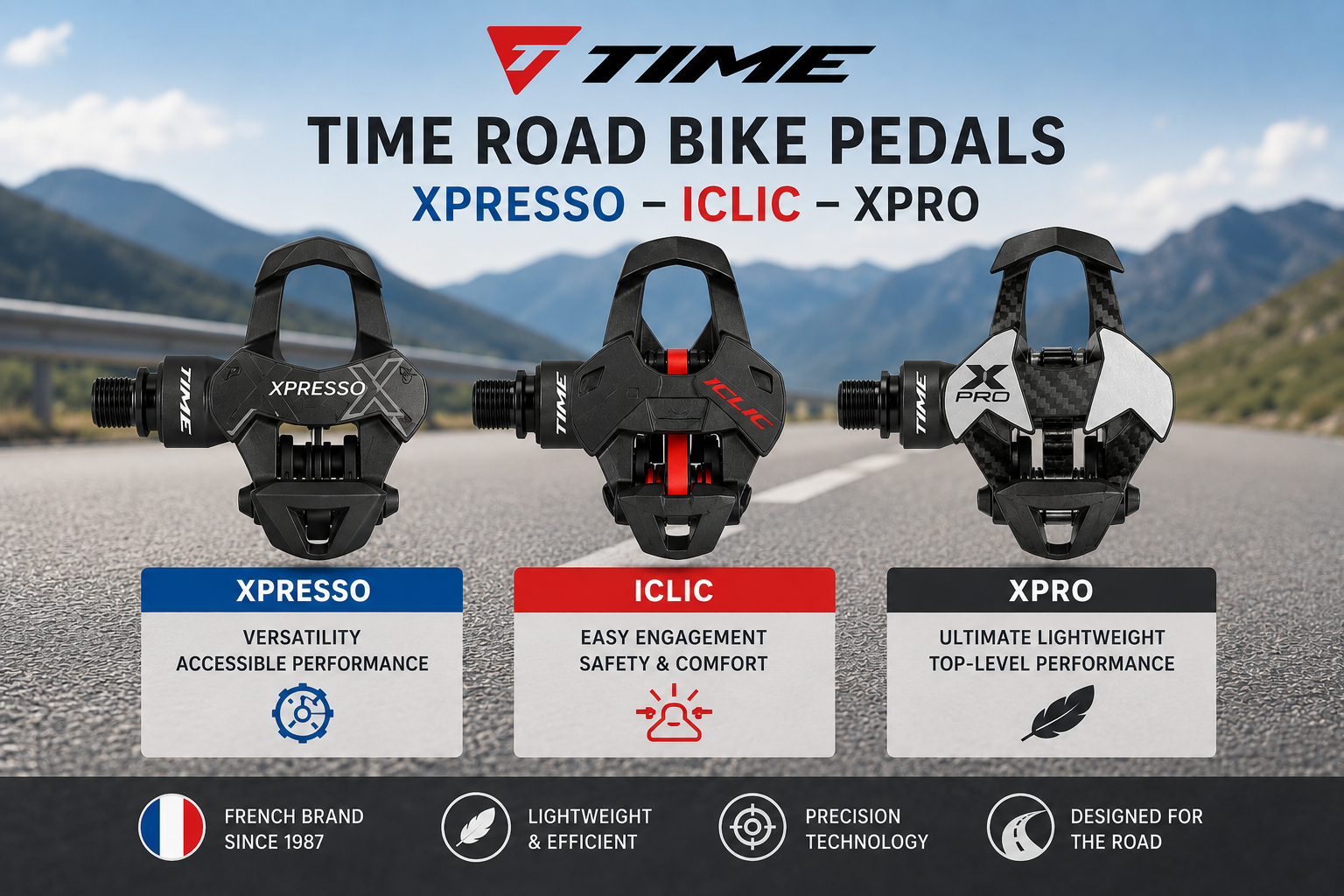
With Time, choosing a road bike pedal is not simply a matter of selecting a range: above all, it is about angular freedom and joint comfort. Unlike Look, which focuses on a large support platform and firm foot retention, or Shimano, whose SPD-SL standard has become renowned for its durability, Time has built its identity around a natural float of the foot that helps protect the knees over the long term. This guide reviews the Xpresso, Iclic and Xpro ranges to help you choose the right model for your riding style.
For the general criteria to consider when choosing a road bike pedal (weight, support platform, threading, maintenance), see our complete road bike pedal guide.
1. Time technology: angular freedom and the Iclic/Xpresso system
Since its early days in road cycling, Time has stood out by focusing on angular float rather than rigidly holding the foot in place. In practical terms, the cleat is not locked along a single axis: it can rotate slightly from side to side with each pedal stroke, allowing the knee to follow its natural movement rather than being forced into a fixed trajectory imposed by the pedal.
This philosophy was historically embodied by the Iclic system, followed by its evolution, the Xpresso system. This was not simply a marketing name change: Xpresso introduced an asymmetric cleat and easier engagement, while retaining the brand's characteristic float. The two systems can still be found side by side on the used market, which explains why Iclic models are still frequently available at attractive prices alongside newer Xpresso models.
Key takeaway: while Look and Shimano primarily optimize stiffness and the size of the support platform, Time focuses on joint comfort through its floating system. The choice therefore depends as much on your body shape and history of knee pain as on your level of riding.
2. Which Time pedal for which type of riding ?
Time's road pedal range is available in several levels, from entry-level aluminium models to carbon versions designed for racing.
| Range | Level | Main material | Key feature |
|---|---|---|---|
| Iclic 1 / 2 | Entry-level / used | Reinforced composite | Historical system, still widely available on the used market |
| Xpresso 2 / 4 | Leisure / regular training | Composite / aluminium | Good weight-to-price ratio, easier engagement |
| Xpresso 6 / 7 | Sportive / amateur racing | Aluminium / partial carbon | Larger support platform, reinforced axle |
| Xpresso 12 / 15 / Xpro | Racing | Carbon | Minimum weight, maximum stiffness under the foot |
Always check whether your pedals use the Iclic or Xpresso system before ordering cleats: the two generations are not interchangeable (see the dedicated section below).
3. Time Xpresso pedals
The Xpresso range is now at the heart of Time's road pedal offering. It features an asymmetric cleat that makes engagement easier, even in difficult conditions (rain, emergency stops), as well as adjustable angular float depending on the cleat model selected.
On entry-level versions (Xpresso 2, 4), the pedal body is made from composite or aluminium, providing a reasonable weight at an accessible price. Higher-end versions (Xpresso 6, 7) offer a larger support platform and a reinforced axle, while top-of-the-range models feature carbon plates to maximize stiffness under the foot, an important factor for powerful cyclists and sprinters.
4. Time Iclic pedals
Predating the Xpresso range, the Iclic generation remains very common on the used market and continues to equip many road bikes currently in use. It is based on the same principle of angular float, with an engagement system that is slightly less immediate than on more recent Xpresso models.
For a leisure cyclist or someone on a tight budget, a good-condition used pair of Iclic pedals remains a relevant choice: the basic mechanical operation has not changed, only the cleat design and engagement ergonomics have evolved. It is also an interesting option for equipping a second bike or a winter bike without investing in new equipment.
5. Time Xpro pedals
The Xpro range (along with the high-end models in the Xpresso family, such as the Xpresso 12 and 15) is designed for cyclists seeking maximum performance: minimal weight, a stiff carbon plate, and an optimized contact area to reduce energy loss during each phase of the pedal stroke. These models are particularly well suited to competitive riders and cyclists who spend a lot of time riding out of the saddle or sprinting, where the stiffness of the foot-pedal interface directly translates into better power transfer.
The trade-off is the higher price compared with mid-range Xpresso models, with the performance gains being fully worthwhile primarily for riders who train and ride regularly and intensively.
6. Time cleats: compatibility and angular float
Choosing the right cleats directly affects both pedaling comfort and safety. Time offers different levels of angular float to suit different needs:
- Zero-float cleats (0°): provide a firmer foot position and are preferred by cyclists who prioritize precision and do not have any particular joint sensitivity.
- Free-float (floating) cleats: allow the foot to pivot naturally, reducing stress on the knee, particularly over long distances or for cyclists who have previously experienced joint pain.
Compatibility warning: cleats designed for the Iclic system are not interchangeable with Xpresso cleats, and vice versa. Always check the exact system used by your pedals before ordering replacement cleats. Likewise, Time cleats cannot be fitted to Look or Shimano pedals, as each brand uses its own proprietary mounting standard.
7. Time vs. Look/Shimano: what really changes?
The comparison often comes up when choosing between the three major brands on the market. When it comes to joint comfort, Time stands out clearly; in terms of availability and standardization, Shimano and Look have the edge.
| Criteria | Time | Look | Shimano |
|---|---|---|---|
| Technical priority | Angular float, joint comfort | Support platform, light weight | Durability, standardization |
| Cleat system | Iclic or Xpresso (not interchangeable) | Keo (0°, 4.5°, 9°) | SPD-SL (0°, 2°, 6°) |
| Spare parts availability | Good, with an active used market | Very wide | Very wide |
In short, if you already experience knee or hip sensitivity, Time's floating angular freedom is a genuine technical advantage, beyond simple brand preference. To explore the criteria that apply to all brands (weight, materials, release tension), see our complete road bike pedal guide, as well as our dedicated pages on Look road bike pedals and Shimano road bike pedals.