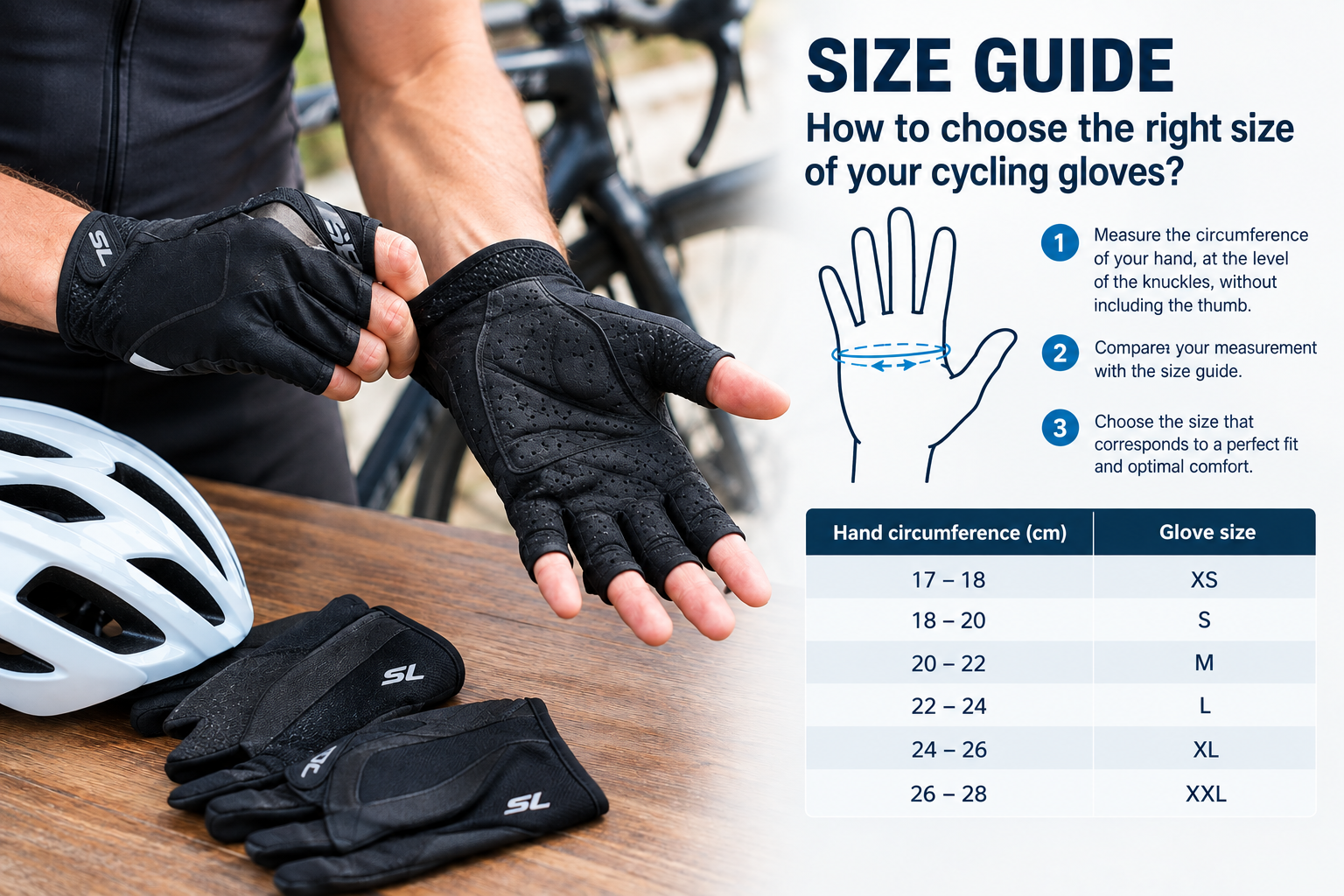
A poorly fitted cycling glove ruins the comfort of even the best pair on the market. Here's how to measure your size in two minutes and avoid the most common mistakes.
Check out our full range of road cycling gloves, either new clearance stock or checked second-hand pieces.
1. Why size matters so much for a cycling glove
A glove that's too big slides on the hand as soon as you start pedalling, creates folds across the palm, and eventually causes uncomfortable friction points over time. On the other hand, a glove that's too tight compresses the fingers, restricts blood flow, and tires the hand faster than a properly fitted one. Beyond comfort, an incorrect size also reduces grip precision on the brake levers — an important point, especially as speed increases or conditions worsen.
2. How to measure your palm circumference
The method is simple and takes less than two minutes:
- Grab a soft tape measure (or a piece of string you'll measure afterwards with a ruler).
- Wrap it around the widest part of your hand, just below the finger joints, without including the thumb.
- Note the measurement in centimetres, with your hand open and relaxed, without pulling the tape tight.
- Compare the result to the chart below to identify your size.
| Size | Palm circumference |
|---|---|
| XS | About 16 cm (6.3 in) |
| S | 17 to 18 cm (6.7-7.1 in) |
| M | 18 to 20 cm (7.1-7.9 in) |
| L | 20 to 22 cm (7.9-8.7 in) |
| XL | 23 cm (9.1 in) and above |
Note: this chart gives a general correspondence. Differences between brands remain common (see the next section) — always check the size guide specific to the model before buying, especially if you're right on the border between two sizes.
3. Men's and women's cycling gloves: is there a real difference?
Most road cycling gloves sold on the second-hand and clearance market are unisex, sized on a common palm-circumference scale. This works well for the majority of riders. Some brands, however, offer specifically women's cuts, generally narrower across the palm and with slightly shorter fingers at the same palm circumference — an adjustment that can make a real difference for smaller or particularly slender hands. If you're unsure, it's better to rely first on your measured palm circumference than on the "men's" or "women's" label on the product page: it's the most reliable criterion, whatever the model.
4. Sizing varies from brand to brand: why, and how to adapt
There's no single sizing standard in cycling: an M from one manufacturer can correspond to an S or an L from another, depending on the pattern each brand uses. Our multi-brand catalogue — BBB, Look, Gist, GES, Ziener, Briko, Decathlon — illustrates this variability well: two gloves both labelled "size M" from different brands can differ by up to a centimetre in actual palm circumference. The habit to build is simple: measure your hand once, remember the number, and compare it to each brand's own size guide rather than to a "usual" size across all brands.
5. Special case: sizing with a liner glove or a smartwatch
If you're planning to wear a thin liner glove under a winter glove — a combination covered in our winter gloves guide — it's usually best to size up half a size from your usual measurement, so the hand isn't compressed once both layers are on. The same principle applies if you wear a smartwatch or a bulky bracelet under a long glove: it's worth checking the fit with your wrist closed, under real conditions of use.
6. What if you're stuck between two sizes?
It depends on the intended use. For a race-oriented or feel-focused glove, where grip precision matters most, go for the smaller size: a slightly snugger glove sits closer to the bar. For a comfort or long-distance touring glove, where ease matters more than direct feel, the larger size avoids any pressure point over several hours. If in doubt, remember that all our items can be returned within 14 days of receipt, giving you time to test the pair under real conditions.