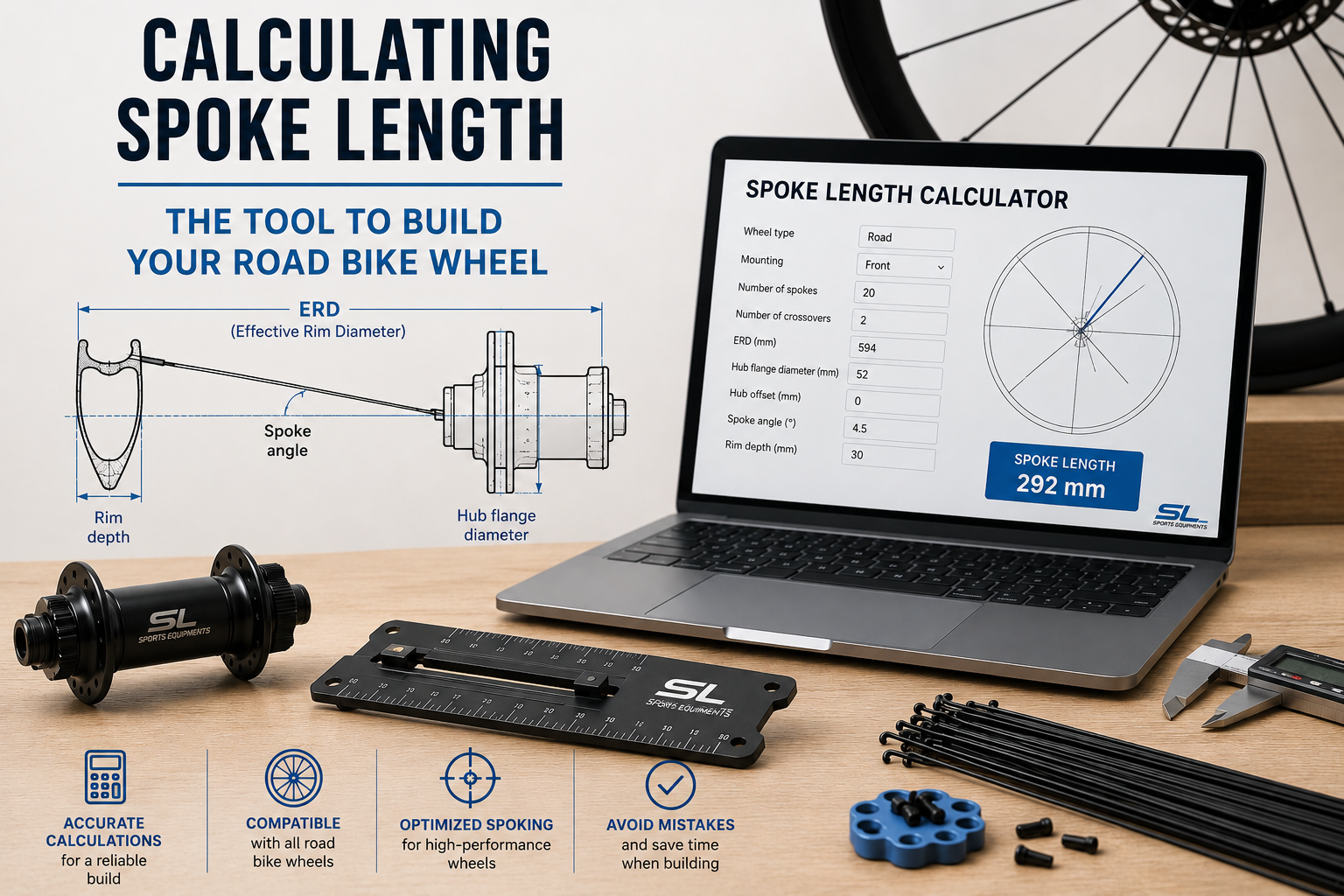
Building or having a road bike wheel built always starts with the same question: what spoke length should you order? A mistake of just a few millimetres is enough to make the build impossible: too short, and there isn't enough thread engaged in the nipple, risking loosening; too long, and it's the rim or the inner tube that pays the price. This length depends on three things you can't guess: the rim dimensions, the hub dimensions, and the number of crosses chosen for the lacing pattern. This article explains which measurements to take, and gives you a free calculator to get the exact length, for both the right and left sides.
1. Why spoke length isn't a guessing game
A spoke isn't a one-size-fits-all part: every wheel, depending on the rim model, the hub and the type of lacing pattern, calls for a precise length, usually accurate to within a millimetre. A spoke that's too short doesn't engage enough thread in the nipple: tension holds poorly, the wheel goes out of true quickly, and the spoke can eventually work completely loose while riding. On the other hand, a spoke that's too long protrudes from the nipple inside the rim: it pierces the rim bed, damages the inner tube, and can cause a sudden puncture mid-ride.
Between these two extremes, the margin for error is small, which is why calculating "by eye" remains a bad idea, even for an experienced home mechanic. That's why we provide a calculator based on the method used by the leading spoke manufacturers: you simply need to enter the right measurements, detailed below.
2. The measurements to take before calculating
Three families of data go into the calculation: the rim, the hub, and the lacing pattern you want. Here's where to find them, and how to measure them if they aren't documented.
Rim: ERD and spoke hole count
The ERD (Effective Rim Diameter) is the key rim measurement. It isn't the outer diameter of the rim, but the diameter measured at the bottom of the nipple seat, where the spoke actually sits. This value is usually listed on the manufacturer's spec sheet; if the rim is second-hand or the model is no longer documented, it's best to ask the seller directly rather than estimate it. The number of spoke holes in the rim (most commonly 20, 24, 28, 32 or 36) must of course match the number of holes in the hub.
Hub: right-side PCD, left-side PCD and flange-to-centre distance
The PCD (Pitch Circle Diameter) is the diameter of the circle formed by the spoke holes on each hub flange. On an asymmetric hub — the case for most disc hubs, and for every rear hub dished to make room for the cassette — the right and left PCD can differ, as can the distance between each flange and the centre of the hub. These two flange-to-centre distances, often listed in manufacturer spec sheets, can also be measured directly with a calliper from the hub axle to each flange.
Lacing pattern: the number of crosses
The number of crosses describes how the spokes cross each other between the hub and the rim: 0 crosses for a radial lacing pattern, often reserved for a light or aerodynamic front wheel, up to 3 or 4 crosses for a sturdier build, better suited to a rear wheel or a loaded touring setup. This choice directly affects the calculated length: with the same rim and hub diameters, more crosses means a longer spoke.
Key takeaway: the ERD is the single most common source of error. Never estimate it from the rim's outer diameter: always ask the seller for it, or refer to the manufacturer's spec sheet.
3. The spoke length calculator
Enter the measurements gathered above into the form below: the tool automatically calculates the required spoke length for the right and left sides, using the triangulation method used by leading spoke manufacturers.
Calculate your spoke length
These lengths are calculated at the bottom of the nipple seat. If in doubt between two commercially available lengths, always choose the shorter one.
4. How to read and interpret the result
Spokes are sold in 1 mm or 2 mm increments depending on the manufacturer: if your result falls between two commercially available lengths, always go with the shorter one. A spoke that's slightly too short remains usable and holds correctly once the nipple is fully tightened; a spoke that's too long does not forgive.
It's entirely normal to get two different lengths for the right and left sides: this is the case on almost every rear wheel, dished to make room for the cassette, as well as on disc hubs, whose two flanges aren't symmetrical about the centre. This isn't a calculation error, it's a characteristic of the build. Once you know the length, you can order your spokes from our road bike wheel catalogue.
5. Common wheel-building mistakes
- Confusing ERD with the rim's outer diameter: these are two different measurements, and the latter never gives a usable result.
- Swapping right and left PCD on an asymmetric hub, which throws off the calculation on both sides.
- Forgetting the offset specific to a disc hub: its two flanges aren't the same distance from the centre, unlike a classic rim-brake hub.
- Not double-checking after the first truing: a correct calculated length combined with a poorly executed build can look like a spoke-length error when it's actually a tension or truing issue.
Please note: if you're working with an old or rare hub whose dimensions aren't documented anywhere, it's best to have the wheel built by a professional rather than estimate a flange-to-centre distance by guesswork.