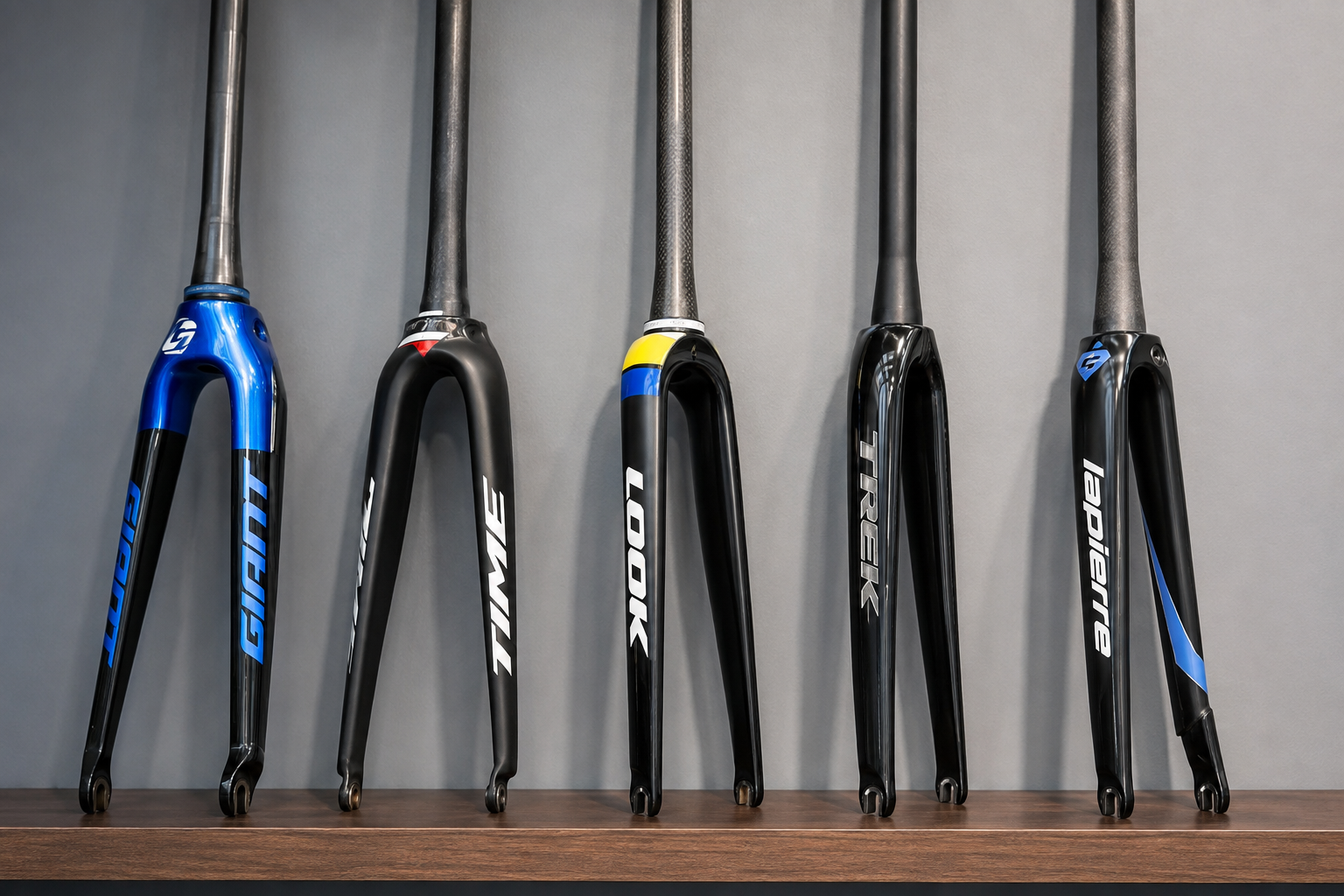
Fork compatibility is not limited to steerer tube diameter or brake type: some brands have their own specific requirements that are worth knowing before placing an order. This guide covers the main road bike brands to help you identify a fork compatible with your Giant, Time, Look, Orbea, Trek, Lapierre or KTM frame.
For the general criteria involved in choosing a 700C road bike fork (materials, braking system, steerer tube), see our complete 700C road bike fork guide.
1. Before choosing by brand: universal compatibility criteria
Regardless of your frame brand, three technical criteria always determine fork compatibility: the diameter and length of the steerer tube, the braking system (rim or disc brakes), and tyre clearance. These criteria are explained in detail in our guides on road bike fork steerers and disc or rim brake road bike forks.
Key point: even within the same brand, compatibility can vary from one model to another and from one generation to the next. The brand name can help narrow down your search, but it never replaces checking these specific technical criteria before placing an order.
2. Giant fork (TCR and other road models)
On the TCR range, the most recent generations feature a more advanced frame-and-fork design, with mounting points and a fork profile specifically engineered for the model. Before replacing a Giant fork, therefore, check the exact year and generation of your frame, as compatibility can differ significantly between two TCR model years.
View our Giant forks in stock →
3. Time fork
Time frames are positioned in the premium/competition segment, with a consistent approach across the range that can also be seen in other components from the brand, such as Time Xpresso and Iclic pedals. For the fork, the same universal criteria (steerer tube, braking system) apply, with no particular proprietary standard to report on most road models.
View our Time forks in stock →
4. Look fork
Some recent Look frames feature a highly integrated design, with internal cable routing and tighter fork tolerances than on conventional models. On these generations, it is best to choose an original fork or one explicitly listed as compatible rather than a generic fork with the same diameter.
5. Orbea fork
On the Orca range and other Orbea road models, compatibility criteria generally follow universal standards (tapered steerer tubes on recent disc-brake versions, straight steerer tubes on older generations). Check the generation of your frame to identify the correct standard.
View our Orbea forks in stock →
6. Trek / Bontrager fork
Trek frequently equips its road frames with components from its in-house Bontrager brand, including the fork itself in some cases. Before replacing your fork, check whether the original fork is a Bontrager model or a generic fork, as certain mounting points (mudguards, cable routing) may be specific to the brand.
View our Trek Bontrager forks in stock →
7. Lapierre fork
On the Xelius and Sensium ranges, compatibility criteria generally follow market standards (1 1/8" or tapered steerer tube depending on the generation, rim or disc brakes depending on the model year). As with other brands, checking the exact steerer tube diameter remains an essential step before placing an order.
View our Lapierre forks in stock →
8. KTM fork
On the Revelator range, compatibility also follows universal standards for steerer tube diameter and braking system. More recent disc-brake models generally use a tapered steerer tube, while older generations retain a straight 1 1/8" steerer tube.
9. Special case: third-party forks compatible with multiple brands
Some forks, such as RockShox models designed for gravel-road configurations or certain specific road models, are not proprietary to any particular frame brand. They can be fitted to several different brands, provided the universal compatibility criteria are met (steerer tube diameter and length, braking system, and tyre clearance). These options often expand the range of available choices, particularly when looking for a compatible used fork for a frame whose original fork has become difficult to find.