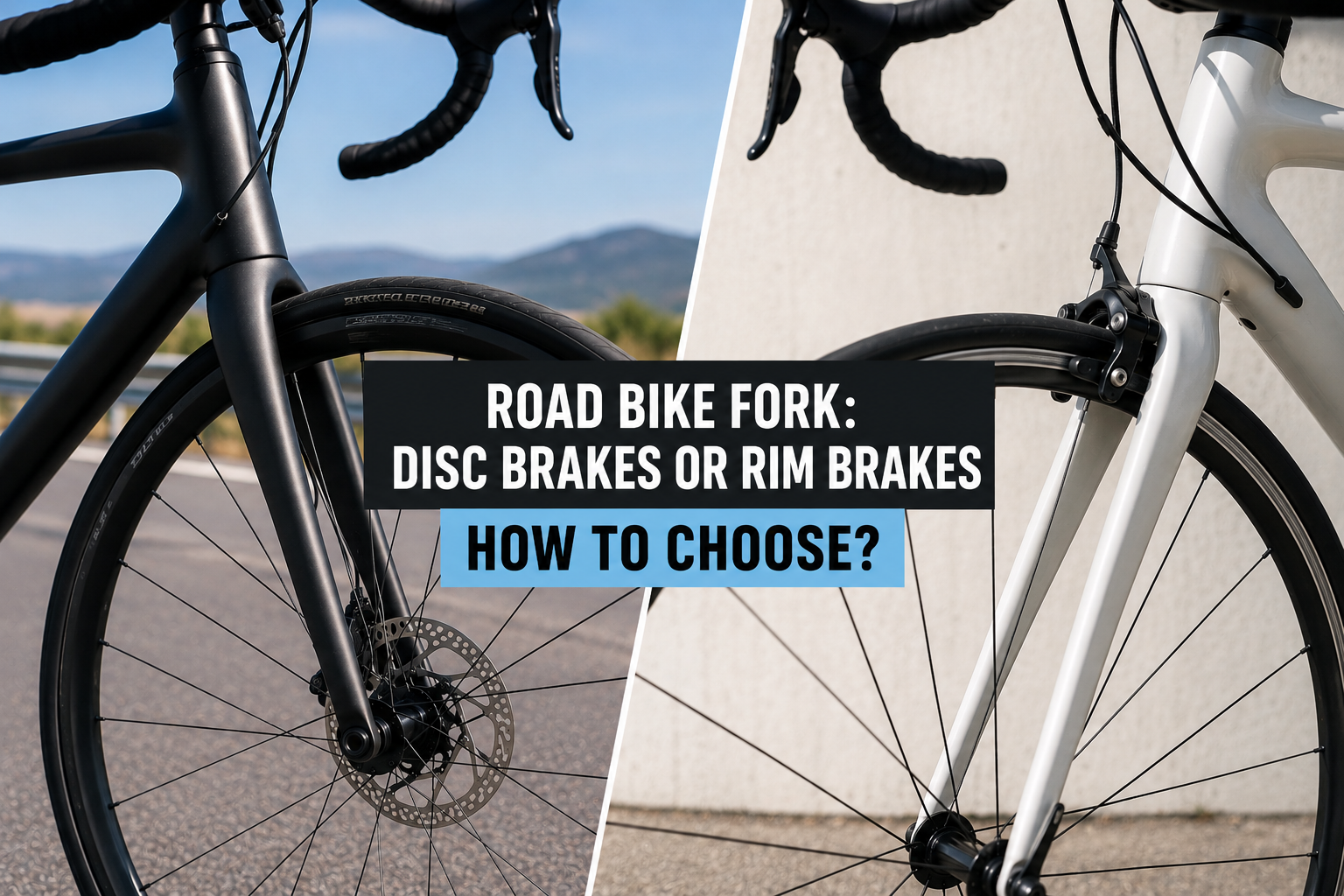
The widespread adoption of disc brakes has reshaped the road bike market, but rim-brake forks are far from obsolete: they are still found on a large proportion of bikes in use, particularly vintage bikes and entry-level configurations. Before replacing your fork or building a new bike, you first need to know which of the two standards actually suits your needs. This guide compares how they work, their advantages, compatibility and cost to help you make the right choice.
For the general criteria involved in choosing a 700C fork (materials, steerer tube length, tyre clearance), see our complete 700C road bike fork guide.
1. Rim-brake fork: how it works and its advantages
With a rim-brake fork, braking is applied directly to the wheel rim: the brake caliper squeezes two rubber brake pads against either side of the rim when you pull the brake lever. This is the traditional road bike braking system, still widely used on classic, vintage and entry-level frames.
Key takeaway: a rim-brake fork remains a relevant choice if your frame is not designed for disc brakes, if you mainly ride in dry conditions, or if you are looking for the lightest and most affordable fork available.
Main advantages:
- Lighter than an equivalent disc-brake fork, using the same material.
- Generally lower purchase price, both new and used.
- Compatible with the vast majority of vintage road frames and traditional wheels.
- Simple maintenance: replacing brake pads, adjusting toe-in, and no bleeding required.
Limitations: braking power drops significantly in wet conditions, the rim gradually wears through contact with the brake pads, and clearance for wider tyres (30 mm and above) is often more limited than with a disc-brake fork.
2. Disc-brake fork: how it works and its advantages
With a disc-brake fork, braking is no longer applied to the rim but to a metal rotor attached to the wheel hub. The caliper, mounted on fork mounts designed for the flat mount standard, clamps the rotor. The fork itself is reinforced to withstand the lateral forces generated by this type of braking, particularly during hard braking on descents.
Main advantages:
- Greater and more consistent braking power, including in wet conditions.
- Rims are protected from wear caused by brake pad friction.
- Greater tyre clearance, allowing wider tyre sizes (28 to 32 mm and above).
- Now the dominant standard on modern road bikes, meaning a wide range of forks is available.
Limitations: slightly heavier than a comparable rim-brake fork, generally higher purchase price, and specific maintenance if the system is hydraulic (bleeding and brake pad replacement).
3. Disc-brake vs rim-brake fork: comparison table
| Criterion | Rim-brake fork | Disc-brake fork |
|---|---|---|
| Weight | Lighter using the same material | Slightly heavier (reinforcements) |
| Braking power | Good in dry conditions | Superior in all conditions |
| Average price | Generally more affordable | Higher, especially in carbon |
| Wheel compatibility | Rim-brake wheels | Disc-brake wheels (specific hub) |
| Maintenance | Simple (pads, toe-in adjustment) | Pads, bleeding if hydraulic |
| Wide tyre clearance | Limited | Greater |
| Recommended use | Classic road riding, budget builds, vintage bikes | Sportive rides, all-weather riding, gravel-friendly setups |
4. Which fork should you choose for your type of riding ?
- Sportive rides or racing: a disc-brake fork is the better choice for consistent braking performance and safety, particularly on descents or in wet conditions.
- Vintage road bike or retrofit: a rim-brake fork remains the logical choice, as it is compatible with the original frame and wheels without modifications.
- Limited budget or entry-level bike: a rim-brake fork, which is often cheaper to purchase, helps keep the overall investment down.
- Wide tyres or gravel-friendly riding: a disc-brake fork provides more clearance for comfortable use of 28–32 mm tyres.
5. Can you replace a rim-brake fork with a disc-brake fork ?
No, not directly. Switching from rim brakes to disc brakes involves more than simply changing the fork: it generally requires checking or replacing several components.
Compatibility points to check before any conversion: the frame itself must be designed for a rear disc brake (otherwise the conversion does not make sense), the wheels must have disc-compatible hubs, and the brake levers must match the chosen system (mechanical or hydraulic). Without these adaptations, a disc-brake fork alone is not enough to convert a rim-brake bike to disc brakes.
In most cases, it is therefore better to consider the bike as a complete system rather than replacing the fork alone. For detailed installation steps, our article road bike fork removal and replacement is still a useful starting point, although switching to disc brakes requires additional compatibility checks.
6. Where to buy your road bike fork (disc or rim brake) ?
At SL Sport equipments, every used fork is inspected and rated from 1 to 10 before being put back on sale, whether you are looking for a rim-brake model for a retrofit or a carbon disc-brake fork for a performance setup. Take a look at:
- Our selection of road bike disc-brake forks, inspected and ready to install.
- Our 1 1/8 road carbon forks, available in both rim-brake and disc-brake versions.
- Our complete 700C road bike fork catalogue, covering all brands and budgets.