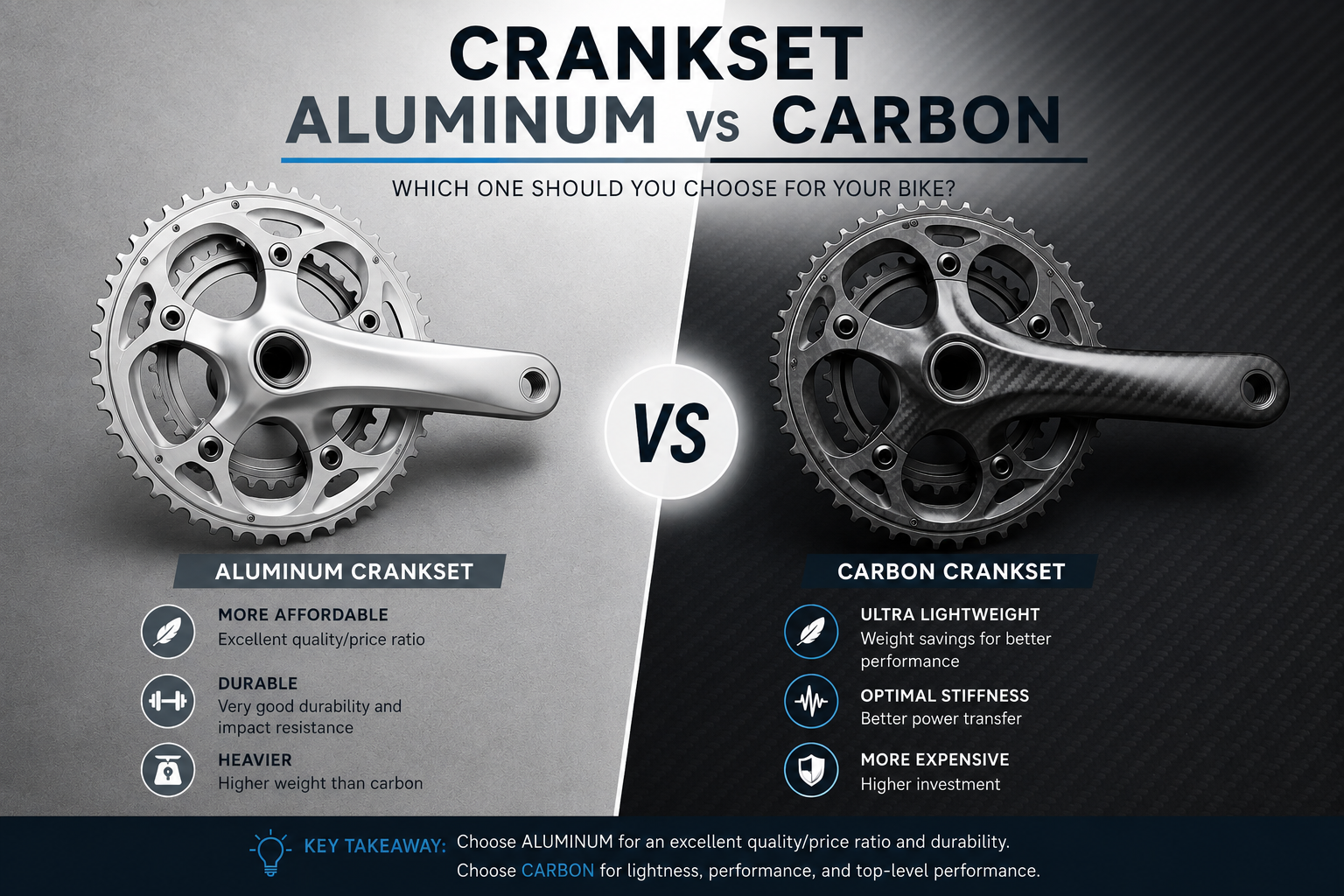
Carbon or aluminum: choosing the right material for a road bike crankset often comes down to balancing performance and budget. Carbon appeals with its low weight and stiffness, while aluminum offers reassurance through its durability and more affordable price. This guide compares the two materials to help you make an informed choice, whether you are buying a new or used crankset.
To learn everything about how a road bike crankset works, see our complete road bike crankset guide. The material is independent of the chainring configuration (see our article compact vs standard vs semi-compact) and crank arm length (see our guide road bike crank arm length): these three criteria can be combined freely depending on the model.
1. Quick comparison table
| Criteria | Carbon | Aluminum |
|---|---|---|
| Weight | Lighter | Heavier |
| Stiffness | Excellent, optimal power transfer | Good, slightly lower |
| Price | Higher | More affordable |
| Impact resistance | Sensitive to impacts, risk of invisible cracking | Resistant to impacts, tends to deform rather than break |
| What to check when buying | Thorough visual inspection recommended, especially when buying used | Standard maintenance and inspection |
| Who is it for? | Racing, performance-oriented riders | Regular use, controlled budget, used-bike component buyers |
2. Carbon crankset: advantages and limitations
Carbon is the benchmark material for high-end cranksets, particularly for racing-oriented models. Its low weight is a genuine advantage, although it should be put into perspective when considering the bike as a whole. Its stiffness also allows for more efficient power transfer, which is especially noticeable when riding out of the saddle or during a sprint.
The downside of this performance is greater sensitivity to impacts than aluminum. A crash or impact can create an internal crack that is invisible to the naked eye, weakening the component without any immediately visible signs. This characteristic deserves particular attention when buying a used carbon crankset.
Before buying a used carbon crankset: carefully inspect the crank arms for cracks, areas of peeling clear coat, or dull-looking surfaces that could indicate a previous impact. If in doubt, it is better to consider an aluminum model or seek professional advice before purchasing.
Advantages: genuine weight savings, greater stiffness, improved power transfer.
Limitations: higher cost, sensitivity to impacts, greater care required when buying used.
Who is it for? Competitive riders, cyclists looking for maximum performance, and riding situations where weight and stiffness are particularly important.
3. Aluminum crankset: advantages and limitations
Aluminum remains a reliable choice for entry-level and mid-range cranksets. Its main advantage is its durability: unlike carbon, it tends to bend or show visible marks after an impact rather than fail suddenly, making its condition more predictable over time and providing greater peace of mind when buying used.
Its more affordable price also makes it a sensible choice for regular riding without a racing objective. The trade-off is that it is heavier than carbon and offers slightly less stiffness, a difference that is mainly noticeable when producing high power.
Advantages: more affordable price, durability and impact tolerance, proven reliability, better choice for used purchases.
Limitations: higher weight, slightly lower stiffness than carbon.
Who is it for? Regular sport cyclists, riders on a controlled budget, and buyers of used components who value greater impact tolerance.
4. What is the actual weight difference?
The weight difference between an equivalent carbon and aluminum crankset generally ranges from a few dozen to a few hundred grams, depending on the models and product ranges being compared. This is a genuine weight saving, but it needs to be put into perspective: when considering the total weight of a road bike, other components such as the wheels or frame generally have a greater impact on overall weight and on the feeling of lightness while riding.
In other words, switching to carbon makes more sense when the goal is improved stiffness and pedaling feel than when looking for an isolated and significant weight saving.
5. Carbon or aluminum: which material for your type of riding ?
- Competitive rider, looking for maximum performance → carbon, for its stiffness and weight savings.
- Regular sport cyclist, controlled budget → aluminum, an excellent reliability/price compromise.
- Buying used → aluminum is recommended as a priority, with less risk of hidden damage; carbon is still an option provided the condition of the crank arms is thoroughly inspected.
Browse all our new and used models, across all ranges and materials, on our road bike crankset page.