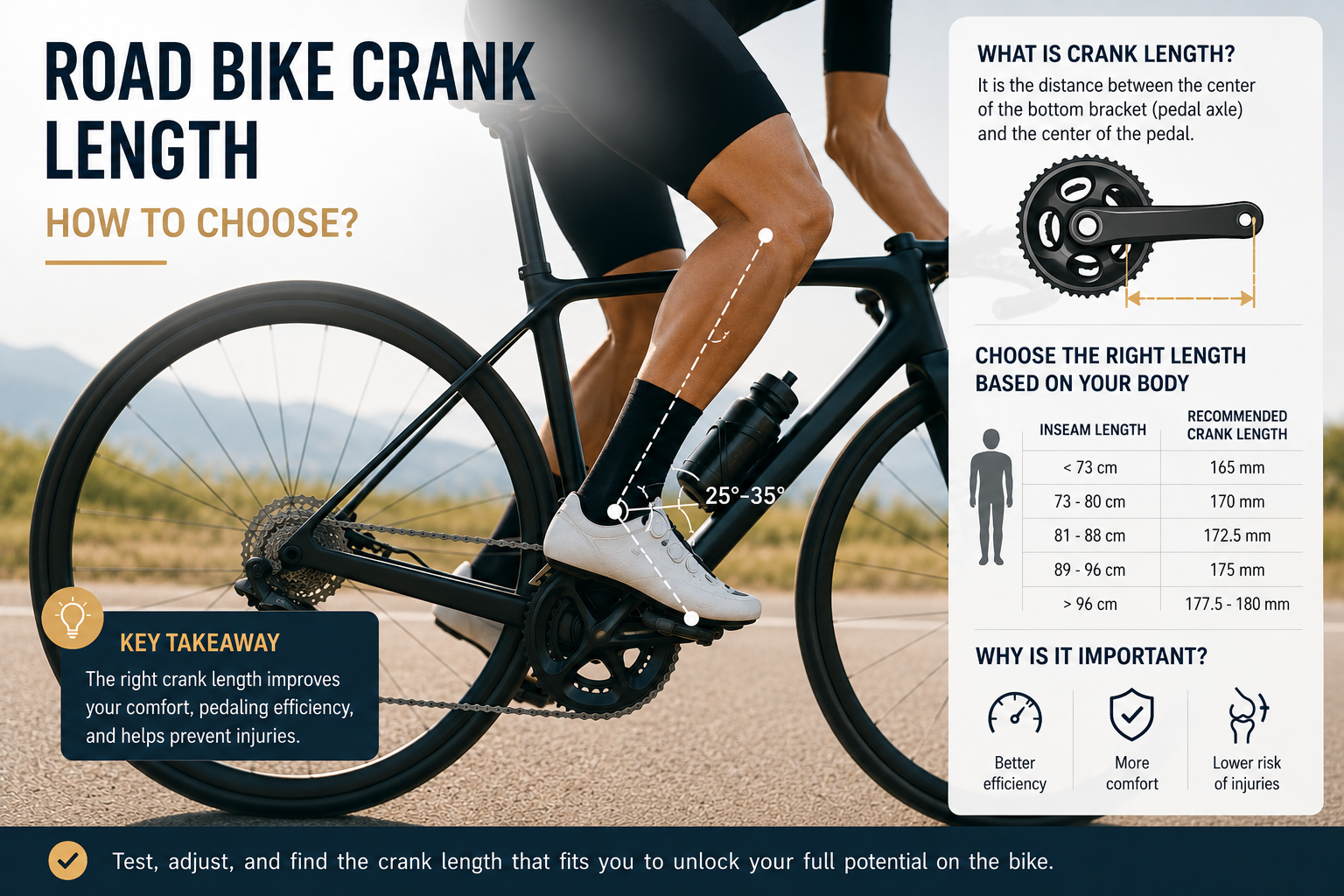
165, 170, 172.5 or 175mm: crank length is one of the most underestimated factors when choosing a crankset, often left at the bike's "default" setting without any real adjustment to the cyclist's body shape. Yet it directly affects your joint comfort, natural cadence, and position on the bike. This guide will help you understand how to choose the right length based on your height and riding style.
To learn everything you need to know about how a road bike crankset works, check out our complete guide to road bike cranksets. For more information on choosing chainrings, see our article compact vs standard vs semi-compact cranksets.
1. Why crank length is an underestimated factor
On the vast majority of road bikes sold in stores or online, crank length is set by default to 170 or 172.5mm, regardless of the cyclist's height. This industrial choice simplifies production, but it does not necessarily match your body shape.
An unsuitable crank length can result in recurring knee pain, an uncomfortable feeling in an aerodynamic position, or a pedaling cadence that never really feels right, without you identifying the cause. This is a setting that is often overlooked, even though, just like saddle height or saddle setback, it is one of the parameters that define your position on the bike.
2. Crank lengths available on the market
Crank length is measured from the center of the bottom bracket axle to the center of the pedal axle. Here are the most common sizes for road bikes:
| Length | Availability | Typical use |
|---|---|---|
| 165mm | Increasingly common | Smaller riders, aerodynamic positioning, time trials |
| 167.5mm | Less common | Intermediate option, often available on high-end models |
| 170mm | Very common (reference size) | Average-sized riders, versatile use |
| 172.5mm | Very common (reference size) | Average to tall riders, frequently fitted as standard |
| 175mm | Common | Tall riders |
| 180mm | Rare, made to order | Very tall riders |
3. How to determine the right crank length based on your height
There is no single, universally validated medical formula for calculating the ideal crank length, but a commonly used approach is to use the cyclist's height as a starting point and then fine-tune the choice based on personal feel.
| Cyclist's height | Indicative crank length |
|---|---|
| Under 1.60m | 160 to 165mm |
| 1.60m to 1.70m | 165 to 170mm |
| 1.70m to 1.80m | 170 to 172.5mm |
| 1.80m to 1.90m | 172.5 to 175mm |
| Over 1.90m | 175 to 180mm |
Use this as a starting point, not a prescription: this table provides an indicative range based on height. Inseam length, hip flexibility, usual cadence, and personal comfort are equally important factors. For precise adjustment, a professional bike fitting remains the most reliable method.
4. Short cranks: what are the advantages ?
The current trend, driven in particular by modern bike fitting and part of the professional peloton, is moving toward shorter cranks than the historical standard. A shorter crank opens up the hip angle in an aerodynamic position, which can improve aerodynamics and reduce compression around the pelvis. It also reduces joint stress on the knees, particularly at high cadence.
Who is it for? Cyclists with limited hip range of motion, triathletes and time-trial riders in a highly aerodynamic position, cyclists with a history of knee pain, and riders who naturally pedal at a high cadence.
5. Long cranks: what are the advantages ?
A longer crank provides greater mechanical leverage, which can be an advantage for cyclists who climb at a low cadence by generating force rather than spinning their legs quickly. However, it places greater stress on the joints, particularly the knees, and is less well suited to maintaining a high cadence.
Who is it for? Tall cyclists with good joint flexibility, "grinder" riders who prioritize force over cadence, and rides with significant elevation gain where torque is more important than rotational speed.
6. Crank length and cadence: the link you need to know
At the same leg angular velocity, a shorter crank naturally allows for a higher pedaling cadence, while a longer crank favors a lower cadence at a comparable effort. This is why cyclists who switch to shorter cranks sometimes adjust their chainring configuration to maintain an equivalent gear ratio, for example by choosing a slightly larger chainring.
This link between crank length and cadence explains why changing crank length often requires an adaptation period: your body needs time to find a natural pedaling rhythm with the new lever length.
7. Changing crank length: what you need to know
On most modern cranksets, only the crank arms need to be changed: the bottom bracket and chainrings can generally remain the same, provided that the crank axle and crankset standard remain compatible. Before making a purchase, check the compatibility between the axle of the new crank arms and your current bottom bracket — a point covered in detail in our guide to crankset compatibility.
After changing crank length, allow for a few rides to adapt: your natural cadence and overall sensations may take some time to adjust to the new lever length, especially if the difference from your previous crank length is greater than 2.5mm.
8. FAQ — Road bike crank length
170mm or 172.5mm: what difference can you actually feel?