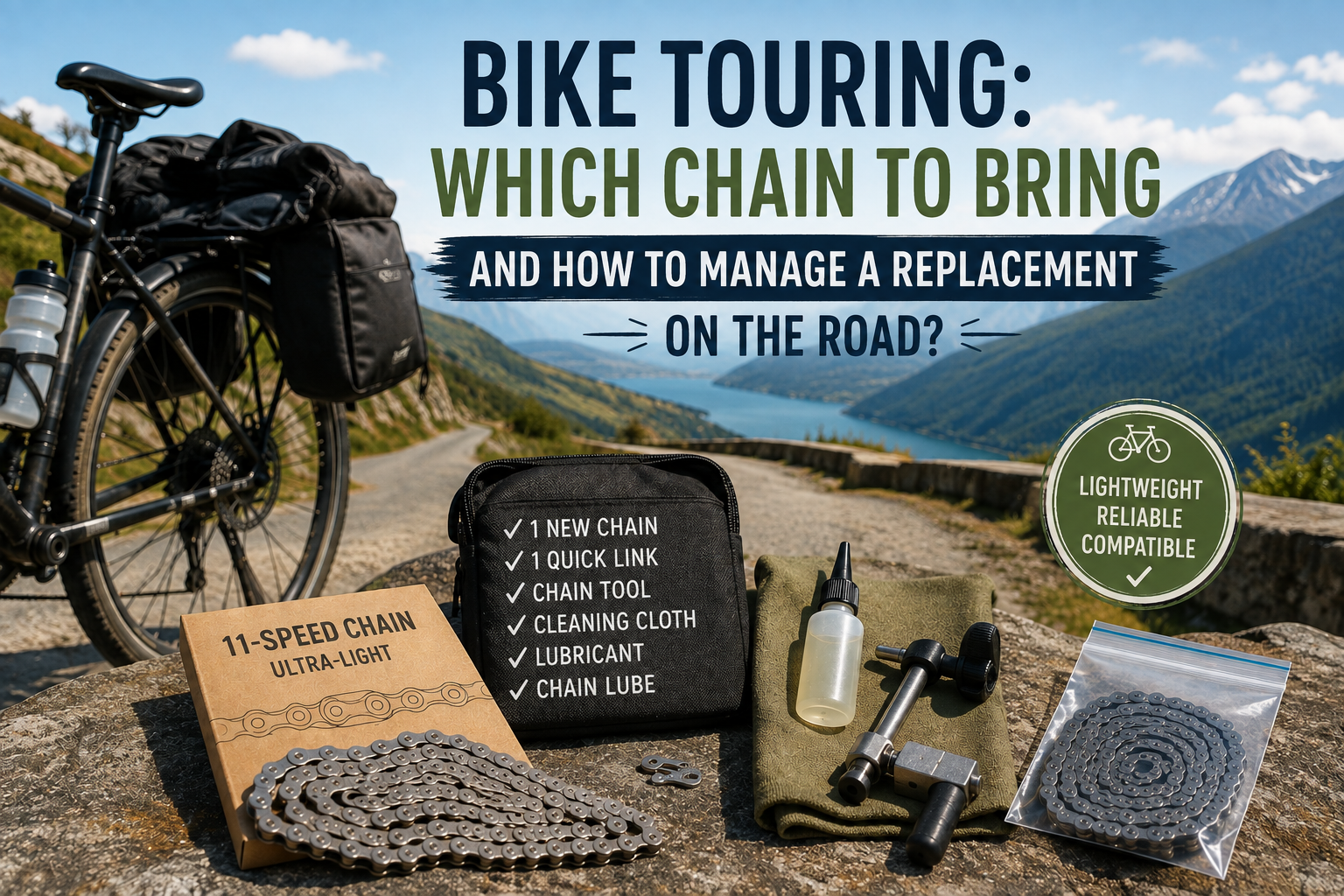
A long-distance bike tour completely changes the way you need to approach chain maintenance: high mileage over a short period, frequent distance from bike shops, and sometimes limited access to parts compatible with your groupset. Preparing for this before departure can prevent you from getting stranded hundreds of kilometers from the nearest bike shop.
This guide covers how to choose your chain, what to carry with you, and how to handle a replacement when you are far from any bike shop. For the general basics, see our complete road bike chain guide.
1. The specific challenges of bike touring
A trip lasting several weeks or months can involve several thousand kilometers of continuous riding, often with a loaded bike (panniers, bikepacking bags), putting more strain on the drivetrain than typical road riding. Added to this is the frequent distance from specialist bike shops depending on the regions you travel through, making preparation and planning essential in a way that may not be necessary for everyday riding in or around town.
2. Standard chain or universal chain for touring?
International availability is an important selection criterion when touring, and can sometimes matter more than outright performance. A widely distributed chain compatible with several brands for the same number of speeds increases your chances of finding a suitable replacement at a local bike shop, even a small one. Our article KMC vs Shimano/SRAM/Campagnolo explains this multi-brand compatibility approach in more detail, which can be particularly useful if your drivetrain allows it.
3. Should you carry a complete spare chain?
| Situation | Complete spare chain | Comment |
|---|---|---|
| Remote destination, long route with no technical resupply | Recommended | No guarantee that you will find the exact reference locally |
| Europe, dense network of bike shops | Not essential | A compatible chain can generally be found fairly easily |
| Proprietary groupset (SRAM AXS, Campagnolo 12-speed) | Strongly recommended | Specific chain references are rarely available outside major cities |
4. The minimum kit to carry in all cases
Basic kit recommended, regardless of your destination:
• One or two spare quick links, compatible with your chain (see our guide quick link vs pin riveting to make the right choice).
• A portable chain tool, usually integrated into a cycling multi-tool.
• A compact, lightweight chain wear checker for regularly checking the condition of your chain without relying on a bike shop.
5. Planning for chain wear checks while touring
The high mileage covered in a short period requires more frequent checks than normal riding. See our chain wear checker guide for the complete method: the recommended replacement threshold (0.75% elongation) remains the same when touring, but it will be reached more quickly in terms of mileage than during everyday use.
Between checks, keep an eye out for warning signs: unusual noise or gear skipping under load. Our guide chain skipping or cracking will help you quickly diagnose a problem, even without a measuring tool at hand.
6. Replacing your chain on the road
Replacing a chain does not require a workshop: see our complete guide how to change your road bike chain for the detailed procedure. When touring, two points deserve an additional check before you set off again:
Chain length: a replacement chain purchased locally must be adjusted to the correct number of links for your drivetrain, rather than simply installed as it comes.
Installation direction: some modern drivetrains require the chain to be installed in a specific orientation — see our article on directional chains if your groupset is affected.
7. Where to find a spare chain abroad
In well-served areas, a general bike shop or a sporting goods store with a cycling section will generally offer a chain compatible with the most common mechanical standards (Shimano, mechanical SRAM, KMC). In more remote areas, bicycle repair shops specializing in utility bikes (often focused on mountain bikes or city bikes) may be able to help with the most common speed configurations, but rarely with high-end proprietary references.
Important point: a proprietary groupset (SRAM AXS Flattop, Campagnolo 12-speed C-Link) makes things considerably more difficult outside major cities or specialist bike shops. This is not a reason to panic, but it is a good reason to plan ahead: carry your own spare chain and compatible quick links rather than relying on local availability.