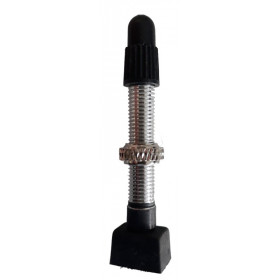


Presta valve: the complete guide for your road bike
It's slim, elegant and a little intimidating the first time you meet it. The Presta valve is fitted to almost every road bike, yet how many cyclists have bent it, jammed it or snapped it off by trying to inflate too quickly? The good news: once you understand how it works, it's simple to use and has real advantages on the road. Here's everything you need to know to choose it, inflate it and look after it.
What is a presta valve ?
The Presta valve, also known as the French valve or Sclaverand valve, is a 6 mm diameter valve, slimmer than the Schrader valve (the one found on cars, at 8 mm). It works differently: instead of a spring-loaded plunger, it relies on a small metal stem topped with a knurled locknut, which you need to loosen before inflating and tighten afterwards.
That slimness is no accident. On a road rim, the valve hole is narrow: the smaller it is, the stiffer and stronger the rim stays. That's why the Presta bike valve is the standard on high-end wheels, and why it copes easily with the high pressures of road cycling.
Presta vs Schrader: what are the differences ?
- Diameter: 6 mm for Presta, 8 mm for Schrader. Check your rim's valve hole before buying anything.
- Pressure: Presta handles high pressures very well, which suits road and gravel bikes.
- Weight: Presta is slightly lighter, a detail that matters when you're counting every gram.
- Inflation: a Presta valve is closed manually with its locknut, whereas a Schrader closes by itself thanks to its spring.
Which presta valve length should you choose?
This is the question that comes up most often, and it's the right one: a valve that's too short won't stick out of the rim, and you won't be able to attach the pump head. The Presta valve length is chosen according to the depth of your rim.
The rule is simple: the valve must extend at least 10 to 15 mm beyond the rim so the pump can connect without forcing.
The 40 mm presta valve: the standard choice
The 40 mm Presta valve is the benchmark for classic road bike rims up to about 30 mm deep. It's the length found on most road inner tubes. If your rims are low or mid profile, this is the one you need.
Longer valves for deep-section rims
As soon as you ride carbon or alloy rims with a deep profile, 40 mm is no longer enough. Here are some common guidelines:
- 40 to 45 mm: rims up to roughly 30 mm deep
- 60 mm: rims from 30 to 45 mm
- 80 mm: rims from 45 to 60 mm
- 100 mm: very deep rims, beyond 60 mm
These figures are indicative: always measure your rim depth, valve hole included, and keep a safety margin. A valve that's a bit too long is better than one that's too tight a fit.
Need to replace your tube? Browse the full range in our road bike inner tubes category, with different valve lengths to suit the depth of your rims.
How to inflate a presta valve, step by step
Inflating a Presta valve takes two or three precise movements, but nothing complicated. Once the routine is second nature, you'll do it with your eyes closed.
- Unscrew the locknut at the top of the valve, without removing it completely. A few turns are enough.
- Press the stem briefly to free it from its seat. A small puff of air confirms it's loose. This is the step many people forget, and it's the main reason a valve "won't inflate".
- Attach the pump head straight on, without forcing, then lock it.
- Inflate to the desired pressure, then remove the pump with a clean, straight movement.
- Tighten the locknut by hand, without over-tightening. Put the cap back on.
To inflate a Presta valve without damaging it, avoid sideways movements: a bent stem never comes back perfectly straight. And if your valve resists, don't force it, or you risk bending it.
Which pump for a presta valve ?
Good news: most hand pumps, floor pumps and inflators today work with both types of valve. A Presta valve pump has either a reversible head or a dual head that fits both standards.
At home, a floor pump with a pressure gauge is ideal: it lets you control the pressure precisely, which matters a lot on a road bike. On the road, a mini pump or a CO₂ cartridge does the job very well. A quality Presta valve inflator can be recognised by its well-fitted head, which doesn't need to be held on by force.
The presta valve adapter: what is it for ?
You've got a flat, and the only pump available is a petrol station one with a head designed for a Schrader valve. That's when a Presta valve adapter comes in handy: this small fitting screws onto the valve and turns it into a Schrader valve for the time it takes to inflate.
It weighs a few grams and slips easily into a saddle bag. Be careful with pressure, though: a garage compressor is very fast, and a road inner tube should be inflated in short bursts. Keep a constant eye on the gauge.
The presta valve core: how do you remove it ?
The Presta valve core is the small internal part that ensures airtightness. On many valves it's removable, which has several benefits: replacing it if it leaks, cleaning the valve, or pouring sealant inside.
To remove a Presta valve core:
- Unscrew and remove the stem locknut if necessary.
- Find the small hexagonal or knurled part at the base of the core.
- Use the tool supplied with some valves, or small pliers, to unscrew it anticlockwise.
- Refit it by tightening gently, without excess.
Not all valves have a removable core: some inner tubes have a core that is bonded or inaccessible. Check the product page before relying on it.
Presta valves for tubeless setups
A tubeless Presta valve isn't quite the same as the one on an inner tube. It has a rubber base that fits against the rim bed to guarantee an airtight seal, and is secured with a lock ring. The rim's valve hole must be suitable, hence the importance of choosing a model compatible with your rim.
Another particularity: sealant tends to clog the small channels. That's why tubeless valves with a removable core are so popular, as they let you inject sealant directly without taking the tyre off. If you're staying with inner tubes, a standard Presta valve remains perfectly suitable.
Mistakes to avoid
- Forgetting to unscrew the locknut before inflating: no air gets through.
- Over-tightening the locknut: it only needs to be closed, not locked with pliers.
- Fitting a valve that's too short on a deep rim.
- Pushing sideways with the pump head, at the risk of bending the stem.
- Ignoring the cap: it protects the thread from dust and moisture.
Choosing the right inner tube with a Presta valve
Beyond the valve, check that the inner tube matches your tyre width (for example 700 x 23/28 or 700 x 28/32) and your rim depth. A latex inner tube is lighter and more supple, but it loses air faster and needs regular checks. Butyl remains the most versatile choice for everyday training.
To compare references, valve lengths and available widths, head to the road bike inner tubes category.
FAQ: your questions about the presta valve
How do you recognise a Presta valve ?
It's the slimmer of the two common valves: it measures 6 mm in diameter and ends in a small knurled locknut at the top of the stem. The Schrader valve, which is wider, looks like the one on a car.
Which Presta valve length should I choose ?
It depends on the depth of your rim. A 40 mm Presta valve suits rims up to about 30 mm deep. Beyond that, you need to move up to 60, 80 or 100 mm. The valve must extend 10 to 15 mm beyond the rim so the pump can attach properly.
Why won't my Presta valve inflate?
In the vast majority of cases, the locknut hasn't been loosened or the stem is stuck to its seat. Unscrew the locknut, press the stem briefly until you hear a small hiss of air, then try inflating again.
Can you inflate a Presta valve with a pump designed for Schrader valves ?
Yes, using an adapter that screws onto the valve. Many modern pumps also have a head compatible with both standards. Watch the pressure closely with a compressor: it inflates very quickly.
How do you remove a Presta valve core ?
Unscrew it anticlockwise with the small tool supplied or suitable pliers. Be aware that not all cores are removable: some valves are bonded to the inner tube.
Can you use a Presta valve for tubeless ?
Yes, but you need a specific tubeless valve, with a rubber base and a lock ring, suited to your rim. Models with a removable core make it easier to add sealant.