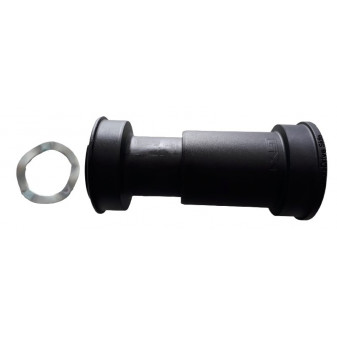
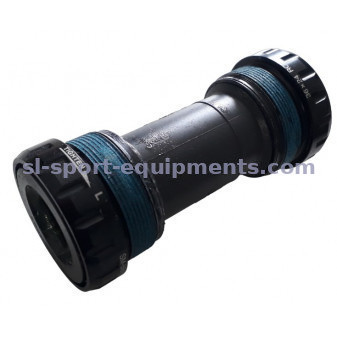
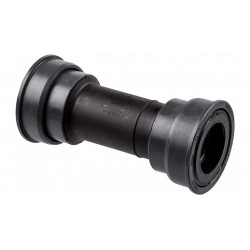
Suspicious creaking, play in the crank arms, or simply fitting a new frame: sooner or later, every road cyclist runs into this technical question that has divided workshops and forums for years. Threaded or press-fit, the two systems have different mechanisms, different advantages, and different limitations.
Discover our range of road bike bottom brackets and road bike drivetrain groups in stock.
1. What is a threaded (BSA) bottom bracket?
The threaded bottom bracket, also known as BSA, is the historic standard for road bikes. Its operation is simple: the cups screw directly into a thread machined into the frame's bottom bracket shell. This screwed mechanical connection guarantees stable holding and precise, torque-controlled tightening.
Two main threadings are found on road bikes:
- BSA (1.37 x 24), very widely used, particularly on Shimano-compatible frames.
- The Italian thread (36 x 24T), rarer today, historically associated with Campagnolo frames.
Threaded remains, even today, the reference standard for its simplicity of installation and its proven long-term reliability.
2. What is a press-fit bottom bracket ?
The press-fit bottom bracket works on a completely different principle: instead of being screwed in, the cups are pressed directly into the bottom bracket shell, with no threading. Retention therefore relies on the tight mechanical fit between the outer diameter of the cups and the inner diameter of the frame.
This system emerged alongside the rise of carbon frames, in a search for weight savings and stiffness. The most common press-fit standards on road bikes are BB86/BB92 (Shimano), BB30, and PF30. To understand the differences between these standards in detail, see our guide to BB30, PF30, BB86, BB92 press-fit standards.
3. Threaded vs press-fit comparison table
| Criteria | Threaded (BSA) | Press-fit |
|---|---|---|
| Reliability | High | Good if fitted carefully |
| Ease of fitting/removal | Simple, with a wrench | Requires a dedicated press and extractor |
| Weight | Slightly higher | Lighter |
| Crankset stiffness | Adequate | Better, especially on a 30 mm axle |
| Risk of creaking | Low | Higher with imprecise tolerances |
| Tools required | Standard bottom bracket wrench | Press + dedicated extractor |
| Frame compatibility | Threaded frames only | Frames designed for press-fit |
Note: this table gives an overview; actual performance also depends on the manufacturing quality of the frame and the bottom bracket fitted.
4. Pros and cons of each system
Pros and cons of threaded
Pros:
- Fitting and removal accessible to any DIY-minded cyclist, with basic tools.
- Very low risk of creaking if the installation is clean.
- Easy maintenance, quick replacement in case of wear.
Cons:
- Slightly heavier than some press-fit solutions.
- Stiffness slightly behind systems with a 30 mm axle.
Pros and cons of press-fit
Pros:
- Appreciable weight saving on a complete bike.
- Increased stiffness, particularly noticeable when standing or sprinting.
- Allows for wider tube diameters, so potentially stiffer frames overall.
Cons:
- Fitting is more technical, requires specific tools.
- More prone to creaking if the frame's tolerances aren't perfect.
- Removal can be trickier, with a risk of damaging the frame if the operation isn't done properly.
5. Which system for which use ?
The choice isn't simply a matter of personal preference: in the vast majority of cases, it's the frame that dictates the standard, not the other way around.
- For leisure riding, sportives, or long distances, where ease of maintenance matters most, threaded remains a reassuring choice.
- For competitive use, where every gram and every watt counts, press-fit on a high-end carbon frame can provide a real stiffness advantage, provided you accept slightly more demanding maintenance.
6. How do I know which standard fits my bike ?
Before any purchase, it's essential to precisely identify the standard fitted on your frame: the manufacturer's spec sheet, measuring the inner diameter of the bottom bracket, or checking the references stamped on the old bottom bracket when removing it.
Good to know: once you've identified your standard, discover our range of road bike bottom brackets, covering both threaded standards (BSA, Italian) and the main press-fit references on the market.