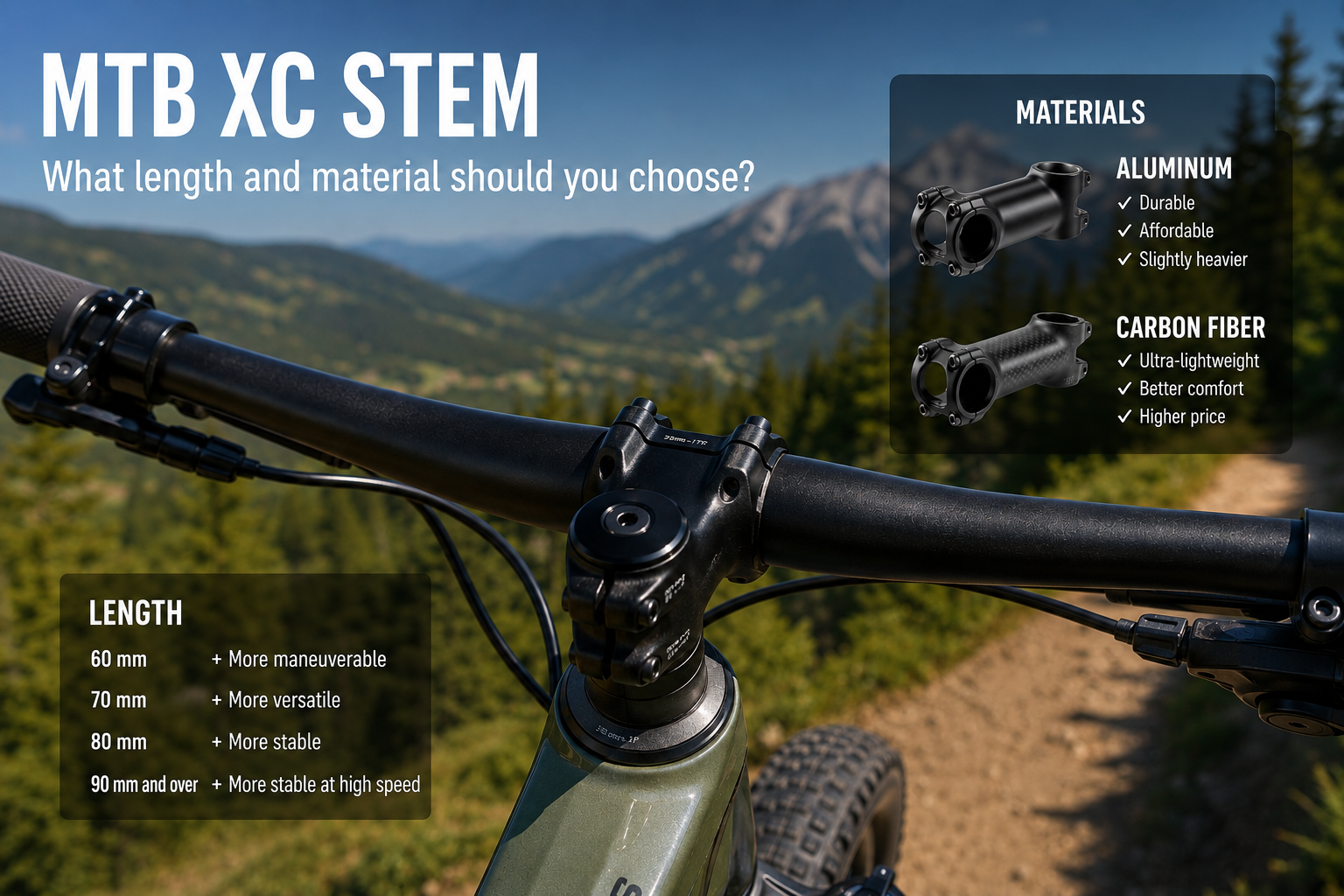
Cross-country occupies a unique position in the MTB world: it is faster and more flowing than an enduro course, but still includes enough technical sections that you cannot think purely in terms of efficiency, as you would on a road bike. This dual requirement is directly reflected in the choice of stem, halfway between the short standards of off-road mountain biking and the longer lengths commonly used on road bikes.
This guide complements our complete MTB stem guide by detailing recommendations specifically for XC, whether for racing or recreational riding such as marathon events.
1. XC: a discipline halfway between road cycling and off-road MTB
In our article on the short MTB stem, we explained why enduro and downhill prioritize very short stems (35 to 40 mm), with handling as the main objective. XC does not follow exactly the same logic.
In cross-country, the course alternates between fast, flowing sections, sustained climbs and occasional technical singletrack. Pedaling efficiency and a stable riding position therefore become more important, without going back to the lengths typically associated with road bikes (90 mm and longer). The ideal compromise generally falls somewhere between these two approaches.
2. What stem length should you choose for XC?
XC Racing
In racing, the goal is to maximize pedaling efficiency and adopt a more stretched-out riding position, closer to the road cycling approach, while retaining enough responsiveness for the technical sections of the course.
Recreational XC / Marathon
Over longer distances, a slight reduction in stem length compared with pure racing helps preserve comfort without excessively compromising efficiency. This is the most versatile range for regular use.
Key takeaway: these ranges deliberately overlap with those already discussed in our article on the short MTB stem — XC racing sits toward the upper end of the MTB range (60–90 mm), while enduro remains at the shorter end (35–40 mm).
3. What material should you choose for an XC stem ?
XC is precisely the type of MTB riding where carbon can make the most of its advantages: the terrain is generally less demanding than in enduro or downhill, exposing the component to fewer direct impacts, while the weight savings can have a direct impact on racing performance.
For a detailed explanation of how carbon behaves under impact and the precautions to take depending on your riding style, see our dedicated article on the carbon MTB stem. For recreational XC, aluminum remains a highly relevant choice, with no significant compromise on riding enjoyment.
4. Stem angle for XC: staying efficient without sacrificing comfort
A neutral to slightly positive angle is generally recommended for XC, in line with the guidelines detailed in our article on the riser MTB stem. The goal is to maintain an efficient pedaling position while avoiding excessive strain on the back and neck that can result from a pronounced negative angle, particularly during long events such as XC marathons or ultra-distance races.
5. Our XC MTB stems
At SL Sport Equipments, you will find several stem options suitable for XC, ranging from 60 to 90 mm in length and available in both aluminum and carbon. All our used components are inspected before shipping, with their condition rated from 1 to 10, ensuring complete transparency regarding wear and condition.
6. FAQ — XC MTB Stems
Conclusion
XC stems follow an approach somewhere between off-road MTB and road cycling: a longer stem than in enduro (60 to 90 mm depending on the rider's level and riding style), carbon that is particularly relevant for racing, and a neutral to slightly positive angle to preserve comfort over longer rides. Adjust these three factors depending on whether your priority is outright performance or endurance over marathon distances.