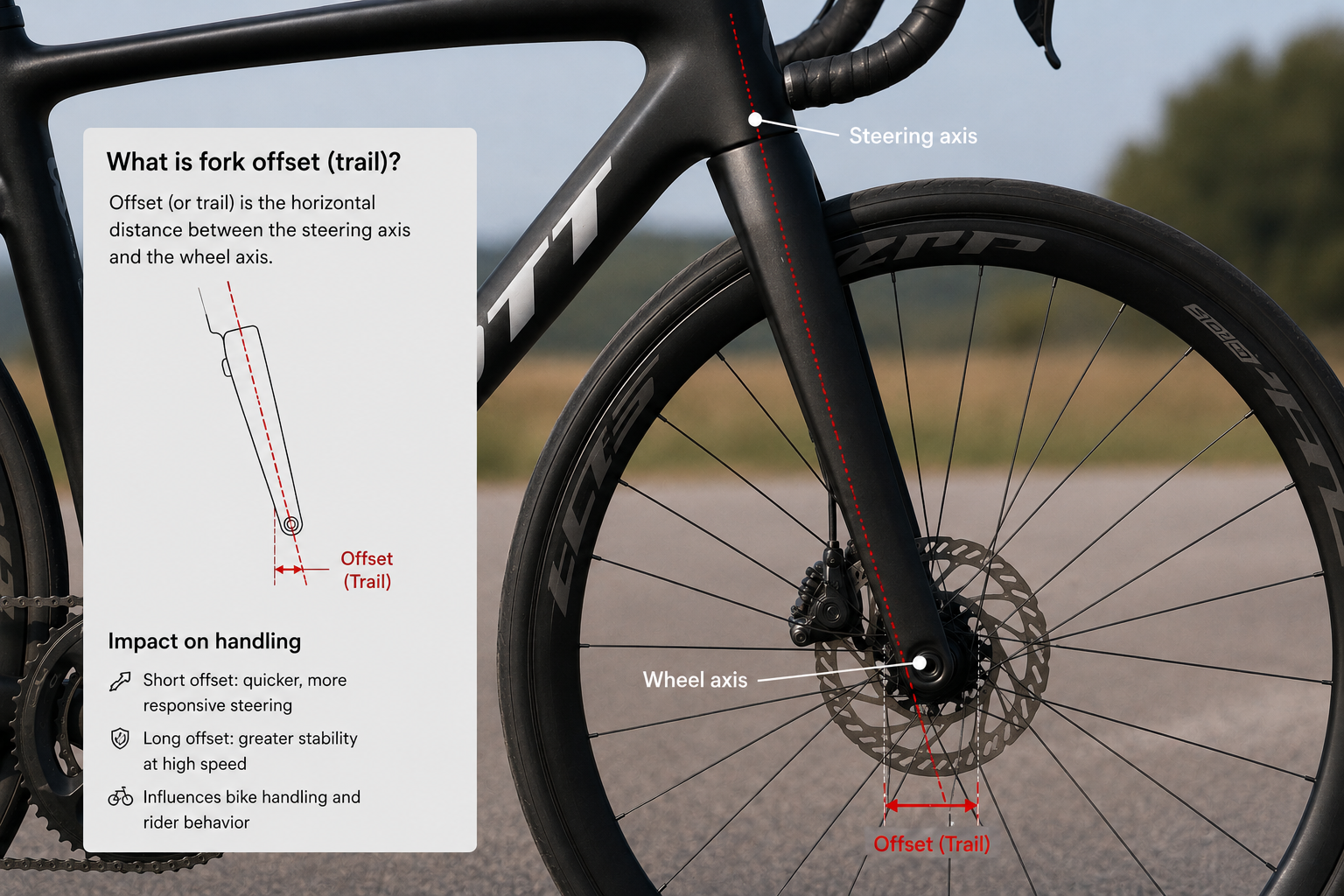
Material, braking system, steerer tube diameter: these fork selection criteria are now familiar to most cyclists. Fork rake, however, is often overlooked, even though it directly affects how your bike behaves both in corners and when riding in a straight line. This guide demystifies this geometry parameter with practical reference points, without complex formulas.
For the general criteria to consider when choosing a 700C road bike fork (materials, braking system, tire clearance), see our complete 700C road bike fork guide.
1. What is fork rake (or offset) ?
Fork rake, also known as offset (or rake in English), is the horizontal distance between the steering axis and the front wheel axle. In practical terms, a fork is never perfectly straight in line with the steerer tube: it is slightly curved or offset forward, precisely to create this rake.
Key point: fork rake is neither a manufacturing defect nor a purely aesthetic detail. It is a geometry parameter calculated by the frame manufacturer, just like the head tube angle or chainstay length.
2. Rake, trail and head tube angle: an inseparable trio
Fork rake should never be considered in isolation. It interacts with the frame's head tube angle to determine a third parameter, trail: the distance on the ground between the theoretical contact point of the steering axis and the actual contact point of the front tire.
Without getting into the mathematical calculation, remember the following principle: with the same head tube angle, the greater the fork rake, the shorter the trail. These three elements — head tube angle, rake and trail — form a coherent system designed into the frame from the outset. Therefore, you should never change the fork rake in isolation without considering the consequences for the bike's overall balance and handling.
3. What is the actual impact on handling ?
| Configuration | Effect on trail | Bike behavior |
|---|---|---|
| Less rake | More trail | More stable steering, with the bike tracking naturally in a straight line |
| More rake | Less trail | Quicker, more responsive steering when changing direction |
Greater trail promotes stability at high speeds and on descents: the bike naturally tends to correct its line, providing confidence on long rides. Shorter trail, on the other hand, makes the steering quicker and more responsive during rapid changes of direction, a characteristic sought after for sprinting or criterium racing, but one that requires greater precision from the rider.
4. What fork rake values are found on road bikes ?
On most modern road bike forks, rake is generally between 43 and 45 mm. These figures are only indicative: the exact rake depends on the manufacturer, the frame model and sometimes the frame size itself. Some manufacturers slightly adjust the rake according to frame size to maintain consistent handling across the entire range.
Important: there is no universally “best” fork rake value. The correct rake is the one specified by the manufacturer for the exact geometry of your frame, rather than a standard value that should be systematically sought.
5. Can you freely change the rake of your fork ?
No, not without consequences. The fork rake should remain within the range specified by the frame manufacturer in order to preserve the geometry intended during the bike's design. Installing a fork with a different rake from the original mechanically changes the trail, and therefore the bike's handling — sometimes noticeably, sometimes more subtly depending on the difference.
When replacing a fork, the safest approach is to keep the same rake, or one that is very close to the original fork, unless you deliberately want to change the bike's handling characteristics. Ideally, seek advice from a qualified bike professional. This check should be carried out alongside the other compatibility criteria already covered in our guide to the road bike fork steerer tube.