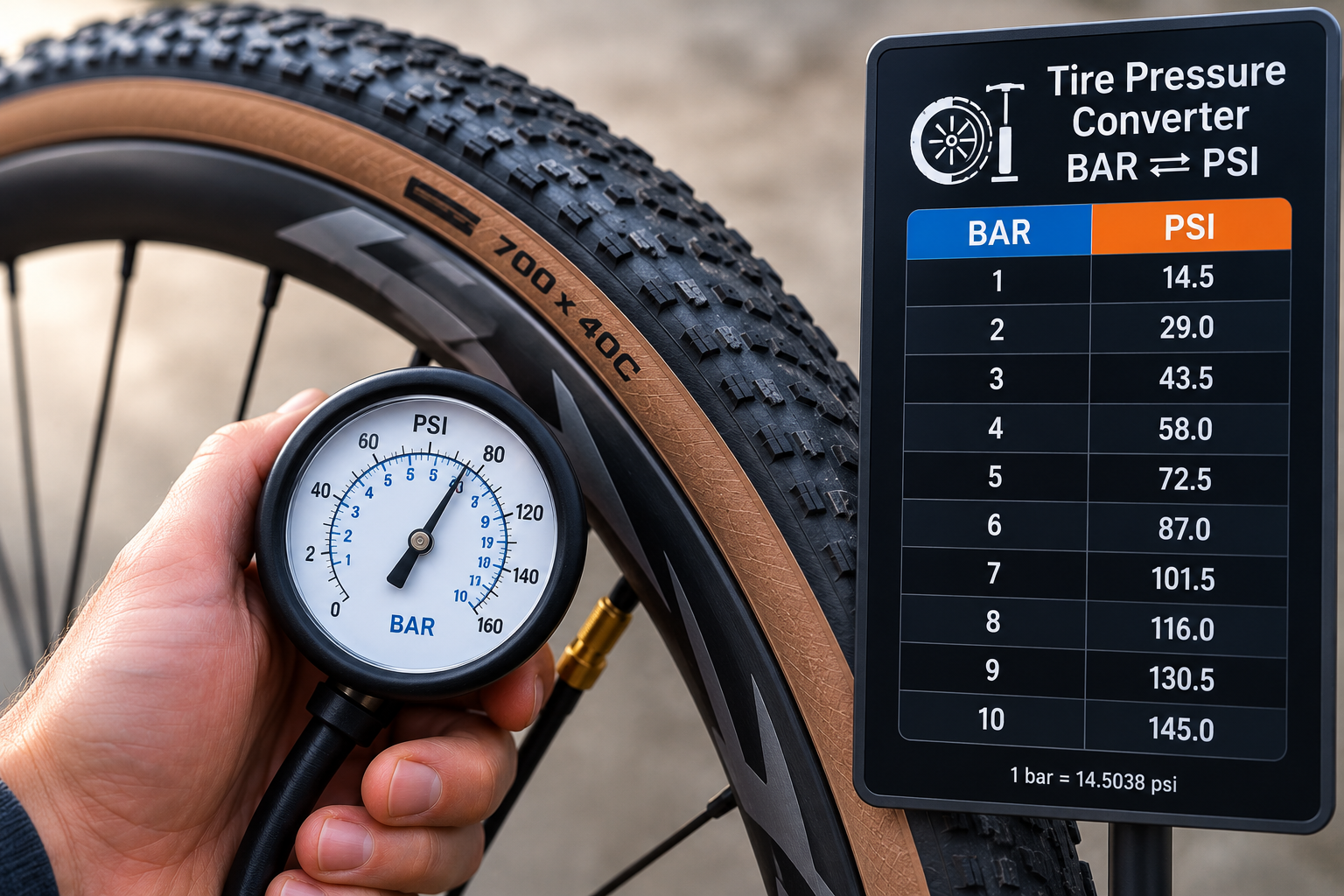

PSI and BAR are the two units used to measure your bike tire pressure, and getting the conversion right — and choosing the correct pressure for your bike — has a direct impact on grip, comfort, rolling resistance and the risk of a pinch flat. Use our PSI to BAR converter below for an instant result, or jump straight to the pressure chart for your bike: road, mountain bike, gravel, BMX or fixie.
Looking for a broader explanation of how tire pressure works, tubeless setups, or weather conditions? Read our full bicycle tire pressure guide for the complete picture — this page focuses on the PSI/BAR conversion tool and the exact pressure to use for each type of bike.
1. The PSI ↔ BAR converter
Enter a value and choose a direction: the tool instantly converts PSI to BAR, or BAR to PSI. This is the fastest way to check a tire pressure printed on a European gauge in PSI, or an American gauge in BAR.
How to use this converter: enter the pressure value shown on your pump gauge or printed on your tire sidewall, choose the conversion direction (PSI to BAR or BAR to PSI), and read the result instantly. No need to press a button — the result updates as you type.
2. PSI and BAR: definitions and conversion formula
PSI (pounds per square inch) is the imperial pressure unit, used mainly in the US and the UK, and printed on most tire sidewalls worldwide alongside the metric value.
BAR is the metric pressure unit, used across most of Europe and on the majority of floor pump gauges sold outside North America. 1 BAR is close to standard atmospheric pressure at sea level, which makes it an intuitive reference unit.
Conversion formula:
BAR = PSI × 0.0689
PSI = BAR ÷ 0.0689
Example: a road tire inflated to 90 PSI is equal to 90 × 0.0689 = 6.21 BAR.
You may also come across a third unit, kPa (kilopascal), used on some digital gauges: 1 BAR is equal to 100 kPa, so 6.2 BAR is approximately 620 kPa.
3. Road bike tire pressure chart
Road tire pressure depends mainly on tire width and rider weight (including the bike and any luggage). Modern road tires are wider than a decade ago (25–32c is now standard), which allows for noticeably lower — and more comfortable — pressures than the traditional 23c/120 PSI setup.
| Rider weight | 23–25c tire | 28c tire | 30–32c tire |
|---|---|---|---|
| Under 60 kg (132 lb) | 85 PSI / 5.9 BAR | 70 PSI / 4.8 BAR | 60 PSI / 4.1 BAR |
| 60–75 kg (132–165 lb) | 95 PSI / 6.6 BAR | 80 PSI / 5.5 BAR | 68 PSI / 4.7 BAR |
| 75–90 kg (165–198 lb) | 105 PSI / 7.2 BAR | 90 PSI / 6.2 BAR | 75 PSI / 5.2 BAR |
| Over 90 kg (198 lb) | 115 PSI / 7.9 BAR | 100 PSI / 6.9 BAR | 85 PSI / 5.9 BAR |
Indicative values for clincher/tubeless road tires on dry, paved roads. Reduce pressure by 5–10% for tubeless setups, and by a further 5% in wet conditions for extra grip.
To remember: the wider the tire, the lower the pressure needed for the same comfort and rolling resistance — a 28c tire at 80 PSI can roll as fast as a 23c tire at 100+ PSI, with far more comfort and puncture protection.
4. Mountain bike (MTB) tire pressure chart
MTB pressure is lower than road pressure by design: it is the tire's deformation that provides grip and shock absorption on technical terrain. Tubeless setups (now the standard on most MTBs) allow safely running lower pressures without pinch-flat risk.
| Discipline | Front tire | Rear tire |
|---|---|---|
| Cross-country (XC) | 24–28 PSI / 1.7–1.9 BAR | 26–30 PSI / 1.8–2.1 BAR |
| Trail / All-mountain | 22–26 PSI / 1.5–1.8 BAR | 24–28 PSI / 1.7–1.9 BAR |
| Enduro | 20–24 PSI / 1.4–1.7 BAR | 22–26 PSI / 1.5–1.8 BAR |
| Downhill (DH) | 18–22 PSI / 1.2–1.5 BAR | 20–24 PSI / 1.4–1.7 BAR |
Values for tubeless setups on 27.5" and 29" wheels. Add 3–5 PSI for tubes to reduce pinch-flat risk. Heavier riders or rockier terrain: use the upper end of the range.
Watch out: running MTB tires too hard is one of the most common beginner mistakes — it reduces grip and comfort without any real speed benefit off-road. If you're unsure, start at the top of the range for your discipline and drop 1–2 PSI at a time.
5. Gravel bike tire pressure chart
Gravel tires (typically 35–45c) sit between road and MTB pressures, and the right value depends heavily on the surface: hardpack gravel needs more pressure than loose gravel, mud or singletrack sections.
| Rider weight | 35–38c tire | 40–45c tire |
|---|---|---|
| Under 70 kg (154 lb) | 35 PSI / 2.4 BAR | 28 PSI / 1.9 BAR |
| 70–85 kg (154–187 lb) | 40 PSI / 2.8 BAR | 32 PSI / 2.2 BAR |
| Over 85 kg (187 lb) | 45 PSI / 3.1 BAR | 36 PSI / 2.5 BAR |
Values for tubeless gravel setups on mixed hardpack/loose surfaces. Drop 3–5 PSI for loose gravel or singletrack, add 3–5 PSI for long tarmac sections.
6. BMX tire pressure chart
BMX pressure varies far more by discipline than by rider weight: race BMX runs high pressure for maximum rolling speed on a smooth track, while freestyle/park/street/dirt riders use lower pressure for grip and impact absorption on landings.
| Discipline | Recommended pressure |
|---|---|
| BMX Race | 80–110 PSI / 5.5–7.6 BAR |
| Freestyle park / street | 50–70 PSI / 3.4–4.8 BAR |
| Dirt / trail | 40–55 PSI / 2.8–3.8 BAR |
Always check the maximum pressure printed on your BMX tire sidewall before inflating — it can vary significantly between models.
7. Fixie / single-speed tire pressure chart
Fixie and single-speed tire pressure is generally close to road bike values, since most fixies run road-width tires (23–28c) on tarmac. Track-specific fixies (velodrome) run at the higher end of the range for minimal rolling resistance.
| Use | 23–25c tire | 28c tire |
|---|---|---|
| Track / velodrome | 110–130 PSI / 7.6–9.0 BAR | 100–115 PSI / 6.9–7.9 BAR |
| Street / everyday riding | 90–105 PSI / 6.2–7.2 BAR | 75–90 PSI / 5.2–6.2 BAR |
8. How to choose the right tire pressure
By rider weight
Heavier riders (including bike and any bags/luggage) need higher pressure to avoid the tire deforming too much, which increases rolling resistance and pinch-flat risk. Lighter riders can run lower pressure for extra comfort and grip without penalty.
By terrain and conditions
Smooth, dry surfaces allow higher pressure for speed. Wet, loose, or technical terrain calls for lower pressure to maximise the contact patch and grip. As a rule of thumb, drop 5–10% of your usual pressure in wet conditions.
Tubeless vs inner tube
Tubeless setups can safely run 3–5 PSI lower than tubed tires, since there's no risk of pinching a tube between the rim and an obstacle. If you're still running inner tubes, stay closer to the upper end of the pressure ranges above.
Front vs rear tire
On mountain bikes and gravel bikes in particular, the rear tire generally needs 2–4 PSI more than the front, since it carries more of the rider's weight and most of the braking/traction load.
9. Quick PSI ⇄ BAR reference table
Common pressure values converted for quick reference, independent of bike type.
| PSI | BAR | PSI | BAR |
|---|---|---|---|
| 20 PSI | 1.4 BAR | 70 PSI | 4.8 BAR |
| 25 PSI | 1.7 BAR | 80 PSI | 5.5 BAR |
| 30 PSI | 2.1 BAR | 90 PSI | 6.2 BAR |
| 40 PSI | 2.8 BAR | 100 PSI | 6.9 BAR |
| 50 PSI | 3.4 BAR | 110 PSI | 7.6 BAR |
| 60 PSI | 4.1 BAR | 120 PSI | 8.3 BAR |