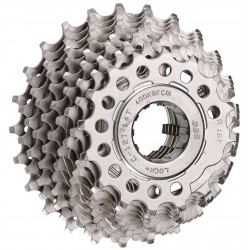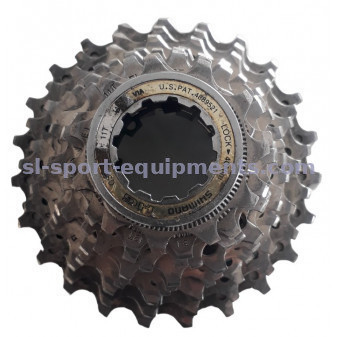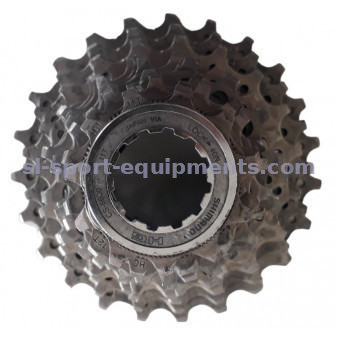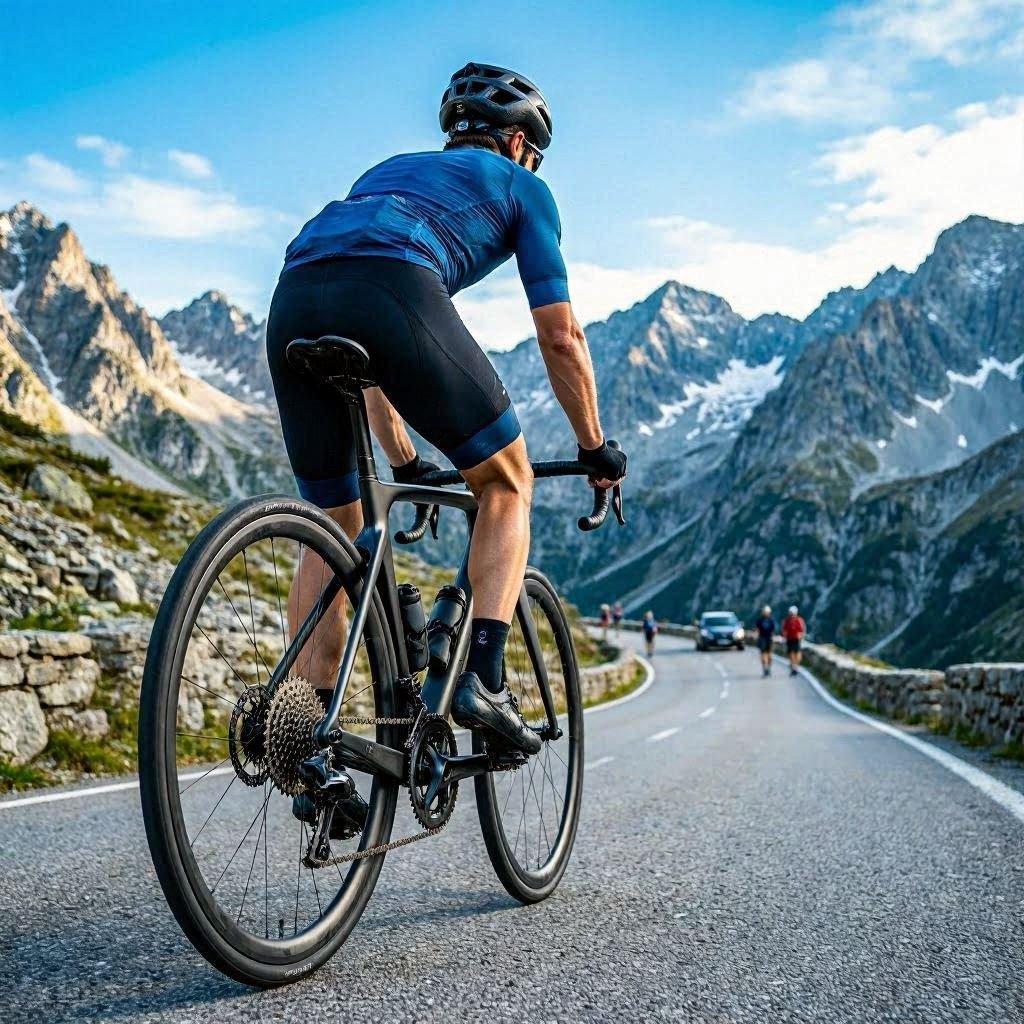
Every extra pedal stroke counts once the road tilts upward. Long climbs and mountain passes put your legs, your cadence and your drivetrain to the test — and one component decides more than any other how comfortable that test will be: your road bike cassette. Choose the wrong range and every hill feels like a fight against your own bike. Choose the right one, and climbing becomes a rhythm you can sustain. This guide breaks down which cassette sizes actually help on climbs, how to compare 11-28, 11-30, 11-32 and 11-34, and what to check for compatibility before you buy.
Looking for the right part straight away? Browse our full range of road bike cassettes, checked and rated before sale.
1. Why cassette choice matters for climbing
The cassette sits on the rear wheel's freehub as a stack of sprockets (cogs) of different sizes. Together with the chain, the rear derailleur and the front chainrings, it forms your drivetrain and determines the full range of gears available to you. On flat terrain, a tightly spaced cassette keeps your cadence smooth between gears. On a climb, what matters most is different: you need at least one large sprocket that lets you spin rather than grind, especially once the gradient goes past 8-10%.
A road bike cassette built for climbing doesn't change how your bike looks or handles on the flat — it simply gives you the option to shift into an easier gear when your legs and heart rate tell you to. That single choice is often the difference between finishing a mountain stage comfortably and being forced off the bike halfway up.
2. Best cassette range for climbing: 11-28, 11-30, 11-32, 11-34
The tooth count of the largest sprocket is the number that matters most when you're shopping for a climbing cassette. A higher number means an easier gear available for steep sections. Here's how the most common ranges compare:
| Cassette range | Best suited for | Recommended gradient | Strength | Limitation |
|---|---|---|---|---|
| 11-28 | Rolling terrain, easy sportives | Up to 6-8% | Close ratios, smooth cadence transitions | Can feel too hard on sustained climbs |
| 11-30 | Moderate mountains, all-round use | 6-10% | Best balance of versatility and climbing ease | — |
| 11-32 | Long climbs, touring riders | 8-12% | Extra comfort over long durations | Slightly bigger jumps between sprockets |
| 11-34 | Very steep passes, lighter or less experienced riders | 10%+ | Maximises ease of pedalling | Needs a long-cage rear derailleur |
Which cassette works best for hill climbing? For most riders tackling regular hilly routes or classic mountain passes, an 11-30 is the sweet spot: it noticeably eases climbing without sacrificing too much on the flat. If your rides regularly include long alpine-style climbs or you're not yet confident on steep gradients, size up to an 11-32 or 11-34 rather than suffering through every ascent.
11-30 vs 11-32 vs 11-34: which one should you pick ?
An 11-30 and an 11-32 feel very similar on the bike; the 32 simply gives you one noticeably easier gear in reserve for the steepest ramps, at the cost of very slightly larger jumps between sprockets. The jump to an 11-34 is more significant: it's the range to choose if you're climbing consistently steep terrain (10%+ average gradient), riding with fatigued legs late in a long event, or simply prioritising comfort over outright speed. The trade-off is mechanical: an 11-34 cassette typically requires a rear derailleur with a long cage to handle the extra chain wrap, so always check compatibility before switching (see section 4).
3. Number of speeds: 10, 11 or 12-speed cassettes
Modern road cassettes come in 10, 11 or 12-speed versions (sometimes referred to loosely as having "more pins" or more sprockets). The speed count refers to the number of individual sprockets stacked on the freehub — a 12-speed cassette simply has more, smaller steps between gears than a 10-speed one, giving you finer control over your cadence without necessarily changing the largest or smallest sprocket size.
For climbing specifically, the speed count matters less than the range (11-30, 11-32, 11-34...), but a higher speed count does mean smoother transitions when you're searching for the right cadence mid-climb. Popular climbing-friendly options we regularly stock include:
- Shimano 105 / Ultegra 11-speed — 11-28, 11-30, 11-32 and 11-34 cassettes, widely compatible with 11-speed groupsets.
- Shimano Ultegra / 105 Di2 12-speed — 11-30 and 11-34 cassettes, the current standard for riders upgrading to 12-speed.
- 10-speed cassettes (11-30, 11-32) — still a reliable, budget-friendly option for older groupsets.
Whatever the number of sprockets, the cassette must always match the number of speeds of your shifters and rear derailleur — an 11-speed cassette will not shift correctly on a 12-speed drivetrain, and vice versa.
4. Compatibility: Shimano, SRAM, Campagnolo
Before buying a wider-range cassette, three compatibility points need checking:
- Groupset brand: Shimano, SRAM and Campagnolo cassettes use different freehub splines and are generally not interchangeable. Always match your cassette to your existing groupset, or to your wheel's freehub body if you're also changing wheels.
- Freehub body: some wide-range cassettes (11-32, 11-34) require a specific freehub body (e.g. Shimano's HG or Micro Spline standards) — worth double-checking against your wheel manufacturer's specifications.
- Rear derailleur capacity: a short-cage road derailleur may not handle a large sprocket such as 32 or 34 teeth. Manufacturers publish a maximum sprocket size for each derailleur model — going beyond it risks poor shifting or chain damage.
For a deeper comparison between brands, see our dedicated guide: Shimano, SRAM or Campagnolo road bike cassette.
5. Adjusting the rest of your drivetrain
Fitting a wider-range cassette rarely means changing the cassette alone. To keep everything shifting smoothly, plan for:
- Chainrings: pairing a wide-range cassette with a compact (50/34) or sub-compact (48/32) crankset lowers your overall gearing even further — ideal if you know most of your riding is uphill.
- Chain length: a larger sprocket usually means a longer chain is needed to maintain proper derailleur tension.
- Rear derailleur cage length: as mentioned above, an 11-32 or 11-34 cassette generally calls for a medium or long-cage derailleur capable of taking up the extra chain slack.
6. Road bike vs mountain bike (MTB) cassette
Not the same part: a road bike cassette and a mountain bike (MTB) cassette are not interchangeable in most cases. MTB cassettes are built for much wider ranges (often 10-51 or more) to suit off-road gearing and different derailleur systems, and they generally require a different freehub standard (Micro Spline or XD/XDR) than most road setups. If you're specifically after a cassette for a mountain bike rather than for climbing hills on a road bike, our cassette compatibility guide and MTB drivetrain category are the better starting point — fitting an MTB cassette on a road bike, or vice versa, is possible in only very specific configurations and generally isn't recommended without expert advice.
7. How to choose according to your riding profile
- Assess your terrain: occasional rolling hills call for an 11-28 or 11-30; regular mountain climbs justify an 11-32 or 11-34.
- Be honest about your cadence: if you prefer spinning at a higher cadence rather than pushing a big gear, size up rather than down.
- Check compatibility first: confirm your derailleur's maximum sprocket size and your groupset's speed count before ordering.
- Buy quality: a well-made cassette shifts more precisely, lasts longer and saves weight compared to a low-end equivalent — all details that show up on a long climb.