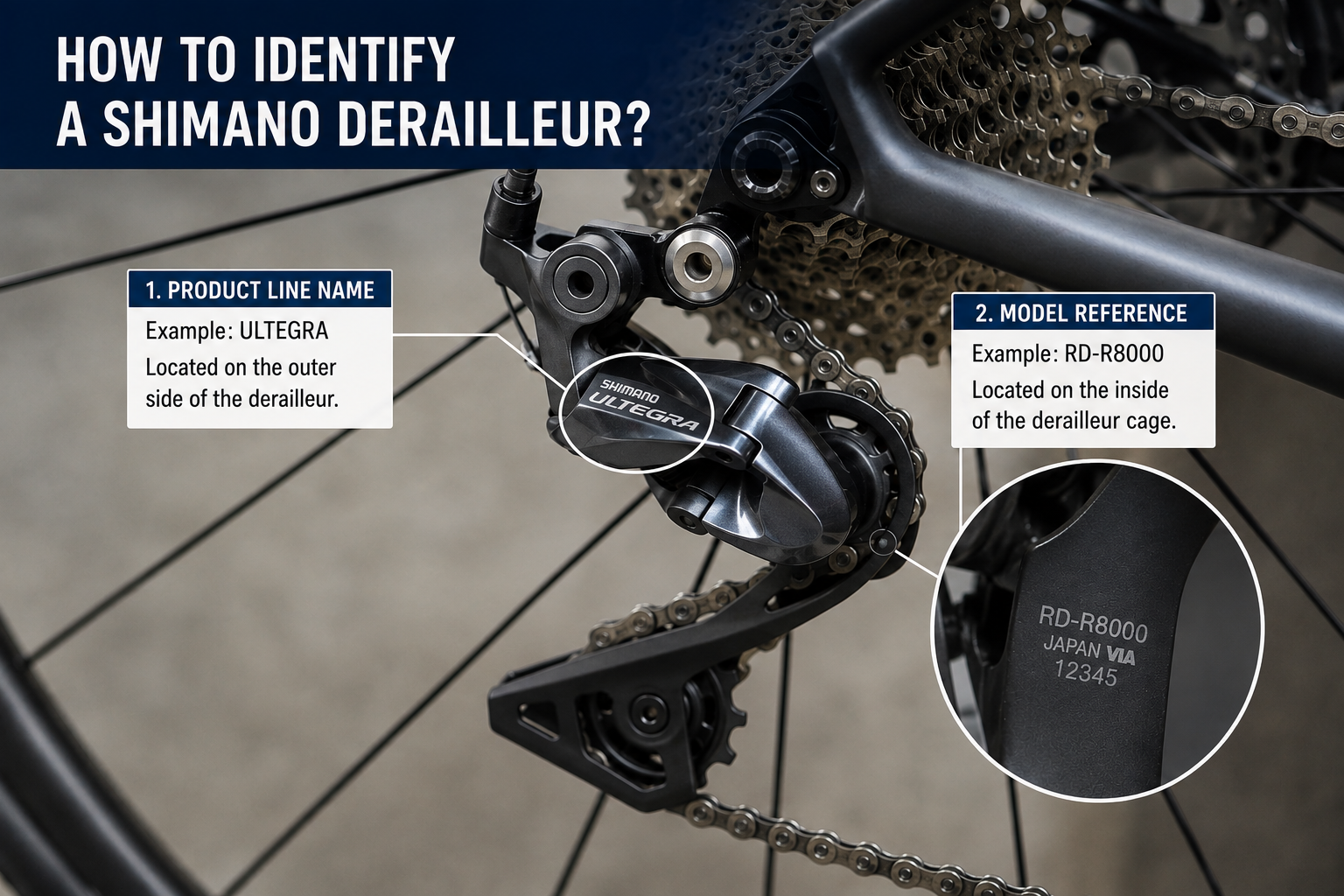
Found a Shimano derailleur with no box, no manual, and no idea what it is? You're not alone — it's one of the most common questions we get. Whether you picked up a spare part, bought a second-hand bike, or simply need a compatible replacement, the fastest way to identify it is to read the model number stamped directly on the part. This guide shows you exactly where to look, how to decode what you find, and how to match it to the right Shimano groupset — from entry-level Tourney to top-of-range XTR and Dura-Ace.
Looking for a replacement part once you've identified your derailleur? Browse our full range of Shimano bike derailleurs in stock, new and refurbished.
1. Where to find the model number on a Shimano derailleur
Every Shimano derailleur carries a model number printed or engraved directly on the part itself — you don't need the original box or receipt to identify it. Look on the outer face of the main body, the moving parallelogram that sits between the derailleur hanger and the cage: the reference is usually printed there, sometimes close to the cable anchor bolt or the small adjustment screw (the "b-screw"). On some models it's on the inner plate of the cage rather than the outer body.
The marking is often small and can fade or get covered in grease and road grime over time. Before concluding that there's no reference at all, wipe the derailleur down with a clean rag or a bit of degreaser — in most cases the code reappears clearly once the part is clean.
To remember: Shimano derailleur references follow the format RD-XXXX-Y for a rear derailleur (RD = Rear Derailleur) or FD-XXXX for a front derailleur (FD = Front Derailleur), for example RD-R7000 or FD-M8100. Once you have this code, the next section explains exactly what each part of it means.
2. How to read a Shimano derailleur model number
Once you've located the code, it can be broken down into three parts:
- The prefix (RD or FD) tells you whether it's a rear or a front derailleur.
- The letter and number series (for example R7000, M8100, U6000) identifies the groupset family and generation — the letter usually points to the discipline (R for road, M for mountain bike, U for the CUES range, RX for GRX gravel), and the digits indicate the tier, roughly from entry-level to top-of-range as the number increases.
- A cage-length suffix (SS, GS or SGS) on some rear derailleurs, indicating a short, medium or long cage — this determines how much chain slack the derailleur can take up, depending on your cassette and chainring combination.
| Model number | Groupset | Type | Typical speed count |
|---|---|---|---|
| RD-R7000 | 105 | Road, rear | 11-speed |
| RD-R8000 | Ultegra | Road, rear | 11-speed |
| RD-R9100 / R9200 | Dura-Ace | Road, rear | 11 / 12-speed |
| FD-R8000 | Ultegra | Road, front | 11-speed |
| RD-M6100 | Deore | MTB, rear | 12-speed |
| RD-M8100 | XT | MTB, rear | 12-speed |
| RD-M9100 | XTR | MTB, rear | 12-speed |
| RD-U6000 | CUES | MTB / hybrid, rear | 10 / 11-speed |
Table for illustration — always double-check the exact reference against Shimano's official documentation before ordering a replacement part.
3. Shimano derailleur groupsets: from entry-level to top-of-range
Shimano organises its derailleurs into groupsets, each aimed at a different level of use and budget. Knowing where your derailleur sits in this hierarchy makes it much easier to find the right replacement or upgrade.
| Road groupset | Positioning |
|---|---|
| Claris | Entry-level, 8-speed |
| Sora | Entry-level, 9-speed |
| Tiagra | Mid-range, 10-speed |
| 105 | Performance / most popular all-round groupset, 11/12-speed |
| Ultegra | High-end, 11/12-speed |
| Dura-Ace | Top-of-range, racing, 11/12-speed |
| Mountain bike groupset | Positioning |
|---|---|
| Tourney | Entry-level, 6/7-speed |
| Altus | Entry-level, 8-speed |
| Acera | Entry-level, 9-speed |
| Alivio | Mid-range, 9-speed |
| Deore | Mid-range / very popular, 10-12-speed |
| SLX | High-end, 12-speed |
| XT | High-end, 12-speed |
| XTR | Top-of-range, racing, 12-speed |
To remember: as a general rule, the higher the digit after the letter prefix in the model number, the higher the groupset sits in the range — but this isn't an absolute rule across every generation, so always cross-check the exact reference against the tables above.
4. New naming explained: CUES and GRX
Shimano has recently reorganised part of its range, which can make identification confusing if you're used to the older naming:
- CUES is a simplified lineup that replaces several separate entry and mid-range mountain and hybrid groupsets under a single naming system, using model numbers starting with U (for example RD-U6000). It's designed to cover what used to be split across Tourney, Altus, Acera and part of the Deore range.
- GRX is a distinct groupset, purpose-built for gravel bikes, with its own model numbers starting with RX (for example RD-RX400 or RD-RX822).
If your derailleur's code starts with U or RX, you're looking at one of these newer ranges rather than a traditional road or MTB groupset.
5. Front vs rear derailleur: how to tell them apart
If you're not even sure which type of part you're holding, a few visual cues make it obvious:
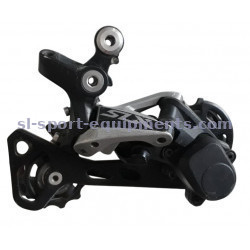
- Rear derailleur: a spring-loaded parallelogram mechanism with a cage holding two small jockey wheels, hanging below the cassette and attached to the derailleur hanger at the rear dropout.
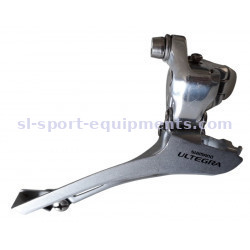
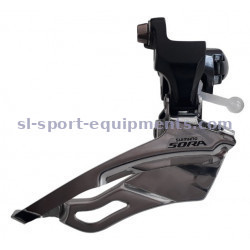
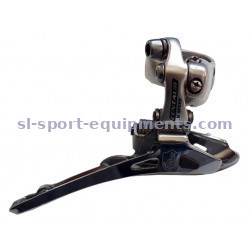
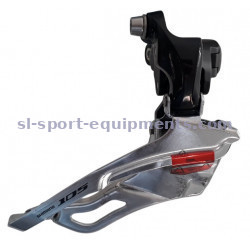
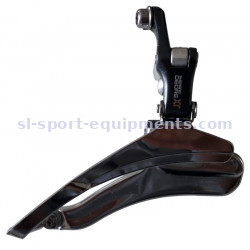
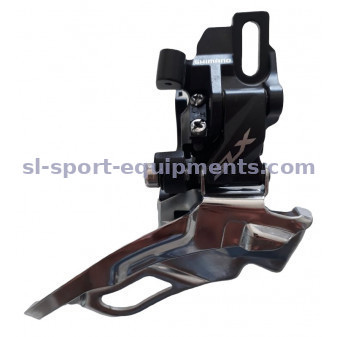
- Front derailleur: a simple open cage that sits around the chain near the chainrings, clamped around the seat tube (or bolted to a specific mount) rather than attached to the rear of the frame.
6. Check compatibility before buying a replacement
Once you've identified your derailleur, check these four points before ordering a replacement or upgrade, since they're the most common sources of compatibility issues:
- Speed count: the derailleur, shifter and cassette must all share the same number of speeds (for example 11-speed with 11-speed).
- Cage length / total capacity: a short cage (SS) suits a narrow gear range, while a long cage (GS/SGS) is needed for wide-range cassettes and large chainring differences.
- Cable pull ratio: road and mountain bike derailleurs use different cable pull ratios, so a road shifter generally won't index a mountain bike derailleur correctly, and vice versa.
- Mount type: standard hanger mount versus direct mount for rear derailleurs; band-on (clamp) versus braze-on for front derailleurs.
Safety point: avoid mixing components across brands or disciplines without checking compatibility first — Shimano and Sram, for instance, use different cable pull ratios in most of their ranges, so pairing a Shimano derailleur with a Sram shifter (or the reverse) will generally prevent the gears from indexing correctly.
7. Don't forget the derailleur hanger
The derailleur hanger is a separate part, specific to your bike frame rather than to Shimano — it's the small metal piece that connects the rear derailleur to the frame's dropout, and it's designed to bend or break in a crash to protect the derailleur and the frame itself. If your derailleur was damaged after an impact, check the hanger too before assuming the derailleur itself needs replacing.
Browse our derailleur hanger selection to find the reference matching your frame.
8. No visible marking? What to do
If you've cleaned the part and still can't find any reference, try the following before giving up:
- Use a magnifying glass or take a close-up, well-lit photo with your phone — markings that are invisible to the naked eye often show up clearly once zoomed in.
- Compare the shape of the cage, the number of pulley wheels and the overall design against Shimano's current and past catalogue.
- Send us a clear photo of the derailleur — our team can often identify the model and confirm compatible replacements even without a visible reference number.