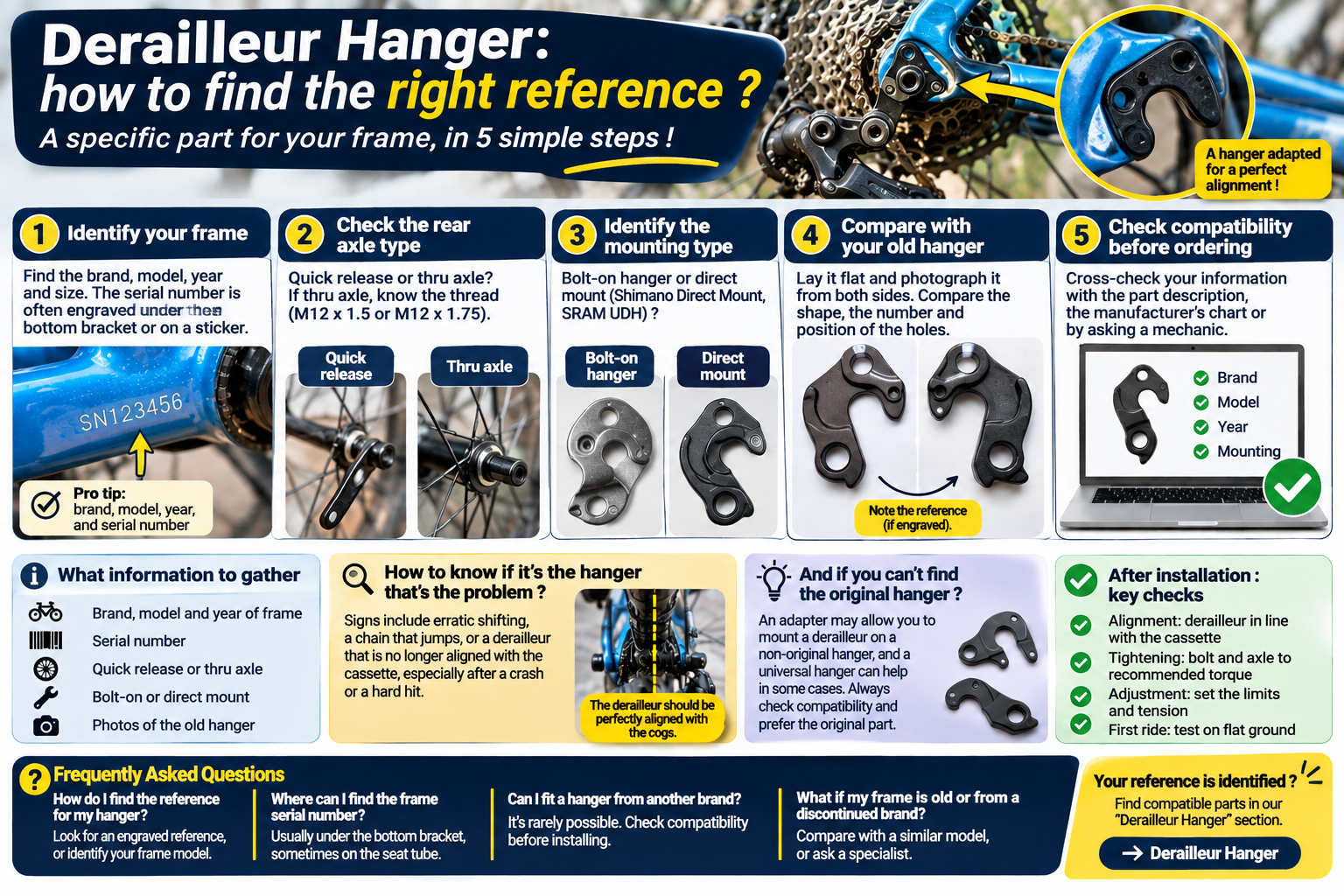
A derailleur hanger is almost never universal: it is designed for a specific frame, and a part that looks like yours may not fit. Here is a simple 5-step method to identify the right part number before you order, whether your hanger is bent, broken or simply hard to find. Once you know which one you need, browse the available models in our derailleur hanger category.
Why a derailleur hanger depends on the frame
The hanger connects the rear derailleur to the frame. Its shape, the position of its holes and the way it receives the wheel axle are specific to each manufacturer, and sometimes to each production year. It is also designed to bend or break before the frame does: it is a common replacement part, but it can't be chosen at random.
The 5 steps to find the right derailleur hanger
- Identify your frame. Note the make, model, year and size. The serial number is often engraved under the bottom bracket or on a frame sticker. Failing that, your purchase invoice or the manufacturer's spec sheet will give you this information.
- Check how the rear wheel is attached. Quick release or thru-axle? The hanger is not the same, and for a thru-axle you also need to know the thread pitch (M12 x 1.5 or M12 x 1.75 depending on the frame).
- Check the derailleur mounting type. Classic bolt-on hanger, or direct mount (Shimano Direct Mount, SRAM UDH): the two are not interchangeable.
- Compare with your old hanger. Lay it flat and photograph both sides. Compare the overall shape, the number and position of the holes, and the mounting side. Some hangers have a part number engraved on them: write it down.
- Check compatibility before ordering. Match your information against the part description, the manufacturer's spec sheet or a mechanic's advice. If in doubt, ask the seller and send your photos.
The information to gather before you search
| Information | Where to find it | Why it matters |
|---|---|---|
| Frame make, model and year | Invoice, frame sticker, manufacturer's website | This is the deciding factor: each hanger is specific to a frame |
| Serial number | Under the bottom bracket, often engraved | Helps tell apart two years or two versions of the same model |
| Quick release or thru-axle | Rear wheel, at the hub | Determines the shape of the hanger and its thread pitch |
| Bolt-on hanger or direct mount | Current derailleur mounting | The two standards are not compatible with each other |
| Photos of the old hanger | Your bike, both sides of the part | Let you compare and get the part number confirmed |
How can you tell the hanger is really the problem?
Before looking for a part, make sure the hanger is the cause. The usual signs are inconsistent shifting, a chain that skips, or a derailleur that is no longer aligned with the cassette, especially after a crash or an impact on the drivetrain side. Look at the bike from behind: the derailleur should sit perfectly in line with the cogs. A slightly bent hanger can sometimes be straightened with an alignment tool, but a cracked hanger must always be replaced.
What if I can't find the original hanger?
When the manufacturer no longer offers the part, there are two options. An adapter can sometimes let you fit a derailleur on a hanger not designed for it, and a universal derailleur hanger can help out on certain frames. These are fallback solutions: always check their compatibility with your frame, and prefer the original part whenever it is available.
After fitting: what to check
- Alignment: check that the derailleur is in line with the cassette, seen from behind.
- Tightening: check the mounting bolt and the wheel axle, to the torque recommended by the manufacturer.
- Adjustment: adjust the limit screws and cable tension, then test every gear while stationary.
- First ride: ride on flat ground, shifting gradually, before heading out on a full ride.
Frequently asked questions
How do I find the part number of my derailleur hanger?
First check whether a part number is engraved on the old hanger. If not, identify the make, model and year of your frame and look up the manufacturer's spec sheet, or compare your old part with photos.
Where can I find my frame's serial number?
It is most often engraved under the bottom bracket, sometimes on a sticker on the seat tube or on the rear dropout. It helps distinguish between two versions of the same model.
Can I fit a derailleur hanger from another brand?
It is rarely possible, because each hanger is designed for a specific frame. An unsuitable part can cause misalignment and damage the derailleur. Always check compatibility before fitting.
What if my frame is old or from a brand that no longer exists?
Compare your old hanger with similar models, send photos to a specialist seller, or consider an adapter. A mechanic can also confirm compatibility on the bike.
Should I replace the hanger after every crash?
Not necessarily. If it is bent, check the derailleur alignment. If it is cracked or doesn't straighten properly, replace it to avoid a failure in the middle of a ride.
Found your part number? Browse compatible parts in our derailleur hanger category.
Further reading: