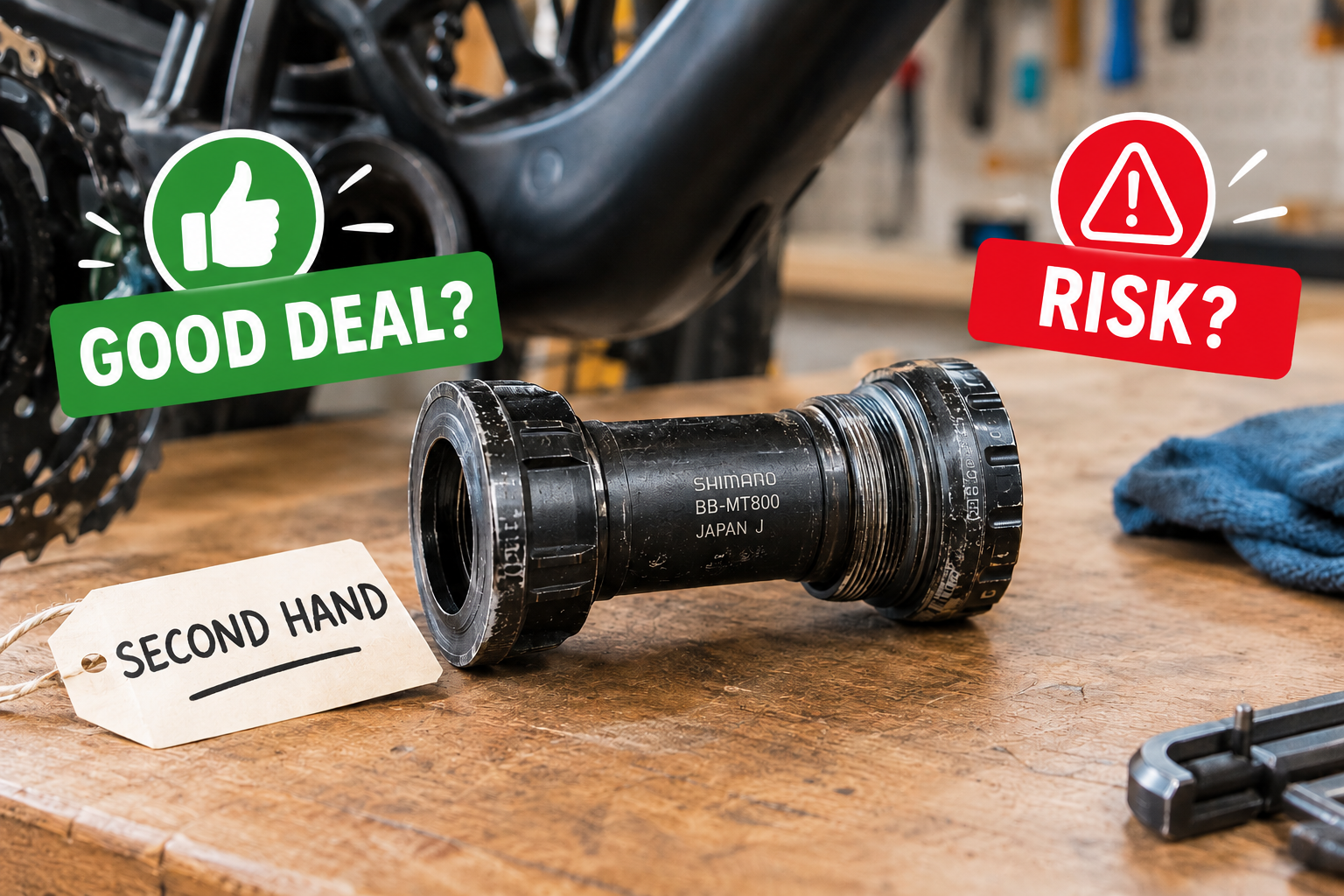
A bottom bracket is one of those parts you'd instinctively want to buy new. Yet a checked second-hand part can be a perfectly reliable alternative, provided it's been seriously inspected before sale. Here's what we check on every bottom bracket at SL Sport Equipments before listing it in stock.
Discover our range of road bike bottom brackets and road bike drivetrain groups in stock.
1. Why consider a second-hand bottom bracket?
Several reasons can make a second-hand bottom bracket a good option over a new one:
- The savings: the price gap with new is often significant, particularly on high-end tiers such as Ultegra, Dura-Ace, or Record.
- Reuse: extending the life of a still-functional part rather than producing something new, as part of a more responsible approach.
- Availability: access to older or discontinued references, sometimes unavailable new, especially for maintaining vintage frames or older standards.
2. The risks of an uninspected second-hand bottom bracket
Buying a second-hand part without a thorough check carries real risks, which it would be dishonest to downplay:
- Wear that's invisible to the naked eye: a bottom bracket can look fine while already having tired bearings.
- No warranty on a part sold without prior inspection.
- A standard sometimes misidentified by the seller, particularly on private-sale platforms, with the risk of receiving a part incompatible with your frame.
Note: these risks mainly concern uninspected purchases, for example between private individuals with no technical check. This is exactly what our inspection process aims to eliminate.
3. How we check every bottom bracket before sale
At SL Sport Equipments, every second-hand bottom bracket listed is cleaned and checked before it goes on sale. Specifically, our inspection covers the following points:
- No lateral play: we check by hand that there's no noticeable play in the axle.
- Smooth rotation: the axle must turn without any rough spot or unusual noise, a sign of bearings in good condition.
- No corrosion: a visual inspection specifically covers the threaded and contact areas, the most sensitive to corrosion.
- Exact standard identification: every reference is checked before it's listed online, to make sure the product page precisely matches the part's actual standard.
Each product is then given a condition score out of 10, shown directly on its product page, so you know exactly what you're buying before placing your order.
Good to know: once you've received your bottom bracket, if you're unsure of its exact standard when fitting it, our comparison of threaded vs press-fit bottom brackets will help you confirm compatibility with your frame.
4. Private sale vs checked second-hand: the difference
Buying from a private individual can offer attractive prices, but it's generally done with no quality check and no recourse if something goes wrong: the part's condition relies solely on the seller's description, with no independent verification.
Checked second-hand, as we offer it, works differently: every part is inspected before it's listed for sale, scored on a clear scale, and you benefit from a 14-day return right after delivery if the product doesn't match your expectations. This difference in approach is exactly what allows you to buy a second-hand part with confidence, rather than gambling on the part's actual condition.
5. FAQ — Second-hand bottom bracket
Road bike bottom bracket guides — go further
- Road bike bottom bracket — full range
- Threaded or press-fit bottom bracket: which one should you choose?
- Bottom bracket creaking: causes and solutions
- How to remove and replace your road bike bottom bracket
- BB30, PF30, BB86, BB92: understanding press-fit standards
- Shimano 105 vs Ultegra vs Dura-Ace bottom bracket
- Ceramic bottom bracket: real performance gain or marketing hype?
- Bottom bracket and carbon frame compatibility
- Bottom bracket lifespan: when should you replace it?
- What tools do you need to remove a road bike bottom bracket?