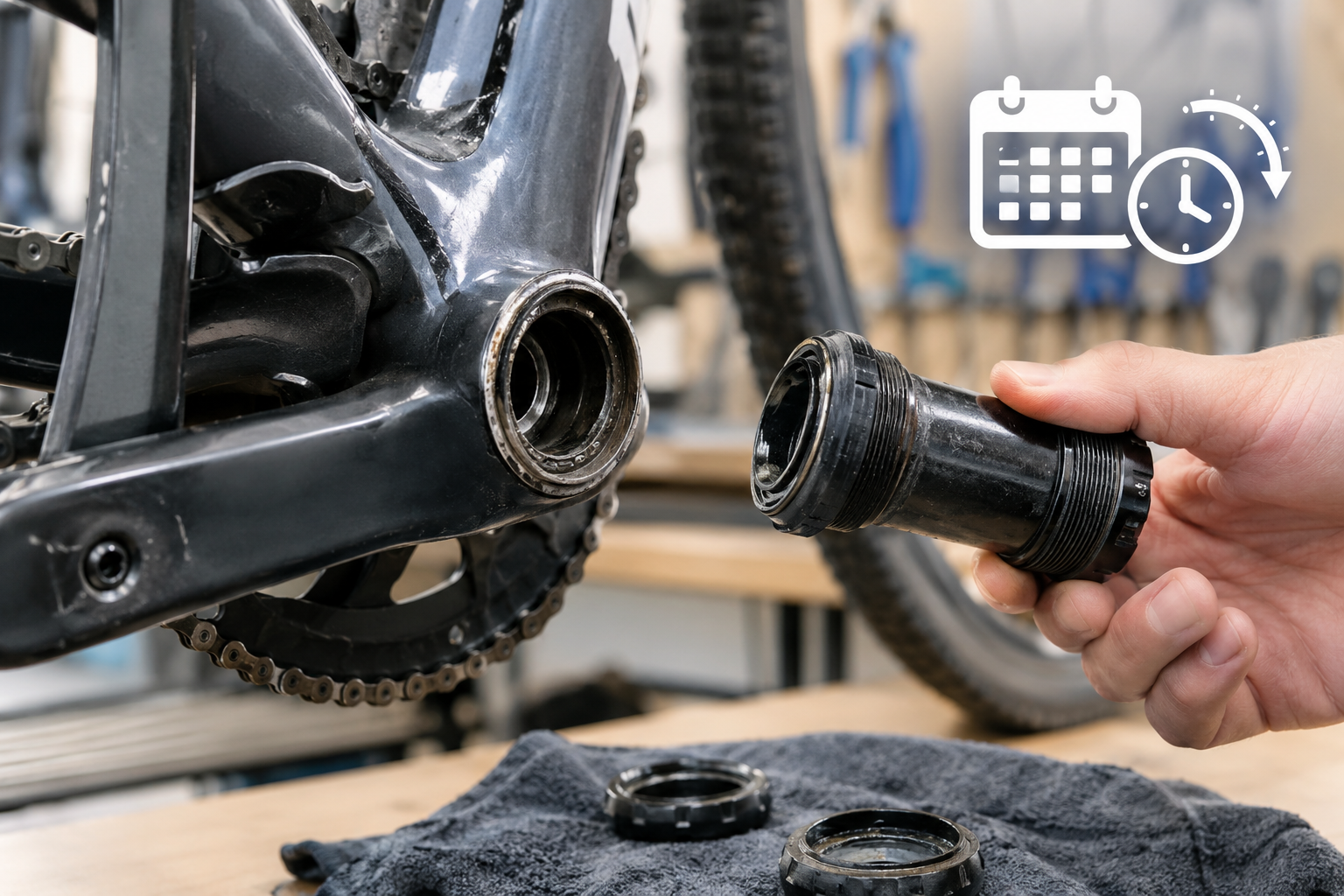
Unlike a chain or brake pads, a bottom bracket's lifespan has no widely communicated universal mileage benchmark. The result: many cyclists remain unsure of the right time to act. Here are the factors that really matter and the signs to watch for.
Discover our range of road bike bottom brackets and road bike drivetrain groups in stock.
1. What factors influence a bottom bracket's lifespan?
Several elements determine how long a bottom bracket lasts, far more than simple mileage:
- Riding conditions: annual mileage, but above all how often you ride in the rain or in wet, muddy conditions, which significantly accelerates wear.
- The bottom bracket standard: a well-maintained threaded bottom bracket generally lasts longer than a press-fit one exposed to imprecise manufacturing tolerances. To understand these differences, see our comparison of threaded vs press-fit bottom brackets.
- The quality and tier of the bottom bracket: an entry-level model generally wears a little faster than a higher-end one, though the gap isn't dramatic in normal use.
- Maintenance frequency: regular cleaning and re-greasing significantly extends lifespan, whatever the standard.
2. Is there a reliable mileage benchmark?
Let's be honest: there's no reliable universal figure for a bottom bracket, unlike a chain, whose lifespan is generally measured in a few thousand kilometres. The variability is too great across different riding conditions to set a rule that applies to everyone.
Purely as a guide, a well-maintained bottom bracket used mainly on dry roads can last several tens of thousands of kilometres, while intensive use in the rain or in tough conditions can noticeably shorten this. These figures should in no way be taken as a guarantee: regularly monitoring the signs of wear remains far more reliable than a simple mileage counter.
Note: these figures are given purely as a guide and vary considerably depending on actual usage conditions. Rely primarily on the signs of wear described below rather than on a theoretical mileage figure.
3. What signs indicate a bottom bracket is at the end of its life?
- Noticeable lateral play in the crank arms, checked by hand.
- Persistent creaking or grinding despite careful cleaning and re-tightening.
- Uneven resistance or a rough spot felt when turning the axle by hand, with the bottom bracket removed.
- Visible corrosion inside the bottom bracket on inspection.
Good to know: if your bottom bracket is creaking but you're not sure it's reached the end of its life, our article on the causes and solutions for a creaking bottom bracket will help you make a full diagnosis before concluding a replacement is needed.
4. How to extend your bottom bracket's lifespan?
- Clean the bottom bracket regularly, especially after riding in rain or muddy conditions.
- Periodically check for play and correct tightening, even with no apparent symptoms.
- Avoid pointing a pressure washer directly at the bottom bracket, which encourages water ingress.
- Follow the maintenance guidelines specific to your standard, threaded or press-fit.
5. FAQ — Bottom bracket lifespan
Road bike bottom bracket guides — go further
- Road bike bottom bracket — full range
- Threaded or press-fit bottom bracket: which one should you choose?
- Bottom bracket creaking: causes and solutions
- How to remove and replace your road bike bottom bracket
- BB30, PF30, BB86, BB92: understanding press-fit standards
- Shimano 105 vs Ultegra vs Dura-Ace bottom bracket
- Ceramic bottom bracket: real performance gain or marketing hype?
- Bottom bracket and carbon frame compatibility