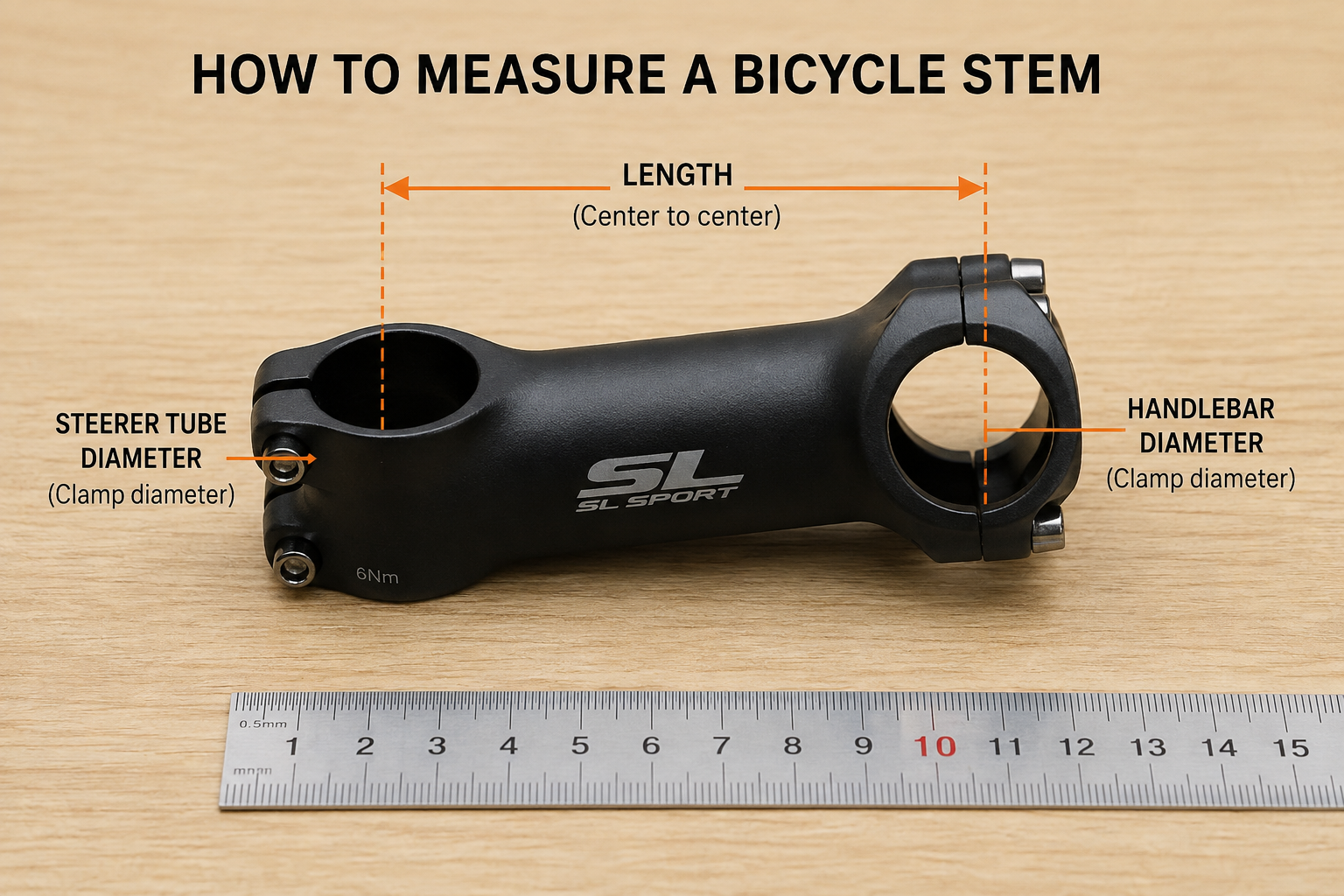
Whether you're replacing a worn stem, fine-tuning your riding position, or simply making sure a new part will fit, measuring a bicycle stem correctly comes down to three numbers: its length, its handlebar clamp diameter, and its steerer clamp diameter. Get any one of them wrong and the stem either won't fit or won't hold your handlebar safely. This guide walks you through each measurement step by step, with a size chart to check your figures against.
These three measurements are also the ones you'll need before adjusting the stem of your bicycle, so it's worth taking a few extra minutes to get them right the first time.
1. Why measuring your stem correctly matters
The stem is the small but critical part that connects your handlebar to your fork's steerer tube. Because it sits at the junction of two components that must both fit exactly, a stem is defined by three independent measurements rather than a single "size". Getting one of them wrong can mean a handlebar that won't clamp securely, a stem that won't fit your fork, or a riding position that never feels quite right.
Measuring your current stem accurately is also the fastest way to buy a compatible replacement online, without having to dismantle your bike or guess at standard sizes.
2. Tools you need to measure a bike stem
You don't need a full workshop to take these measurements. Gather the following before you start:
- A ruler or tape measure, for the length.
- A calliper (digital or manual), for accurate diameter readings.
- If you don't have a calliper, a flexible tape measure can be used to estimate diameter from the circumference (see note below).
- Ideally, the stem removed from the bike, or at least the handlebar loosened, for easier access.
3. How to measure stem length
Stem length is the horizontal distance between the centre of the steerer clamp bolt (where the stem attaches to the fork) and the centre of the handlebar clamp. It's the measurement that has the biggest impact on your riding position.
- Position the stem so you can see both clamp areas clearly, ideally removed from the bike or with the handlebar loosened.
- Measure the distance between the centre of the steerer bolt and the centre of the handlebar clamp, using a ruler or tape measure.
- Read the result in millimetres — common stem lengths range from 60mm to 140mm, with 80mm, 100mm and 120mm being the most widely used on road and mountain bikes.
Good to know: a shorter stem gives a more upright, reactive riding position, while a longer stem stretches you out and can improve stability at higher speeds. Changing stem length by just 10-20mm is one of the simplest and cheapest ways to fine-tune your bike fit.
If your bike uses an older quill stem (the type that slides inside the steerer tube rather than clamping around it), the length is measured the same way, between the centre of the expander bolt and the centre of the handlebar clamp — but be aware that quill stems are not compatible with modern threadless forks.
4. How to measure the handlebar clamp diameter
The handlebar clamp diameter is the internal diameter of the part of the stem that grips the handlebar. This measurement must match your handlebar exactly — it is not adjustable.
- Use a calliper to measure the internal diameter of the stem's handlebar clamp, at the point where the handlebar sits.
- No calliper? Measure the diameter of the handlebar itself, at the section that inserts into the stem, using a tape measure wrapped around it and dividing the circumference by π (3.14).
- Compare to standard sizes: 25.4mm on older or vintage road bikes, 31.8mm on the vast majority of modern road and mountain bikes, and 35mm on some higher-end mountain bike, enduro and downhill handlebars.
Safety point: 31.8mm and 35mm clamps are not interchangeable without a dedicated shim adapter. Fitting a handlebar into a stem with the wrong clamp diameter — even if it seems to squeeze in — is unsafe and can lead to the handlebar slipping or the clamp cracking under load.
5. How to measure the steerer clamp diameter
The steerer clamp diameter is the internal diameter of the bottom part of the stem, the section that clamps around the fork's steerer tube.
- Check the most common size first: the vast majority of modern bikes use a 1 1/8 inch steerer, which is approximately 28.6mm.
- Use a calliper to measure the internal diameter of the stem's steerer clamp, or the outside diameter of the steerer tube itself, if you're measuring the fork rather than the stem.
- Watch for older or specific setups: some vintage or budget bikes use a 1 inch steerer (25.4mm), while a small number of older mountain bikes and some tandems use 1 1/4 inch (31.8mm).
6. Standard bike stem size chart
Use this table as a quick reference once you have taken your own measurements, to check them against the most common industry standards.
| Measurement | Standard sizes | Typical use |
|---|---|---|
| Stem length | 60 – 140mm (80/100/120mm most common) | Road, MTB, hybrid — adjustable to fit your position |
| Handlebar clamp diameter | 31.8mm | Standard on most modern road and mountain bikes |
| Handlebar clamp diameter | 25.4mm | Older / vintage road bikes |
| Handlebar clamp diameter | 35mm | Some MTB, enduro and DH handlebars |
| Steerer clamp diameter | 1 1/8" (≈28.6mm) | Standard on the vast majority of modern bikes |
| Steerer clamp diameter | 1" (25.4mm) | Vintage or budget bikes |
| Steerer clamp diameter | 1 1/4" (31.8mm) | Some older MTBs, tandems |
7. How to choose the right stem once you have your measurements
Once you have your three figures, choosing a replacement stem comes down to a simple rule: the two diameters are non-negotiable, the length is a matter of preference.
- Handlebar clamp diameter and steerer clamp diameter must match exactly — these are fixed by your handlebar and your fork, and there is no safe way around a mismatch other than a proper shim adapter designed for that purpose.
- Stem length can be adjusted within reason to change how stretched out or upright your riding position feels. Going up or down by 10-20mm from your current length is a common and safe way to test a different fit.
- Stem angle (often between +6° and +17°, or negative for a more aggressive position) is worth checking too if you're trying to raise or lower your bar height without changing spacers.
8. Common measuring mistakes to avoid
- Confusing handlebar clamp diameter with steerer clamp diameter — the two numbers are unrelated and both must be checked separately.
- Measuring the outside of the handlebar or steerer instead of the clamp's internal diameter — always measure the surface that actually makes contact.
- Assuming 31.8mm and 35mm are interchangeable — they require a shim adapter and should never be forced together.
- Forgetting to measure length from centre to centre — measuring from the edges of the clamps will give an incorrect, usually shorter, reading.