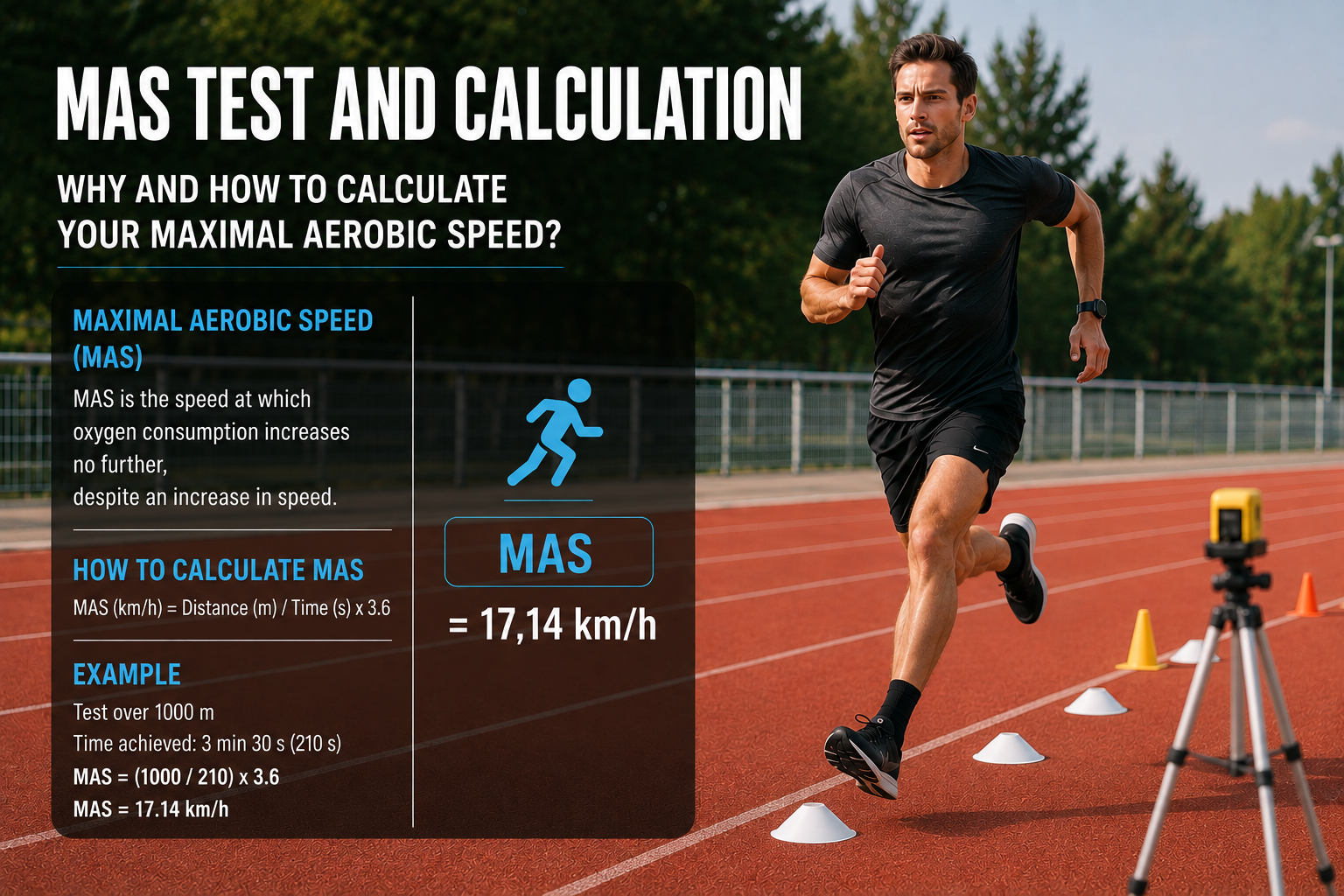
Maximum Aerobic Speed, or MAS (also called maximal aerobic speed, or MAS running pace), is a performance measurement intended for runners, trail runners and other athletes, allowing the determination of maximum aerobic capacity for exercise. Calculating your MAS — also known as VMA in French — is a basic measure to determine a state of performance at a given moment in order to improve or confirm a level of physical condition. In this guide you will find a free MAS calculator, the MAS formula for each method, and a full breakdown of every MAS testing protocol: Cooper, Half-Cooper (Demi-Cooper), Astrand, Vameval, Luc Léger and the Gacon test.
1. MAS Calculator: Cooper, Half-Cooper & Astrand
Use the calculator below to get your Maximum Aerobic Speed instantly. Enter the distance you covered during a fixed-pace, straight-line MAS test and the MAS calculator will apply the right formula automatically. All three methods below (Cooper, Half-Cooper, Astrand) are straight-line MAS tests, meaning they are run at a constant pace over a fixed time, without acceleration.
Cooper method:
Half-Cooper method:
Astrand method:
Good to know: these three calculators use the Cooper, Half-Cooper and Astrand formulas — the most common straight-line MAS tests. For a more precise MAS test result, run two different methods and average the two MAS scores you obtain.
2. What is MAS ? Definition of Maximum Aerobic Speed
MAS — Maximum Aerobic Speed, also called maximal aerobic speed or MAS running pace — is an indicator of running performance. It corresponds to the running speed at which your maximum oxygen consumption (VO2max) is reached. Calculated in km/h, this is a pace that you can maintain for 4 to 8 minutes, depending on your physical level.
More concretely, during a physical effort of running, the more your speed increases, the more oxygen you consume, until you reach your maximum consumption capacity. This speed level, where your muscles consume 100% of the stored oxygen transmitted by your cardiovascular system, is your Maximum Aerobic Speed (MAS). Along with the endurance index and stride efficiency, MAS testing is a key element in measuring your running performance.
Be careful not to confuse MAS with raw maximum speed, which is the maximum speed you can reach by sprinting for a few seconds. For example, if your MAS is 15 km/h, your gross maximum speed might be 22 km/h — this is why "how to calculate top speed" and "how to calculate MAS" are two different questions.
What is a good MAS score? A good average MAS is considered to be 10 km/h for beginners, 14 km/h for intermediate runners, and more than 24 km/h for athletes and champions. Although it differs according to physical and sporting profiles, MAS tends to remain stable until middle age.
Recommended average MAS pace for standard events:
- 85% of the MAS pace for a half-marathon (21 kilometers)
- 80% of the MAS pace for a marathon (42 kilometers)
3. What is the difference between MAS and VO2max ?
MAS and VO2max are two complementary data points: MAS (Maximum Aerobic Speed) represents the speed in km/h at which you reach your VO2max (maximum oxygen consumption) during an effort. VO2max is therefore a parameter used to determine MAS.
VO2max is the maximum amount of oxygen that the body can consume and supply to the muscles to function during physical exercise. Calculated in milliliters per minute per kilo (ml/min/kg), it varies depending on gender, age or physical condition.
Like the MAS calculation, VO2max is an indicator of performance and endurance. It is mainly calculated during exercise tests on a treadmill or bicycle, in specialized sports or medical centers. It can also be estimated using the formula:
VO2max formula: VO2max = (22.35 × distance in km) – 11.288
4. Why calculate your MAS ? What is the purpose of MAS testing ?
MAS is a performance measurement tool intended for runners, trail runners, and other racing athletes. Taking a MAS test allows you to:
- measure your performance and your current level (oxygen consumption during a running effort, cardiovascular capacity),
- design tailor-made training according to the level measured (MAS pace) to progress, improve your results, and improve your MAS,
- have precise information to adjust your running pace to your abilities during training and competitions,
- predict or estimate your race times based on your MAS pace, and set goals accordingly.
Running at the wrong pace over long distances exposes you more quickly to injuries and will not allow you to perform in competition. Calculating your MAS therefore lets you know your ideal pace and your limits, and helps you avoid tiring too early, since your body will not lack the oxygen needed by your muscles.
For all athletes doing trail running or road running, calculating MAS is essential to build a good training plan, work at the right pace, and choose the ideal MAS pace for a given event.
5. How often should you test your MAS ?
In general, it is recommended to run a MAS test 2 or 3 times per year. If you compete regularly, plan a MAS test at least every 2 months, especially at the start and end of a training block, to measure your progress.
The frequency of MAS testing depends on your running level and your goals. A beginner trail runner will not need to regularly estimate their MAS, whereas a competitor will need to calculate their MAS every month to track their current level.
When to test: after a period of injury, a break, or in preparation for a competition, an updated MAS test result becomes especially valuable to resume or effectively adapt your training.
6. Continuous MAS tests: Cooper, Half-Cooper, Astrand
Continuous MAS tests, also called straight-line MAS tests, require you to cover the greatest distance in a given time while maintaining a fixed running pace throughout the effort. Most often carried out on an athletics track or on any straight, flat course, this method of MAS testing is made up of three main tests:
- The Cooper test
- The Half-Cooper test (Demi-Cooper)
- The Astrand test
These MAS calculation tests require a warm-up of approximately 15–20 minutes, to raise the heart rate sufficiently to run efficiently for the given time. They end with a cool-down via a 10–15 minute jog.
The Cooper MAS test
The Cooper test is a MAS test developed by an American doctor, Dr. Kenneth Cooper, consisting of running the longest distance possible in 12 minutes, without changing your running pace. Created to evaluate US Air Force personnel, the Cooper test provides a general estimate of MAS.
Cooper MAS formula: MAS = (distance in km ÷ 2) × 10
For example, if you ran 3 km in 12 minutes, your MAS calculation is (3 ÷ 2) × 10 = 15 km/h. The Cooper MAS test also lets you estimate your VO2max, using the same formula as above.
The main disadvantage of the Cooper MAS test is that the pace is very difficult to maintain, with most people only able to hold a true MAS effort for 4–8 minutes. Consequently, this test is used less and less, in particular in favor of the Half-Cooper test.
The Half-Cooper test (Demi-Cooper)
The Half-Cooper test — also called the Demi-Cooper test — is the most widely used MAS calculation test, because it is short and requires no equipment. Basically identical to the Cooper test (covering the greatest distance possible at a fixed pace, over a given time), it only lasts 6 minutes, which makes it much more accessible.
Half-Cooper MAS formula: MAS = distance (in km) × 10, or MAS = distance (in meters) ÷ 100
For example, for a distance of 1.7 km covered in 6 minutes, your MAS is 17 km/h.
The Astrand test
Even shorter than the Half-Cooper test, the Astrand test consists of covering the greatest distance possible, at a fixed running pace, in 3 minutes.
With this 3-minute MAS test, the calculation adjusts the distance covered to a reference time of 3 minutes 30 seconds (the time considered necessary to reach your MAS according to Astrand):
Astrand MAS formula: MAS = (distance in km ÷ 210) × 3600 (seconds)
For example, if you cover 850 meters in 3 minutes, your MAS = (0.850 ÷ 210) × 3600 = 14.57 km/h.
Note that the Astrand test is based on statistical elements, which do not offer the most precise MAS test result.
While these three straight-line MAS tests are practical, can be done alone and require no equipment, they are not recommended for complete beginners, mainly because maintaining a fixed pace is difficult without prior pacing experience. It is necessary to know your abilities beforehand, so as not to go too fast or too slow. It may therefore be preferable to start with a progressive MAS test to first estimate your level.
7. Progressive MAS tests: Vameval, Luc Léger
Progressive MAS tests are tests where the pace increases gradually, until the runner can no longer maintain it. More precise in their operation, using audible signals, these MAS tests in stages are generally considered more reliable than continuous tests because the execution precision is higher. They are also used in swimming and cycling.
Carried out on an athletics track, in a club or individually, there are two main progressive MAS tests:
- The Vameval test
- The Luc Léger test
Unlike continuous MAS tests, these tests do not require a long warm-up.
The Vameval test
The Vameval test consists of reaching cones placed every 20 m on a 400 m track, within a given time, at a speed that increases in steps of 0.5 km/h per minute. Each point must be reached exactly on the audible signal. Your MAS then corresponds to the last speed level you successfully completed.
In the Vameval MAS test, you start at a pace of 8 km/h for 2 minutes, then the pace increases by 0.5 km/h every minute. For example, if you complete level 12 within the allotted time but fail to reach a cone at the next level, your MAS is 14 km/h (8 km/h initially + 6 km/h from level 12).
The Vameval test requires equipment (cones, sound signal) and can be difficult to run alone, but it offers one of the most reliable MAS test results available.
The Luc Léger test
The Luc Léger test, or shuttle run test, is a progressive MAS test widely used in schools. Similar to the Vameval test, it consists of running back and forth over a distance of 20 meters within a time limit indicated by sound signals, at a speed which gradually increases (0.5 km/h every minute).
However, the Luc Léger test is more taxing on the legs than the Vameval, forcing runners to stop and turn at each end. It is therefore more suited to team sports such as basketball. For track or trail runners, the Vameval test is generally more appropriate, since it allows continuous running.
A variation exists, called the Léger–Boucher test, in which the distance between cones is 50 meters, with a speed increase of 1 km/h every 2 minutes, starting at 8 km/h. The MAS calculation remains the same: it corresponds to the running speed reached during the last successfully completed block.
8. The Gacon test: a 45-15 intermittent MAS test
The Gacon test (also called the "Gacon 45-15 test") is an intermittent MAS testing protocol, alternating short running and short recovery phases rather than one continuous or steadily progressive effort. It is one of the most frequently asked-about MAS tests, alongside Vameval and Luc Léger.
What is the Gacon test?
The Gacon test consists of running for 45 seconds, followed by a walking or light jogging recovery of 15 seconds, repeated over several stages. The running pace increases progressively by 0.5 km/h every minute of effort, in the same way as the Vameval test, but with a built-in recovery window every 45 seconds.
How to set up a Gacon test
To run a Gacon test, mark out a track every 6.25 m (instead of 20 m for the Vameval or Luc Léger tests). During each 45-second running block, you must reach the marker corresponding to the current speed level exactly when the audible signal sounds, then use the following 15 seconds to walk or jog back and recover before the next block starts.
Gacon MAS test results: your MAS is calculated the same way as for the Vameval test — it corresponds to the speed of the last level you completed on time before failing to reach a marker.
The Gacon test is particularly well suited to younger athletes, less-fit runners, or anyone training in a confined space, thanks to its short running bouts and the presence of a recovery phase every 45 seconds. It remains a demanding MAS test, however, and still requires the ability to hold a regular pace during each running block.
9. Which MAS test should you choose based on your profile?
There is no single "right" MAS test. All of these tests are effective, with more or less precision. However, some will suit you better depending on your profile, your level, and your goals.
- Beginner runner: start with a progressive MAS test, like the Vameval, which does not require you to already know your pace or to warm up extensively, and which gives precise results. A Gacon test is also a good option, since it allows active recovery between each running block. Testing in an athletics club, or with a specialized coach, gives you good testing conditions. Once your first MAS is known, you can perform a Half-Cooper test and average the two results for the most accurate MAS possible.
- Intermediate runner: if you already know your MAS pace capabilities, the Half-Cooper test is ideal, because its 6-minute duration is very close — or even identical — to the average time needed to reach MAS. It is easy to calculate and you can do it alone, without equipment.
- Advanced runner: it is recommended to alternate between MAS tests according to your training block, for the most accurate measurements. A mix of Cooper or Half-Cooper with Vameval, plus the addition of a Gacon test, is ideal.
How to perform your MAS test on a treadmill, in a lab, or via an app
MAS calculation tests, whether continuous or progressive, are mostly carried out on an athletics track or in a straight line outdoors, offering the most direct and natural terrain to evaluate yourself. It is, however, entirely possible to run a MAS test in another context.
On a treadmill, at a gym or at home, you can easily run a Half-Cooper or Astrand test over the set duration. For a Vameval-style test, configure the speed increase of 0.5 km/h every minute. To best simulate outdoor running, set an incline of 1–2% on your treadmill (this compensates for the lack of air resistance).
All these tests can also be run in a laboratory, during a stress test. Under the supervision of a doctor and using sensors placed on the body, you can perform MAS tests in progressive stages or continuously. This method not only gives a very precise MAS estimate, but also your VO2max and Maximum Heart Rate.
If you own a sports smartwatch, many MAS/VMA calculation apps are available. You can use one to estimate your MAS among other metrics; however, the data often lacks precision and should be supplemented with a real test, such as the Vameval or the Half-Cooper.
10. Why and how to improve your MAS
Once you know your MAS, it is important to train accordingly to improve it. Improving your MAS means improving your speed, endurance and consistency, so you can run faster and longer. The higher your MAS, the longer and faster you can run: in the same race, a runner with a higher MAS will be able to run faster than another runner with a lower MAS, for a similar effort.
To improve your MAS, several running exercises work well. Interval sessions in particular are very effective, pushing your heart rate to its maximum and often forcing you to run at a pace above your MAS.
- Fartlek: alternating phases of sprinting with breath holding and calm phases of steady breathing. It helps develop the ventilatory system and delays reliance on the anaerobic pathway.
- 30/30 interval training: alternating 30 seconds of fast running at 100–110% of MAS with 30 seconds of jogging at 65% of MAS. Each series is followed by a recovery of 1 min 30 to 3 minutes, depending on level.
- Repetition sessions: intense running phases of 200–400 m at 100% MAS, with recovery phases of 500–1000 m at 65–70% MAS, possibly including sprint phases at 105–110% MAS before the recovery.
- 10×400 m intervals: running 400 m ten times at 100% MAS, alternating with an active recovery time roughly 15 seconds shorter than the running time.
- Jogging with short acceleration phases integrated into an easy run.
It is recommended to include one dedicated MAS training session per week to progressively raise your MAS. The important thing is to accustom your body to running at 100% of your MAS for an increasingly long time. Finally, improving your MAS also requires working on your running technique and stride: a more efficient stride costs less energy, letting you hold 100% of your MAS for longer.